Pranav Hotkar
Data centers are racing to cut emissions, but not all emissions are created equal. Most operators have a clear view of how much power they consume. Far fewer understand the full carbon footprint behind that energy, and everything beyond it.
That gap is where Scope 1, 2, and 3 emissions start to matter. Together, they define the total climate impact of a data center, from on-site fuel use and purchased electricity to the far larger footprint embedded in supply chains, hardware manufacturing, and construction.
For years, the industry has focused on efficiency metrics like PUE and renewable energy sourcing. But those measures only address part of the equation. A facility can run on clean power and still carry significant emissions tied to how it is built, equipped, and operated across its lifecycle.
As sustainability commitments tighten and reporting standards evolve, understanding these three scopes is no longer optional. It is becoming central to how data centers measure, manage, and ultimately reduce their environmental impact.
How are data centers currently measuring and reporting emissions?
Data center operators today have a relatively strong understanding of operational emissions, but a far less complete view of their full carbon footprint. This divide reflects how emissions are structured under the Greenhouse Gas Protocol, which separates direct, energy-related, and value chain emissions.
Scope 1 and Scope 2 are the most mature areas of reporting. Scope 1 includes on-site fuel use, such as diesel backup generators, while Scope 2 covers purchased electricity, the dominant operational source of emissions. According to the International Energy Agency, data centers and data transmission networks accounted for around 330 Mt CO₂e in 2020, including both operational and embodied emissions, highlighting the scale of electricity-driven impact.
Real-World Emissions Split by Scope
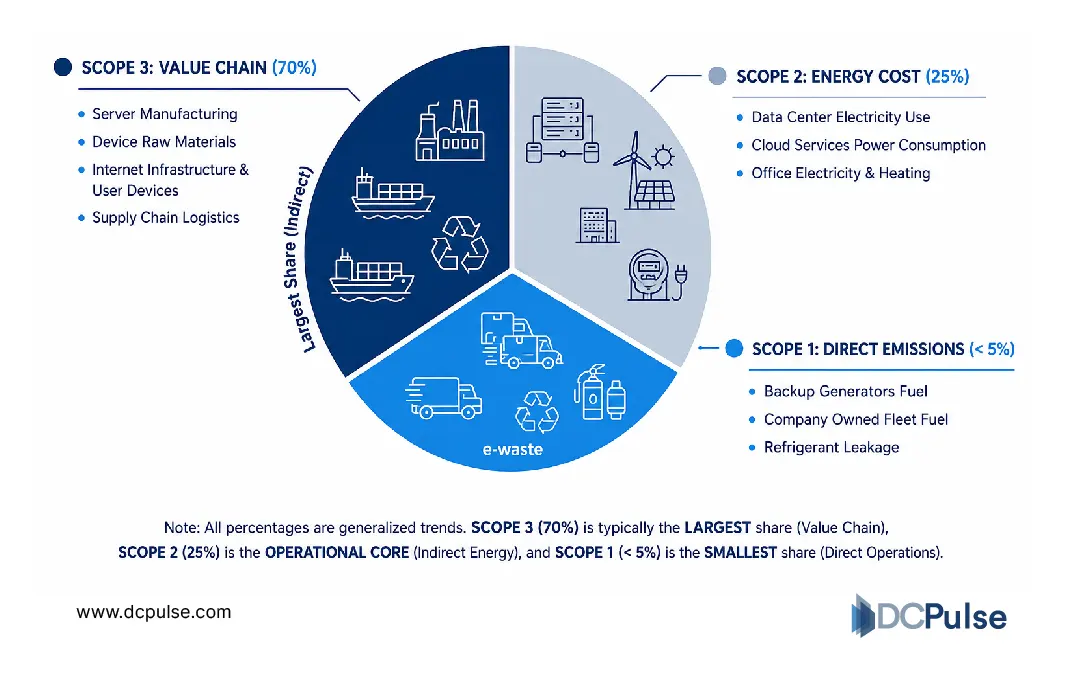
The challenge becomes significantly more complex with Scope 3. These emissions span the entire lifecycle, including hardware manufacturing, construction materials, and supply chains. The ICEF notes that embodied emissions alone can exceed 40% of total lifecycle emissions, particularly when facilities run on low-carbon electricity.
Lifecycle Emissions Breakdown - Operational vs Embodied Emissions
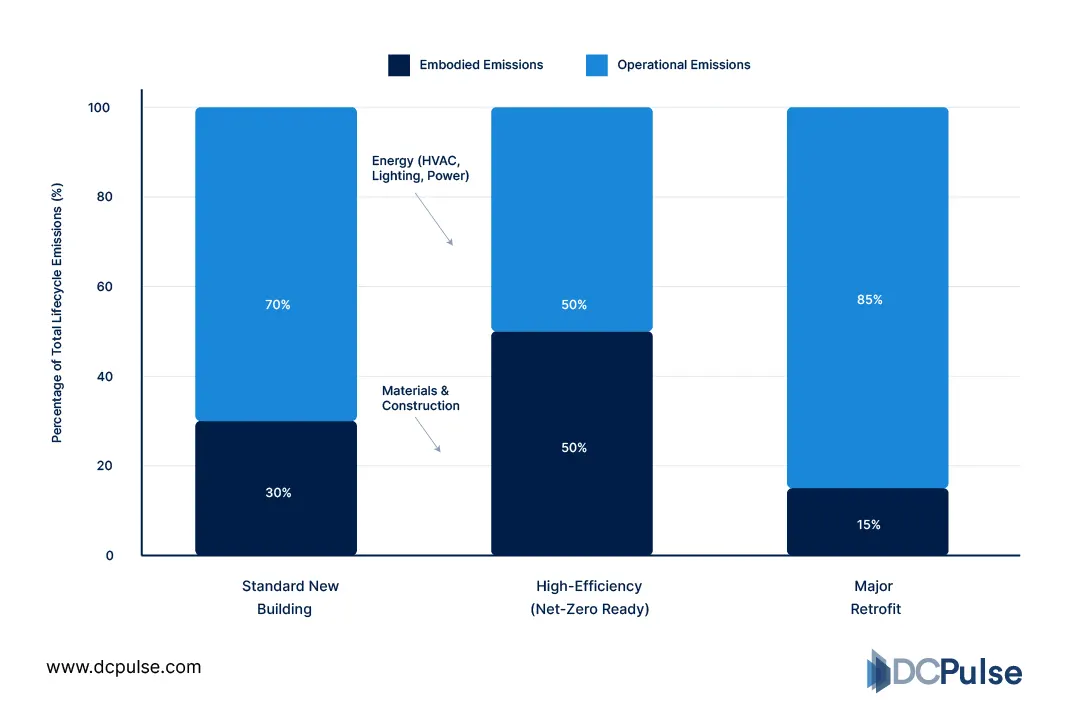
This creates a structural gap. While Scope 1 and 2 are measurable and increasingly optimized, Scope 3 remains fragmented due to limited supplier transparency and inconsistent reporting practices.
The result is an industry that is improving operational efficiency but still working toward full visibility of its total emissions footprint.
What innovations are helping data centers reduce Scope 1, 2, and 3 emissions?
Reducing emissions across all three scopes requires a shift from isolated efficiency gains to full-lifecycle innovation, targeting energy, on-site systems, and supply chains together.
For Scope 2, the focus is moving beyond simple renewable procurement toward carbon-aware energy use and deeper grid decarbonization. Data centers already account for roughly 330 Mt CO₂e globally (including embodied emissions), with electricity consumption as the dominant driver, reinforcing why energy sourcing remains central to decarbonization.
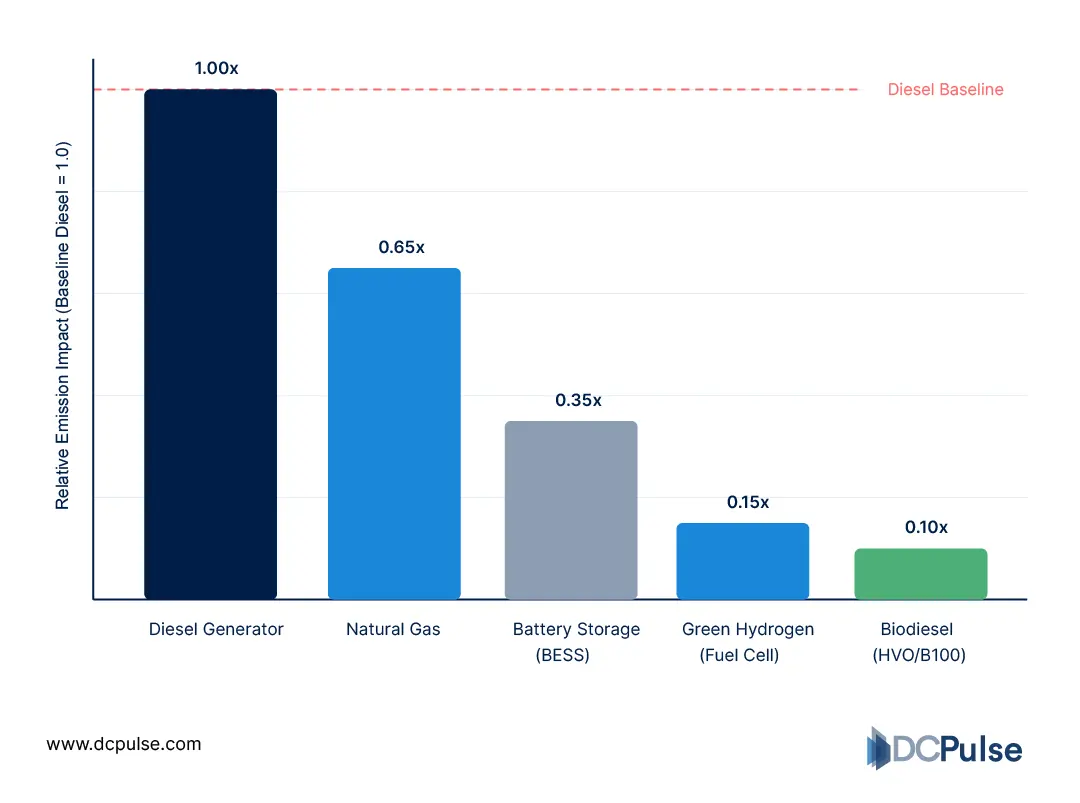
Scope 1 innovation is centered on replacing or reducing diesel-based backup systems. The ICEF roadmap confirms that diesel generators remain the primary backup power source, emitting CO₂, NOx, and particulate matter during operation, making them a key target for decarbonization through alternatives like cleaner fuels, batteries, and fuel cells.
Emissions comparison - Diesel vs alternative backup systems
Scope 3 remains the most complex frontier. Research shows that beyond operational energy, construction materials and IT hardware contribute substantial embodied emissions across the lifecycle of a data center.
Together, these innovations reflect a broader transition: from optimizing operations to redesigning the entire lifecycle of data center infrastructure to reduce emissions at scale.
Who is driving emissions reduction across Scope 1, 2, and 3 in data centers?
Efforts to reduce emissions across Scope 1, 2, and 3 are being led by hyperscalers and large data center operators, each targeting different parts of the emissions stack.
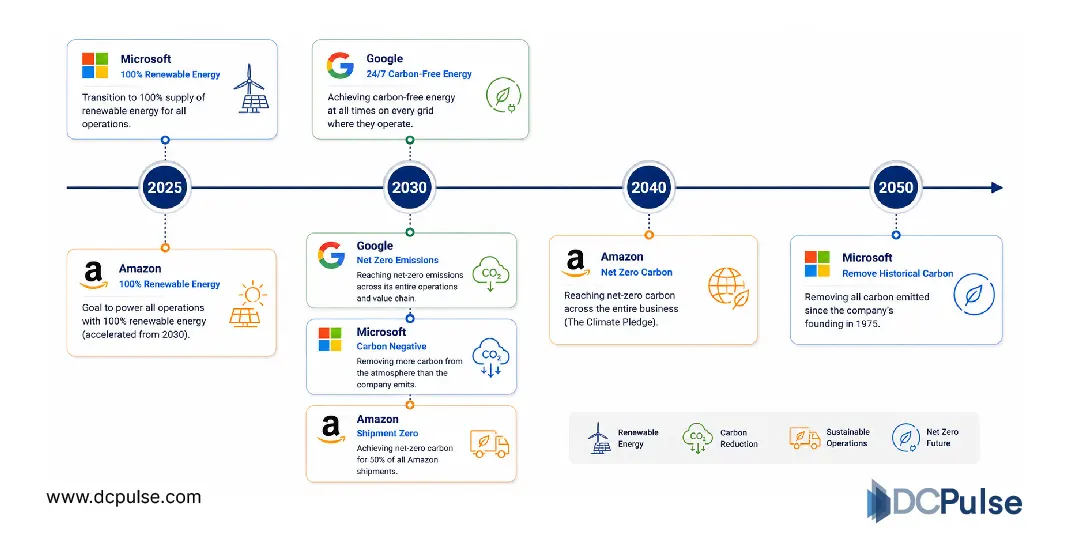
Google is advancing Scope 2 decarbonization through its push toward 24/7 carbon-free energy, aiming to match electricity consumption with clean energy on an hourly basis rather than annual offsets. This reflects a shift from procurement volume to time-based energy alignment, directly addressing how data centers consume power.
Microsoft is taking a broader approach, targeting all three scopes through its carbon-negative by 2030 commitment. Its latest sustainability reporting highlights efforts to cut both operational emissions and embodied carbon through material innovation and large-scale renewable energy procurement.
Amazon, through its Climate Pledge, is working toward net-zero carbon by 2040, focusing on decarbonizing operations, infrastructure, and logistics across its global footprint.
Corporate Decarbonization Milestones
These efforts extend beyond operations. Microsoft, for example, is experimenting with low-carbon construction materials, reducing embodied emissions in data center builds, while Google is scaling circular economy practices across hardware and infrastructure.
The pattern is clear: Scope 2 is being aggressively optimized, Scope 1 is being reduced through cleaner operations, and Scope 3, particularly supply chain and construction, is emerging as the defining battleground for the next phase of data center sustainability.
What does managing scope 1, 2, and 3 emissions mean for the future of data centers?
Managing emissions in data centers is no longer just an operational challenge; it is becoming a full lifecycle responsibility. While Scope 1 and 2 emissions have driven early progress through efficiency and renewable energy adoption, the next phase will be defined by how effectively organizations address Scope 3.
This shift fundamentally changes how infrastructure is planned and operated. Emissions are no longer tied only to energy use but to decisions made across procurement, construction, and hardware lifecycle. As a result, sustainability is moving upstream, into supplier selection, material choices, and design strategies.
At the same time, energy strategies are evolving. The focus is shifting from meeting renewable targets on paper to aligning consumption with real-time carbon intensity, making energy sourcing a dynamic, continuous decision rather than a static one.
The implication is clear: data centers must move beyond optimizing what they directly control and begin managing emissions across the entire value chain. Those that succeed will treat carbon not as a reporting metric, but as a core design constraint, embedding it into every layer of infrastructure.
Because in the next phase of digital growth, sustainability will not be defined by efficiency alone but by accountability.