Pranav Hotkar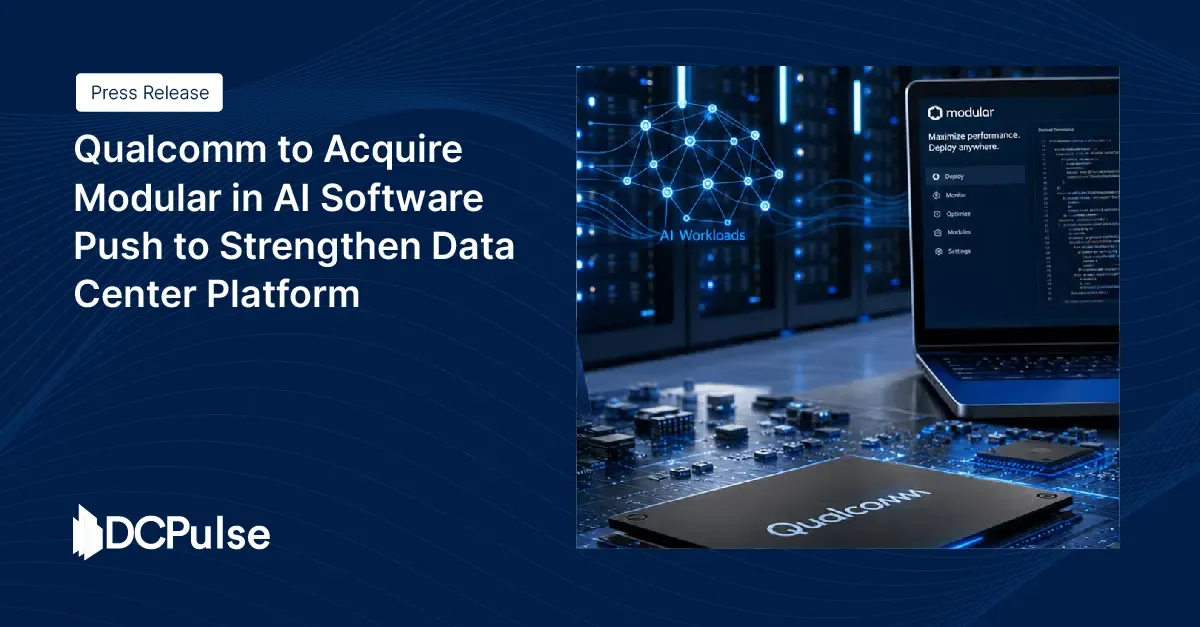
New York - June 24, 2026 - Qualcomm has agreed to acquire AI software company Modular in a deal that significantly expands its data center software capabilities as the chipmaker accelerates its push into AI infrastructure and cloud computing.
The acquisition brings Modular's AI-native software platform, compiler technologies, and developer tools into Qualcomm's portfolio, enabling the company to offer a more complete hardware-and-software stack for generative and agentic AI deployments spanning edge devices and hyperscale data centers. The transaction is expected to close in the second half of 2026, subject to customary regulatory approvals and closing conditions.
Although Qualcomm did not disclose financial terms in its announcement, Reuters and other financial publications reported the all-stock transaction is valued at approximately USD 4 billion, with Qualcomm issuing up to 19.2 million common shares to Modular's shareholders.
Founded in 2022 by former Apple and Google engineers Chris Lattner and Tim Davis, Modular has developed an AI software platform that enables developers to deploy models across different hardware architectures without rewriting applications for each processor. Its technologies, including the Mojo programming language and MAX inference platform, are designed to improve portability and performance across GPUs, CPUs, and custom AI accelerators, reducing dependence on proprietary software ecosystems.
For Qualcomm, the acquisition addresses a key gap in its expanding AI strategy. While the company has built a strong presence in edge AI through Snapdragon and Dragonwing processors, it has been steadily extending its ambitions into hyperscale infrastructure. Earlier this month, Qualcomm completed its acquisition of Alphawave IP to strengthen high-speed connectivity for AI data centers, while also confirming plans to begin shipping custom AI data center processors later this year.
The combination of Modular's software platform with Qualcomm's AI silicon could create an open alternative to tightly integrated ecosystems that currently dominate AI infrastructure. Qualcomm said the goal is to provide developers with a unified software environment capable of scaling AI applications across diverse compute environments, from edge devices to cloud data centers.
The acquisition reflects a broader shift in the AI infrastructure market, where software has become as strategically important as silicon. As enterprises deploy increasingly complex AI workloads across heterogeneous computing environments, demand is growing for software that can orchestrate inference and training across multiple processor architectures while maximizing performance and efficiency.
For data center operators, greater hardware portability could provide increased flexibility when designing AI clusters, reducing reliance on a single accelerator vendor and enabling more diverse infrastructure choices. As hyperscalers invest billions of dollars in next-generation AI facilities, open software platforms are expected to play an increasingly important role in determining how efficiently those computing resources are deployed and managed.
The modular acquisition positions Qualcomm to compete more aggressively in the rapidly evolving AI infrastructure market, where success will increasingly depend on delivering an integrated platform that combines high-performance silicon, networking, and developer-friendly software for large-scale AI deployments.