Pranav Hotkar
For over a decade, Power Usage Effectiveness (PUE) has been the gold standard for measuring data center efficiency, but its dominance is now being questioned.
Originally introduced as a simple metric to compare energy efficiency across facilities, PUE helped operators optimize infrastructure by focusing on the ratio of total facility energy to IT equipment energy. It brought much-needed transparency and drove significant improvements across the industry.
But today’s data centers are fundamentally different.
With the rise of AI workloads, liquid cooling, and distributed edge infrastructure, energy efficiency is no longer just about how much power reaches IT equipment. It is about how efficiently compute is delivered, how carbon impact is managed, and how resources are utilized across the entire lifecycle.
This has exposed a key limitation; PUE measures facility efficiency, but not computational efficiency, sustainability impact, or workload performance.
As a result, operators and investors are beginning to ask a more important question:
Is PUE still enough, or do new metrics better reflect what truly matters in modern data centers?
What Does the Current Landscape of Data Center Efficiency Metrics Look Like?
The current landscape of data center efficiency metrics is still dominated by Power Usage Effectiveness (PUE), but its relevance is increasingly being questioned as infrastructure and workloads evolve.
PUE remains widely used because of its simplicity and standardization. According to the Uptime Institute Global Data Center Survey 2025, the industry-wide weighted average PUE is approximately 1.54 and has remained largely unchanged for several years.
Global Average PUE Trends (2007–2025)
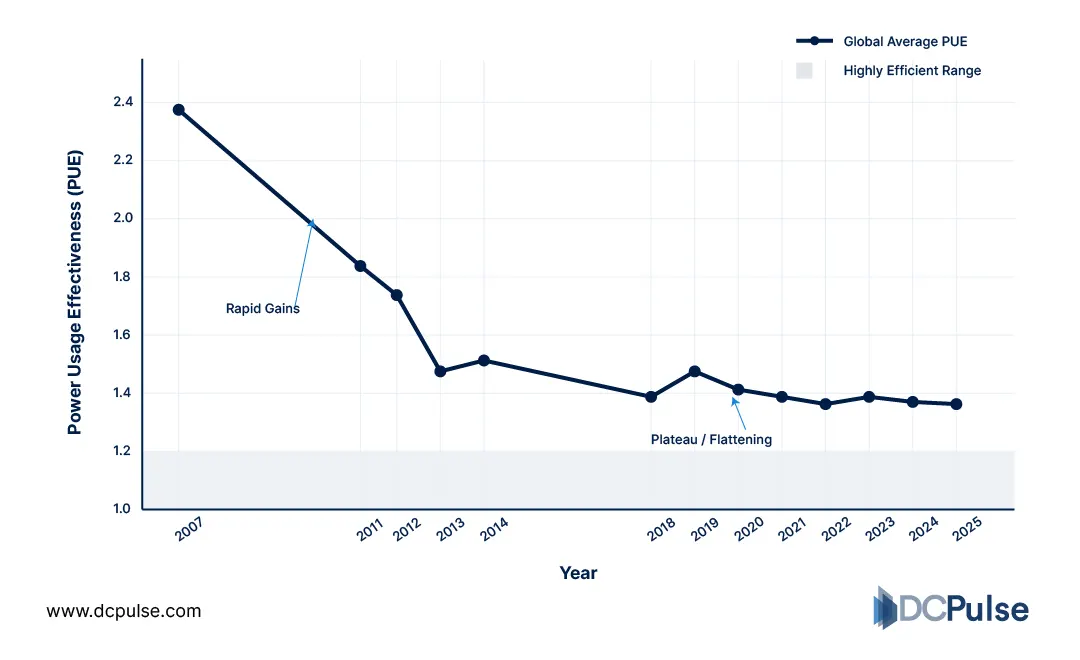
This plateau highlights a key shift. Early gains in efficiency, driven by improvements in cooling, airflow management, and power systems, have already been realized, bringing PUE down from ~2.5 in 2007 to near 1.5 today.
However, more recent data shows that progress has slowed. Industry averages have remained in the range of ~1.55-1.59 since 2020, indicating that traditional efficiency improvements are reaching diminishing returns.
The limitation lies in what PUE measures. While it effectively captures facility-level energy efficiency, it does not account for IT efficiency, workload output, or sustainability factors such as water and carbon usage.
Scope of PUE vs. Missing Efficiency Dimensions (2026)
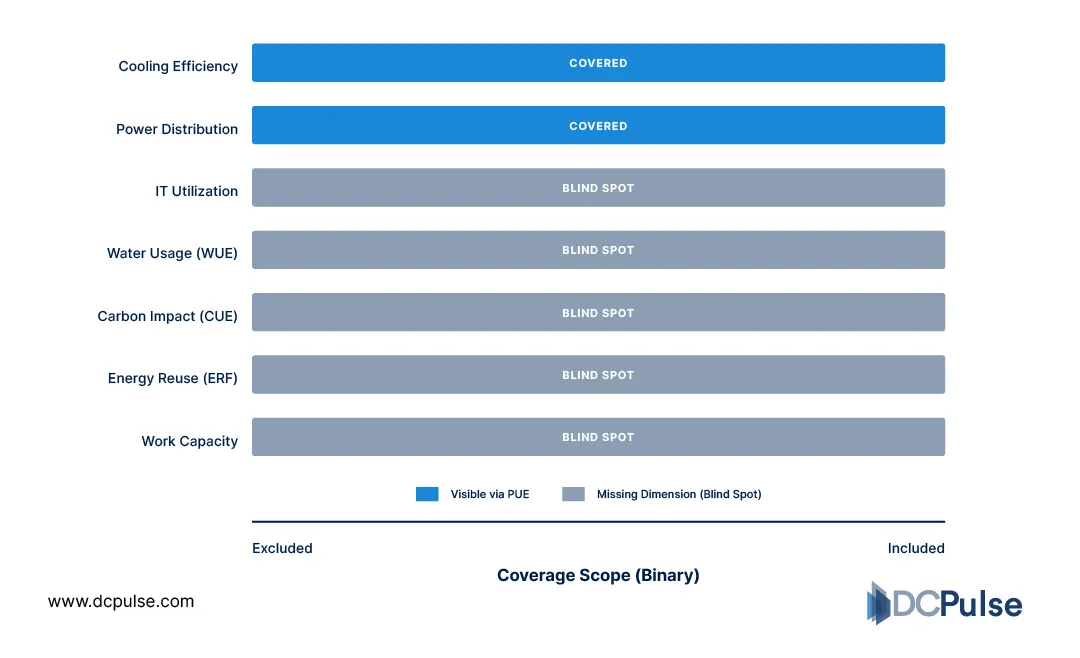
The pattern is clear; PUE remains the industry’s baseline metric, but the current landscape is shifting toward a broader, multi-metric approach, as operators seek more comprehensive ways to measure efficiency in modern, high-density data center environments.
What New Metrics Are Emerging Beyond PUE, and Why Do They Matter?
As the limitations of PUE become clearer, the industry is expanding toward a broader family of metrics designed to measure sustainability and resource efficiency more comprehensively.
One of the most important additions is Carbon Usage Effectiveness (CUE), introduced by The Green Grid. CUE measures the carbon emissions associated with data center energy consumption, enabling operators to evaluate environmental impact alongside energy efficiency.
Global PUE & CUE Performance (2007-2026)
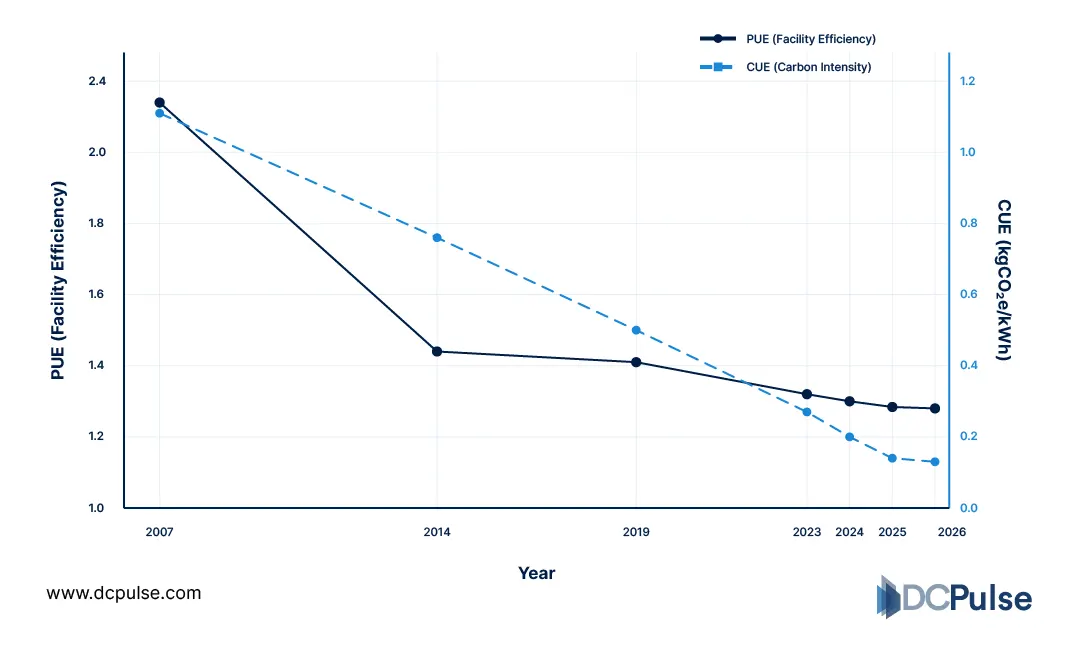
Another key metric is Water Usage Effectiveness (WUE), which tracks how much water is used relative to IT energy consumption. This has become increasingly important as cooling demands rise and water usage emerges as a critical sustainability concern in data center operations.
Global Average Water Usage Trends (WUE)
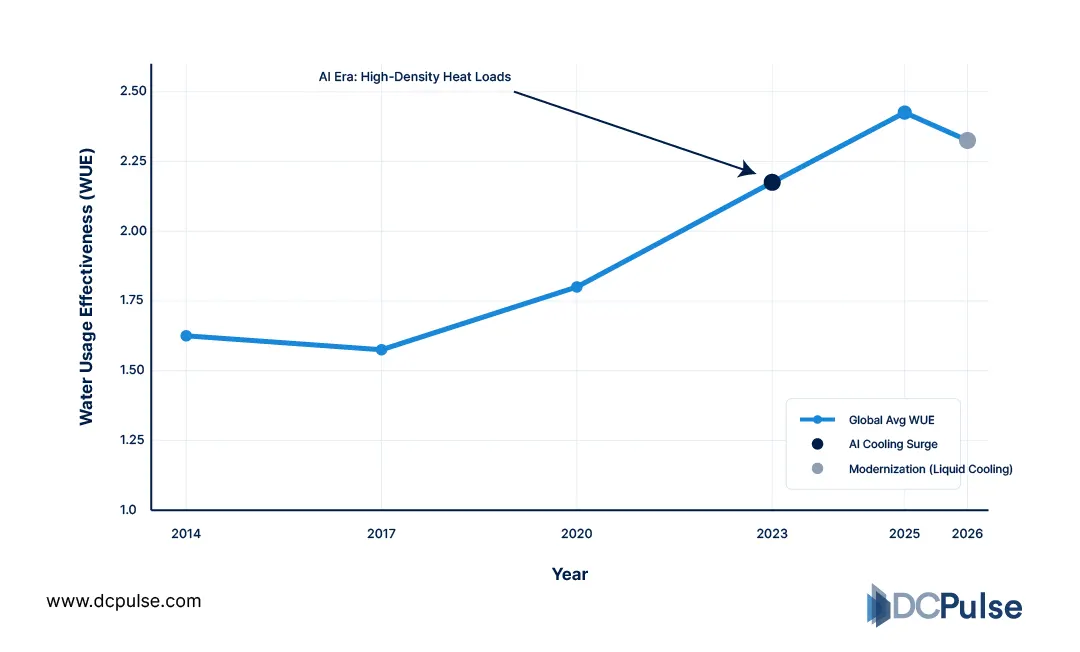
Beyond these, the industry is developing additional metrics such as Data Center Energy Productivity (DCeP) and Energy Reuse Effectiveness (ERE), which aim to measure how effectively energy is converted into useful computational work or reused within the system. These metrics extend the original PUE framework into a broader “xUE” family, covering energy, carbon, water, and resource efficiency.
The shift is driven by a fundamental gap; PUE measures infrastructure efficiency, but modern data centers require visibility into carbon impact, water consumption, and actual computational output.
The direction is clear;
New metrics are not replacing PUE; they are augmenting it, creating a multi-dimensional framework that better reflects the realities of sustainability and high-density computing in modern data centers.
Who Is Driving the Shift Beyond PUE in Data Center Metrics?
The shift beyond PUE is being driven by a combination of industry standards bodies, hyperscale operators, and sustainability-driven frameworks, all pushing for broader and more meaningful efficiency measurement.
At the standards level, The Green Grid has played a central role. It originally introduced PUE and later expanded the framework by developing additional metrics such as CUE, WUE, and ERE to address carbon emissions, water usage, and energy reuse. These metrics were explicitly designed to complement PUE and extend efficiency measurement into sustainability domains.
Expansion of Data Center Metrics (PUE → CUE → WUE → xUE Family)
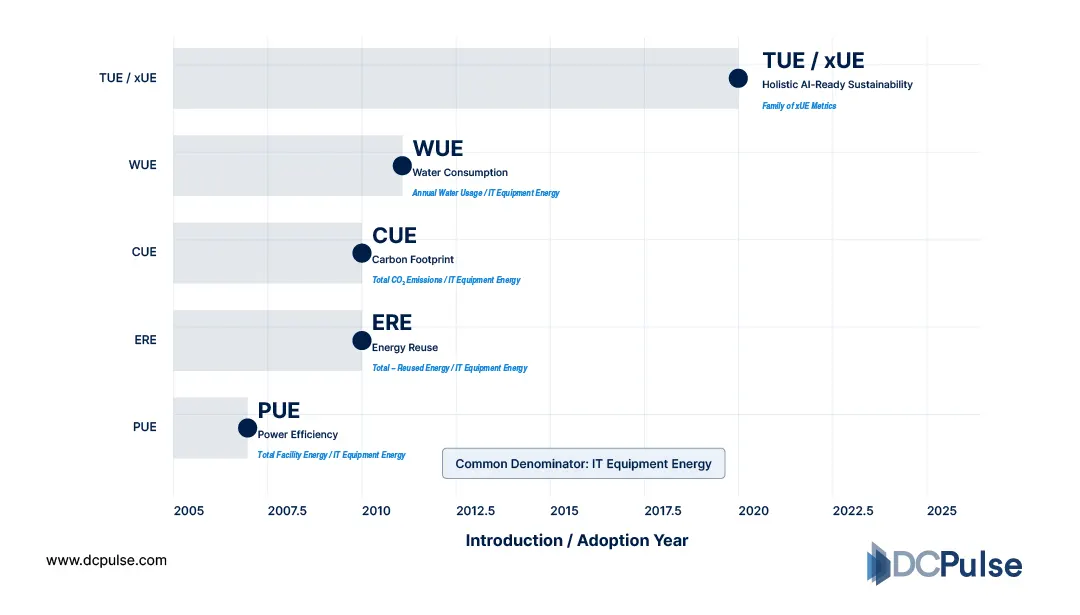
This expansion reflects a broader industry realization: a single metric cannot capture the full environmental impact of data centers. The growing “xUE” family allows operators to evaluate energy, carbon, water, and resource efficiency together, rather than in isolation.
At the same time, hyperscale operators are reinforcing this shift in practice. Industry analysis shows that modern data center evaluation increasingly considers carbon intensity, water consumption, and energy sourcing, rather than relying solely on PUE, especially as sustainability reporting becomes more critical.
The implication is clear.
The move beyond PUE is not driven by a single entity; it is the result of standards evolution and operational necessity as the industry transitions toward multi-dimensional efficiency frameworks that better reflect real-world environmental and performance impact.
What Will Matter More Than PUE Going Forward?
PUE will remain relevant, but it will no longer be sufficient on its own.
As data centers evolve, efficiency is being redefined across multiple dimensions. Operators are no longer evaluated solely on how efficiently power is delivered but on how sustainably, effectively, and intelligently that power is used.
In this context, metrics such as carbon intensity, water usage, and energy reuse will become increasingly important. These factors provide a more complete picture of environmental impact, particularly as regulatory scrutiny and investor expectations continue to rise.
At the same time, there is a growing emphasis on compute efficiency, or how much useful work is delivered per unit of energy. This reflects the shift toward high-performance and AI-driven workloads, where raw power consumption alone does not capture operational value.
However, the transition will not eliminate PUE. Instead, it will reposition it as a baseline metric, complemented by a broader set of indicators that together define overall efficiency.
The direction is clear:
What matters more than PUE is not a single replacement metric but a multi-dimensional framework where energy, sustainability, and performance are measured together to reflect the true efficiency of modern data centers.