Pranav Hotkar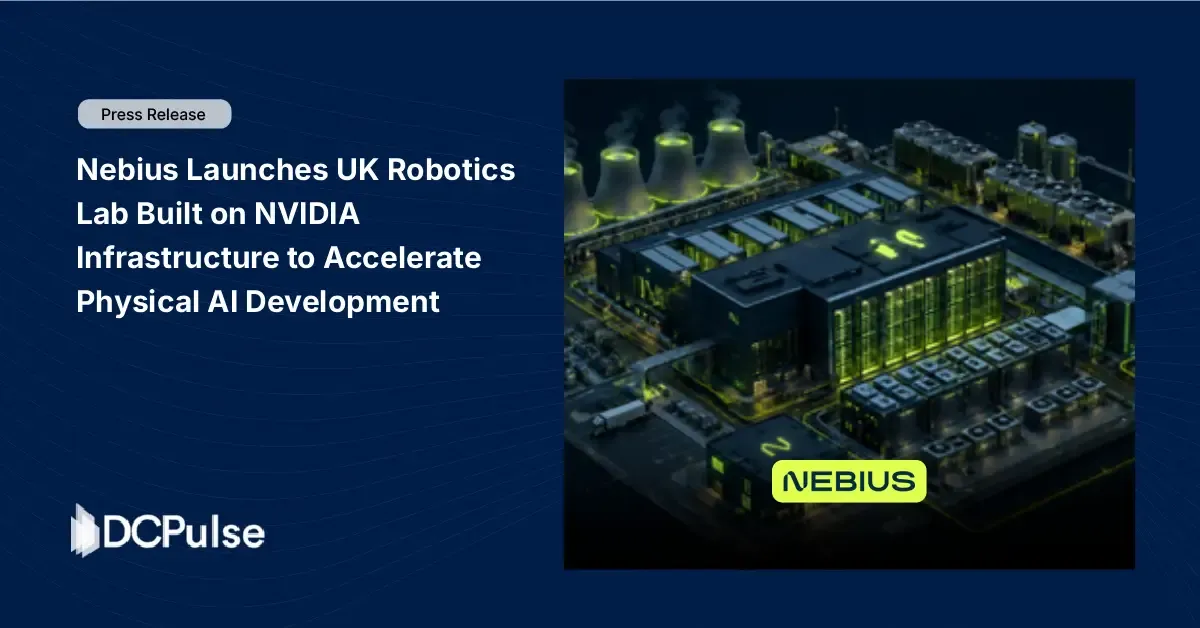
London, United Kingdom - June 9, 2026 - Nebius has launched a new Physical AI Living Lab in the United Kingdom aimed at helping European robotics startups access advanced AI infrastructure, simulation tools, and accelerated computing resources typically available only to larger technology companies.
The six-month program, developed in collaboration with NVIDIA, will provide startups with access to Nebius AI Cloud infrastructure and NVIDIA’s physical AI software stack, including Cosmos World foundation models, Isaac Sim, Isaac Lab, and Omniverse-based robotics development technologies.
The initiative reflects growing industry focus on “physical AI," AI systems capable of interacting with real-world environments through robots, autonomous machines, industrial automation systems, and embodied AI applications. Unlike conventional generative AI workloads, physical AI requires large-scale simulation environments, synthetic data generation, and highly specialized accelerated compute infrastructure.
Nebius said the new lab is designed to remove infrastructure barriers facing early-stage robotics companies by providing direct access to cloud-scale training environments and AI simulation tools.
“Most robotics teams can build a strong model; the bottleneck is getting the simulation, synthetic data, and compute in place to take it further,” said Evan Helda, Head of Physical AI at Nebius, in the announcement.
The first phase of the program will run on Nebius’ UK-based infrastructure powered by NVIDIA RTX PRO 6000 Blackwell Server Edition GPUs. Participating startups will also gain access to NVIDIA OSMO workload orchestration tools and the NVIDIA Physical AI Data Factory Blueprint for synthetic data generation and robotics training workflows.
Applications for the program will be processed through NVIDIA’s Inception startup ecosystem, with the first startup cohort scheduled to begin in September 2026. Engineers from both NVIDIA and Nebius will provide technical guidance throughout the initiative.
The launch comes as global investment in AI infrastructure rapidly expands beyond traditional cloud and language-model training into robotics, autonomous systems, and industrial AI applications. Physical AI workloads require increasingly sophisticated data center infrastructure capable of supporting GPU-intensive simulation, real-time inference, and large-scale synthetic data pipelines.
Nebius has been aggressively expanding its AI infrastructure footprint globally. Earlier this week, the company announced plans to invest in UK AI infrastructure capacity across multiple NVIDIA-powered deployments expected to reach 65 MW by 2027.
Industry analysts increasingly view robotics and embodied AI as the next major phase of AI infrastructure growth, requiring new classes of AI factories optimized for simulation-heavy computing environments. NVIDIA has positioned physical AI as a major long-term infrastructure category, particularly for robotics, manufacturing, logistics, and autonomous mobility applications.
The Nebius initiative further highlights how AI cloud providers are evolving beyond traditional GPU rental platforms into full-stack infrastructure ecosystems supporting robotics development, AI simulation, and real-world autonomous systems deployment.
.jpg)