Pranav Hotkar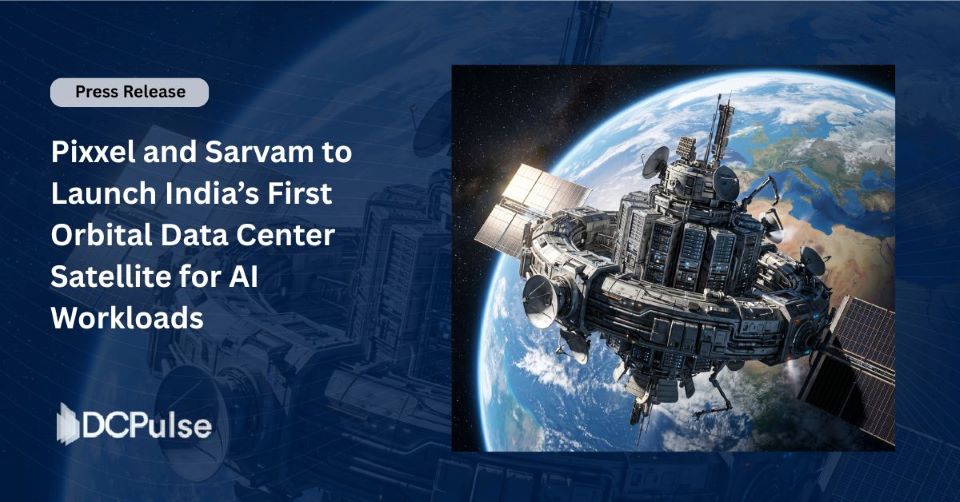
Bengaluru, India - May 4, 2026 - Pixxel has announced a strategic partnership with Sarvam AI to develop and launch India’s first orbital data center satellite, marking a major step toward space-based computing infrastructure.
The satellite, named “Pathfinder,” will be designed, built, launched, and operated by Pixxel, while Sarvam will provide the artificial intelligence backbone. The system is intended to enable both AI training and inference directly in orbit, bringing data center–grade computing capabilities into space.
The Pathfinder satellite is expected to be a 200-kilogram-class platform, with a targeted launch timeline as early as the fourth quarter of 2026. Unlike traditional satellites that rely on low-power processors, the platform will integrate high-performance computing systems capable of running advanced AI models onboard.
A key feature of the satellite will be its ability to process data in space rather than transmitting large volumes of raw data back to Earth. This approach reduces latency, lowers bandwidth requirements, and enables real-time insights for applications such as Earth observation, defense, and environmental monitoring.
The satellite will also integrate Pixxel’s hyperspectral imaging technology, allowing it to capture highly detailed Earth data while simultaneously processing it using AI models in orbit. This combination of sensing and compute is expected to significantly enhance the speed and efficiency of data-driven decision-making.
The initiative reflects a broader shift toward decentralized and edge-based computing, extending beyond terrestrial data centers into space. By enabling processing closer to the source of data generation, orbital data centers could transform how large-scale datasets are handled, particularly for applications requiring immediate analysis.
Industry momentum around space-based computing is accelerating, with multiple companies exploring similar concepts. However, the Pixxel-Sarvam collaboration represents one of the first efforts to combine AI model execution with satellite-based infrastructure at this scale.
The project also aligns with India’s growing ambitions in both artificial intelligence and private space technology. By integrating AI capabilities directly into orbital platforms, the companies aim to position India at the forefront of next-generation computing infrastructure.
If successfully deployed, the Pathfinder satellite could serve as a foundational step toward a broader network of space-based data centers, supporting future AI workloads that demand low-latency processing and global coverage.
The announcement underscores an emerging convergence between space technology and digital infrastructure, as companies explore new frontiers to meet the rapidly increasing compute demands of the AI era.