Pranav Hotkar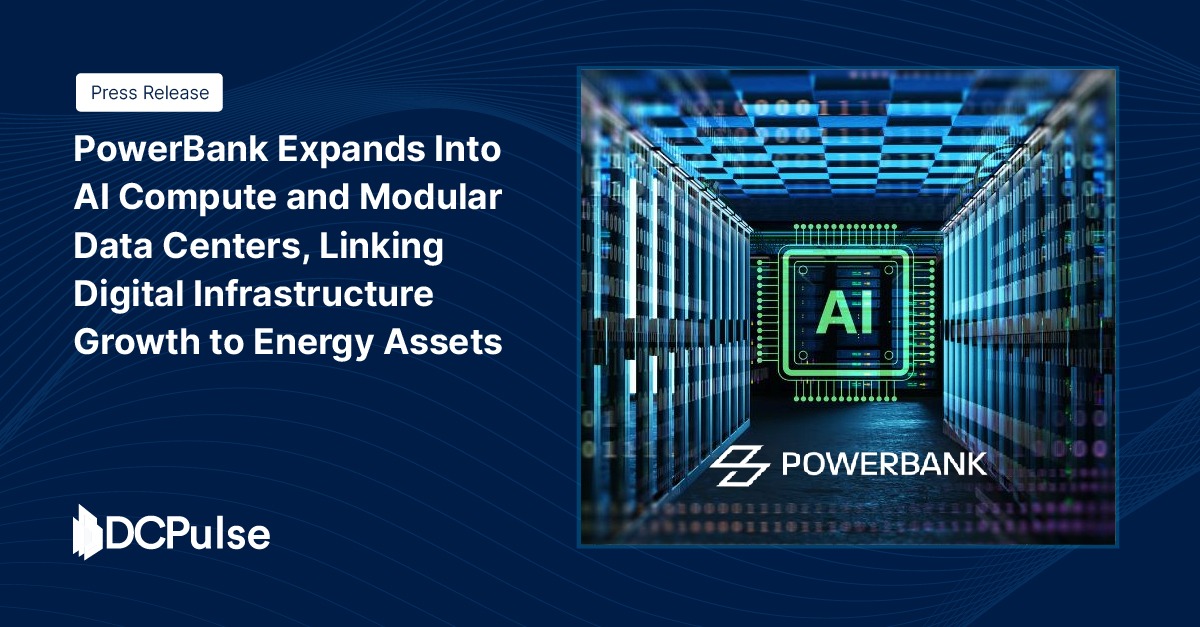
Toronto, Canada – June 1, 2026 - PowerBank Corporation is expanding its focus beyond renewable energy development and positioning AI compute infrastructure, modular data centers, and energy-backed digital infrastructure as a core strategic growth vertical, reflecting the growing convergence between power generation and data center development.
The company announced that it will pursue opportunities in AI compute, modular data centers, battery energy storage systems (BESS), and behind-the-meter energy infrastructure alongside its existing solar and energy storage business. The move comes as demand for AI computing capacity continues to accelerate, driving increased interest in distributed and rapidly deployable data center infrastructure.
PowerBank said it sees a significant opportunity in combining its renewable energy portfolio with modular AI data center deployments. The company believes co-locating compute infrastructure with solar generation and battery storage assets can help address one of the industry's most pressing challenges: securing reliable power for AI workloads.
“AI compute and modular data centers represent a natural extension of our energy infrastructure platform,” said Dr. Richard Lu, President and CEO of PowerBank. The company noted that access to power is becoming a critical factor in determining where new AI infrastructure can be deployed.
Unlike traditional large-scale data center campuses that often require years of planning and grid interconnection work, modular data centers can be deployed more quickly and closer to available energy resources. PowerBank's strategy centers on leveraging its existing energy development expertise to support these emerging infrastructure models.
The company highlighted its previously announced Letter of Intent with Nodiac Inc., under which the two companies are evaluating the deployment of modular AI data centers at selected PowerBank energy sites. The initiative is intended to explore how renewable energy assets can be integrated directly with compute infrastructure, potentially creating new revenue streams from existing power projects.
PowerBank currently has more than 1 GW of renewable energy and battery storage projects under development across North America. The company believes this portfolio could provide a foundation for future AI infrastructure deployments, particularly as hyperscalers, AI operators, and enterprise customers face increasing power constraints.
Industry-wide, electricity availability has emerged as one of the largest bottlenecks for AI data center expansion. As GPU clusters become larger and more power-intensive, developers are increasingly seeking alternative approaches that combine compute, energy generation, and storage within a single infrastructure ecosystem.
While PowerBank has not announced a specific data center project, customer deployment, or capital investment tied to the strategy, the company’s move underscores a broader trend across the industry. Energy developers are increasingly looking to participate directly in the AI infrastructure market as demand for power-hungry compute capacity reshapes both the data center and energy sectors.
By positioning modular data centers and AI compute alongside its solar and battery storage business, PowerBank is seeking to capitalize on the growing intersection of digital infrastructure and energy infrastructure, where access to power is becoming as important as access to computing hardware.

.jpg)