Pranav Hotkar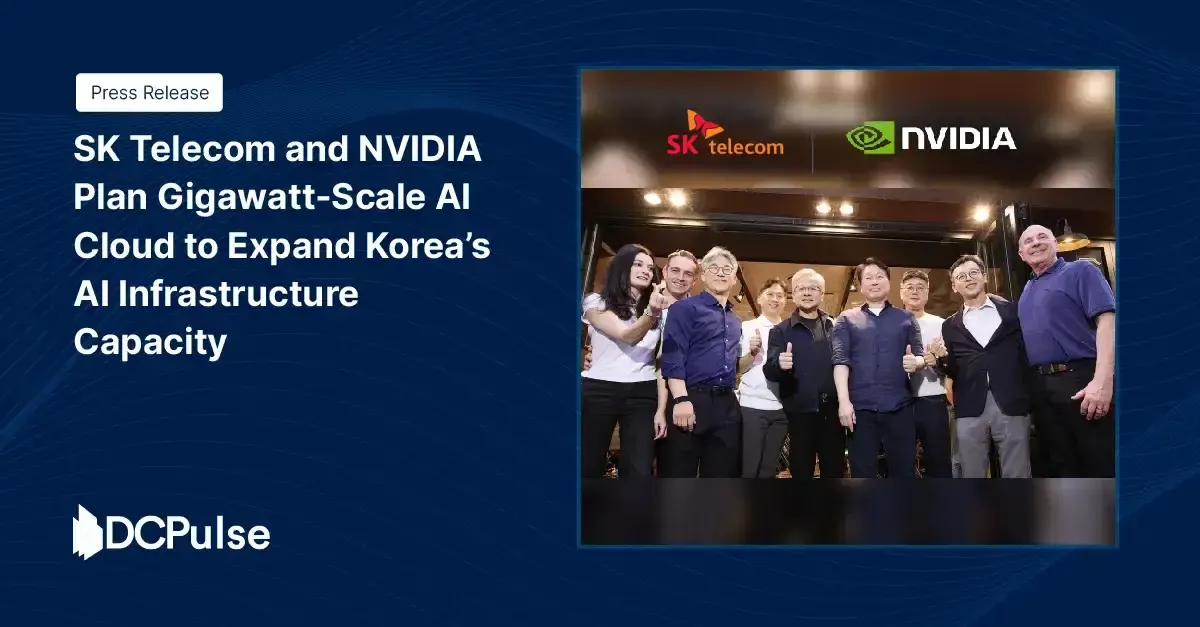
Seoul, South Korea - June 7, 2026 - SK Telecom and NVIDIA have announced plans to build a gigawatt-scale AI cloud platform in South Korea, marking one of the country’s largest proposed AI infrastructure initiatives as demand for sovereign AI, enterprise AI services, and high-density compute capacity accelerates across Asia.
The project will utilize NVIDIA’s DSX AI Factory architecture, a full-stack infrastructure platform that combines accelerated computing, networking, software, and operational frameworks optimized for AI workloads. SK Telecom said the first AI factory within the platform is expected to come online in 2027.
According to the companies, the AI cloud will support a broad range of workloads, including AI training, inference, sovereign AI models, physical AI systems, and enterprise AI applications for industries across South Korea. SK Telecom also plans to expand services into broader Asia-Pacific markets over time.
Unlike traditional cloud infrastructure designed around general-purpose computing, AI clouds are purpose-built environments optimized for GPU-intensive workloads. These facilities increasingly rely on high-density racks, advanced networking, liquid cooling, and large-scale power infrastructure to support rapidly growing AI demand.
“Telecom networks are becoming national AI infrastructure,” NVIDIA CEO Jensen Huang said in the announcement, describing AI factories as the next evolution of digital infrastructure capable of powering autonomous AI agents, industrial AI systems, and large-scale enterprise deployments.
The announcement highlights the growing role telecommunications operators are playing in the global AI infrastructure race. Carriers with existing data center assets, fiber networks, and enterprise infrastructure are increasingly positioning themselves as providers of sovereign AI cloud capacity and national-scale compute infrastructure.
SK Telecom said the initiative will build on its existing network, data center, and enterprise infrastructure expertise. The company has been expanding its AI strategy across infrastructure, models, GPU-as-a-service platforms, and AI-native telecom systems.
The project also reflects South Korea’s broader ambitions to become a leading AI infrastructure and semiconductor hub. NVIDIA has recently expanded partnerships across the country involving SK hynix, Naver, Samsung, LG, and other industrial groups as demand for AI compute infrastructure continues rising.
Industry-wide, operators are increasingly pursuing gigawatt-scale AI campuses as AI training clusters become larger and more power-intensive. Analysts view access to power, advanced memory, networking infrastructure, and sovereign compute capacity as critical competitive advantages in the next phase of AI infrastructure development.
The SK Telecom initiative further demonstrates how AI infrastructure is evolving beyond hyperscale cloud providers alone, with telecom operators emerging as major participants in building national AI ecosystems and next-generation digital infrastructure platforms.

.jpg)