Pranav Hotkar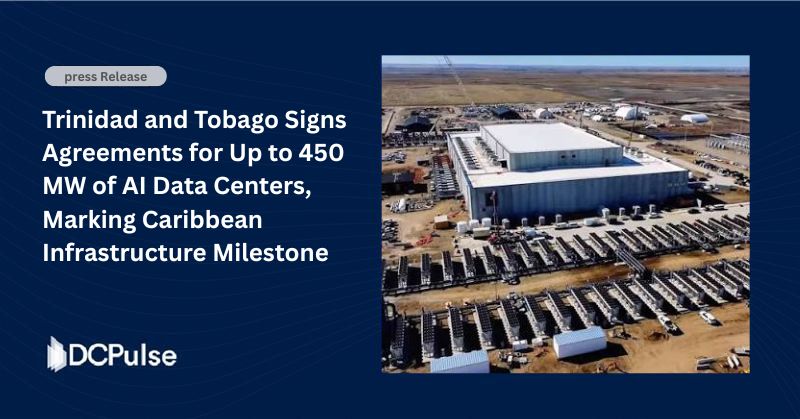
Port of Spain, Trinidad and Tobago - July 12, 2026 - Trinidad and Tobago has signed agreements with two U.S.-based companies to advance the development of up to 450 MW of AI and hyperscale data center capacity, marking one of the Caribbean's most ambitious digital infrastructure initiatives as the country seeks to diversify its economy beyond energy exports.
The memorandums of understanding, signed by the government with Hummingbird AI Holdings and Ernst & Young LLP (EY), establish a framework for due diligence, project planning, and future collaboration on large-scale data center developments. Under the agreements, EY plans to work with third-party partners to develop a 300 MW data center campus, while Hummingbird AI Holdings will evaluate a proposed 150 MW AI infrastructure and data center facility. Together, the projects would introduce an unprecedented level of computing capacity to the Caribbean market.
The announcement represents Trinidad and Tobago's first formal push to attract hyperscale digital infrastructure investment. Government officials said the initiatives form part of a broader strategy to position the country as a regional technology and AI hub by leveraging its established energy sector, industrial base, and strategic location in the Americas. The administration also signed a separate agreement with Pinnacle Steel and Vanadium Corporation to support the restart of a local steel plant, with the three initiatives collectively expected to create more than 5,000 jobs.
For the data center industry, the proposed developments highlight the emergence of new markets beyond traditional hyperscale hubs. As power constraints, land shortages, and lengthy grid interconnection timelines challenge expansion in North America and Europe, developers are increasingly exploring regions with available energy resources and supportive government policies. Trinidad and Tobago's natural gas-based power system and established industrial infrastructure could provide advantages for energy-intensive AI workloads, although the projects remain in the preliminary planning stage.
The announcements have also prompted debate over the environmental implications of large-scale digital infrastructure. Community groups and environmental advocates have raised concerns about electricity consumption and water availability, noting that Trinidad and Tobago continues to face periodic water shortages despite maintaining a relatively reliable electricity network. AI data centers typically require substantial power and cooling resources, making sustainability and resource management key considerations as the projects move forward.
If the developments proceed, they would significantly expand the Caribbean's digital infrastructure footprint and could attract cloud providers, AI companies, and enterprise customers seeking regional computing capacity. While no construction timelines or financial commitments have been disclosed, the agreements signal growing interest in extending hyperscale and AI infrastructure into emerging markets as global demand for compute capacity continues to accelerate.