DCPulse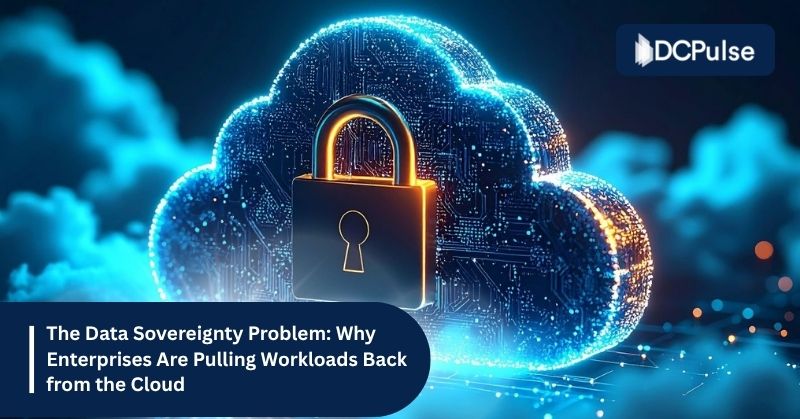
Enterprise cloud strategies are entering a more complex phase as organizations reassess where their data is stored, how it is processed, and which legal jurisdictions govern its use. Public cloud platforms continue to support digital transformation, artificial intelligence (AI), analytics, and business applications, but concerns surrounding data sovereignty are prompting some enterprises to reconsider how much infrastructure they should operate outside their direct control.
Data sovereignty refers to the principle that data is subject to the laws and regulatory requirements of the jurisdiction in which it is collected, stored, or processed. For multinational organizations, the issue becomes particularly complicated when data crosses borders, cloud services rely on distributed infrastructure, or foreign legal frameworks may affect access to information.
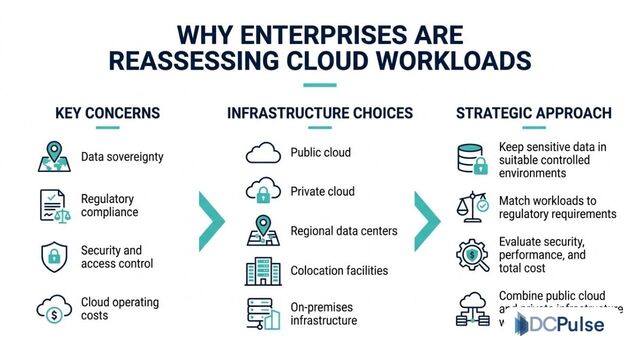
The resulting shift is contributing to renewed interest in cloud repatriation, in which organizations move selected workloads from public cloud environments to private cloud platforms, colocation facilities, on-premises infrastructure, or locally operated data centers. Rather than representing a universal retreat from cloud computing, the trend reflects a more selective approach to infrastructure decisions, with greater attention to regulatory obligations, operational control, security requirements, and long-term costs.
Why Data Sovereignty Is Becoming a Strategic Concern

Data has become a critical business asset, supporting financial transactions, customer services, healthcare systems, industrial operations, and AI applications. As enterprises digitize more of their operations, the consequences of storing or processing sensitive information in the wrong jurisdiction can become increasingly significant.
Regulatory frameworks such as the European Union's General Data Protection Regulation (GDPR) establish requirements for personal data processing and international transfers. Other jurisdictions maintain their own rules governing sensitive information, financial records, public-sector data, and critical infrastructure.
These requirements do not always mandate that every piece of data remain physically within national borders. However, they can impose conditions on international transfers, access, processing, and safeguards. Understanding those distinctions is essential when organizations select cloud providers and determine where workloads should operate.
For enterprises using global cloud platforms, compliance assessments may need to consider data storage locations, backup arrangements, disaster recovery environments, administrative access, subcontractors, and the legal responsibilities of service providers.
A cloud region located within a country does not automatically resolve every sovereignty concern. Organizations may also need to understand who controls encryption keys, which entities can access systems, and how contractual and legal obligations apply to their data.
Why Some Enterprises Are Repatriating Cloud Workloads
Cloud repatriation is rarely driven by a single factor. Regulatory requirements, cost considerations, application performance, security policies, and the need for operational control can all influence decisions about workload placement.
For businesses handling highly sensitive information, a private infrastructure environment may offer greater control over physical access, system configuration, data handling procedures, and administrative permissions. Dedicated infrastructure can also make it easier to establish certain technical and contractual arrangements required by internal governance policies or sector-specific regulations.
Financial institutions, healthcare organizations, government agencies, and businesses operating critical services may have particularly detailed requirements for managing confidential information. The appropriate infrastructure model depends on the applicable rules, the nature of the workload, and the controls available from the provider.
Cost is another consideration. Some applications with predictable and continuous resource requirements may become expensive to operate in public cloud environments, depending on pricing, data transfer charges, storage consumption, and infrastructure utilization. Moving selected workloads to owned or dedicated infrastructure can provide a different cost structure, although it introduces capital expenditure, maintenance responsibilities, and capacity planning requirements.
For many organizations, the resulting strategy is a hybrid environment. Public cloud platforms remain useful for elastic computing, application development, and services that benefit from global scalability, while selected workloads operate in private or locally controlled environments.
The Implications for Data Center Infrastructure

The reassessment of cloud strategies has implications for data center developers, colocation providers, and operators of enterprise infrastructure. Organizations seeking greater control over data location may evaluate facilities based on jurisdiction, ownership arrangements, operational transparency, security certifications, and the ability to support specific compliance requirements.
Regional data centers can provide an infrastructure option for businesses that need workloads to remain within a defined geographic area. Colocation facilities allow enterprises to deploy their own hardware while relying on specialized operators for power, cooling, physical security, and connectivity.
This model can be particularly relevant when an enterprise wants to retain control over servers, encryption systems, or application architecture without constructing and operating an entire facility independently.
However, physical location is only one component of sovereignty. A locally situated data center may still rely on foreign-owned service providers, overseas support teams, or external management platforms. Enterprises therefore need to evaluate the complete operating model rather than treating the facility's address as sufficient proof of regulatory compliance.
For data center operators, the opportunity lies in providing transparent information about facility locations, access controls, service dependencies, operational responsibilities, and contractual arrangements. The ability to support clearly defined customer requirements may become an important consideration in enterprise infrastructure procurement.
Sovereign Cloud and the Changing Role of Cloud Providers
Sovereign cloud offerings are emerging as one response to growing demands for jurisdictional control. These services are designed to address particular sovereignty requirements through combinations of local infrastructure, operational controls, access restrictions, contractual commitments, and governance arrangements.
The exact meaning of sovereign cloud varies by provider and jurisdiction. Some offerings emphasize data residency, while others place greater emphasis on local operational control, personnel requirements, ownership structures, or restrictions on foreign access.
For enterprises, the distinction matters because data residency and data sovereignty are related but not interchangeable. Keeping information within a country's borders does not necessarily eliminate every legal, security, or governance concern.
Cloud providers and infrastructure operators may therefore need to demonstrate how their services address specific customer obligations. Relevant considerations can include encryption and key management, privileged administrator access, incident response, backup locations, subcontractor arrangements, and the handling of government or law-enforcement requests.
These requirements also create opportunities for data center operators to work with cloud platforms, telecommunications companies, managed service providers, and enterprise IT teams to develop infrastructure arrangements suited to regional compliance needs.
Security, Control, and the Limits of Repatriation
Greater control over infrastructure can help organizations implement specific security policies, but moving workloads away from public cloud platforms does not automatically make them more secure.
Public cloud providers offer security capabilities and operational resources that many enterprises would find difficult or expensive to reproduce independently. Private infrastructure, meanwhile, can provide greater configuration flexibility and direct oversight, but its security depends on effective patch management, monitoring, identity controls, physical protection, incident response, and operational expertise.
Cloud repatriation can also introduce migration risks. Data must be transferred safely, applications may require architectural changes, and dependencies between systems need to be understood before workloads are relocated. Poorly planned transitions can create downtime, inconsistencies, or gaps in security controls.
A sound infrastructure strategy therefore begins with workload classification and risk assessment rather than an assumption that one environment is inherently superior. Organizations need to determine which applications require strict location controls, which can operate across jurisdictions, and which benefit most from the scalability of public cloud services.
The result may be a distributed architecture in which sensitive records remain in controlled environments while less restricted applications continue to use public cloud infrastructure.
AI Workloads Add Another Layer of Complexity
The growth of AI introduces additional questions about where enterprise data is processed and how it is used. Training datasets, customer information, proprietary documents, model inputs, and generated outputs may each be subject to different confidentiality, contractual, or regulatory requirements.
Enterprises deploying AI systems must consider more than where the application is hosted. Data pipelines, model-serving infrastructure, logging systems, third-party APIs, and backup services can all create additional data flows that require governance.
For organizations working with sensitive information, locally controlled AI infrastructure may offer greater flexibility in restricting access to datasets and managing computing environments. Private GPU clusters and dedicated data center deployments can support selected workloads where isolation, predictable access, or specific operational controls are important.
These arrangements also involve trade-offs. Dedicated AI infrastructure requires substantial investment in computing equipment, power distribution, cooling, and technical operations. Public cloud platforms can offer access to specialized accelerators without requiring enterprises to purchase and maintain the hardware themselves.
Consequently, AI sovereignty is likely to involve workload-specific decisions about data control, model deployment, computing capacity, and infrastructure economics rather than a uniform migration away from cloud services.
The Future of Enterprise Cloud Strategy
Data sovereignty is becoming a more prominent factor in infrastructure planning as enterprises face increasingly complex legal, operational, and security requirements. The response is not necessarily to abandon public cloud computing, but to establish clearer rules about where different workloads belong and which providers can meet the associated obligations.
For data center developers and operators, this creates a need to understand the requirements of customers seeking regional infrastructure, dedicated environments, and transparent operational arrangements. Local facilities, colocation platforms, private cloud services, and sovereign cloud offerings may all play roles in these strategies, depending on the workload and jurisdiction.
The broader direction is toward infrastructure portfolios that balance control with flexibility. Public cloud, private infrastructure, colocation, and on-premises systems can coexist when organizations have a clear understanding of their data flows, regulatory responsibilities, and operational priorities.
Ultimately, the data sovereignty challenge is not simply about choosing between the cloud and a physical data center. It is about establishing who controls enterprise data, which laws govern it, how it is protected, and whether the infrastructure supporting it meets the organization's obligations. As these questions become more central to digital strategy, data location and operational control will remain important considerations in the evolution of enterprise computing.