DCPulse
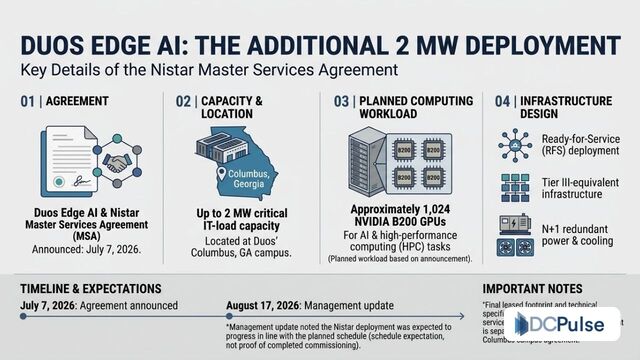
Duos Edge AI has signed an agreement with digital infrastructure developer Nistar to deploy up to 2 megawatts (MW) of critical IT-load capacity at its Columbus, Georgia, data center campus. Announced on July 7, 2026, the Master Services Agreement covers supporting utility infrastructure and a deployment designed for high-density artificial intelligence (AI) and high-performance computing (HPC) workloads. The planned installation is intended to support approximately 1,024 NVIDIA B200 GPUs, placing power availability, cooling resilience, and deployment readiness at the center of the project.
The agreement adds to Duos Edge AI’s expanding commercial footprint in Columbus, where the company has described potential campus expansion capacity of up to 20 MW. The announcement also reflects a broader infrastructure challenge for AI developers: securing usable power and data center capacity quickly enough to support demanding computing systems, without compromising reliability or operational requirements.
Nistar Agreement Targets High-Density AI Computing
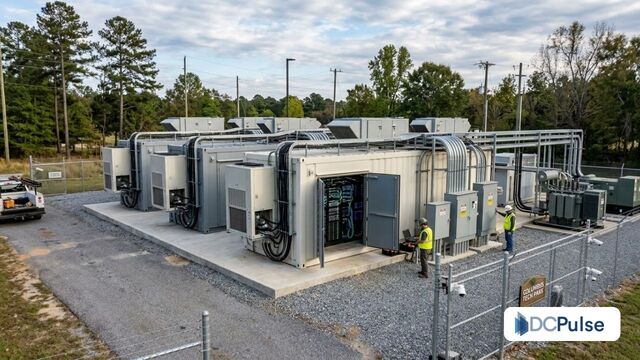
Under the agreement, Duos Edge AI is to provide a “Ready for Service” deployment that allows Nistar to install and commission server equipment once the relevant infrastructure is prepared. The planned 2 MW allocation refers to critical IT load, rather than necessarily representing the total electricity drawn by the complete facility, which also needs to support cooling, power conversion, lighting, and other building systems. The exact leased footprint and technical specifications are to be defined through service orders and related contract documents.
The proposed GPU deployment provides a clear indication of the intended workload. NVIDIA’s B200 platform is designed for AI training, fine-tuning, and inference, and its systems combine GPU accelerators with high-speed memory and networking. Such workloads can place substantial demands on electrical distribution, rack configuration, thermal management, and interconnect performance.
The agreement does not publicly disclose the final rack count, detailed facility design, or the identity of the end customer. Those details matter because GPU counts alone do not determine a data center’s full power profile or cooling requirements. Server configurations, networking equipment, workload utilization, and the final deployment design all influence the infrastructure needed to support an installation.
Redundant Power and Cooling Are Central to Readiness
Duos said the Nistar deployment would use Tier III-equivalent infrastructure with N+1 redundant power and cooling systems. In an N+1 arrangement, the design includes an additional component beyond the minimum required capacity, helping the system maintain service when one component is unavailable. The actual resilience delivered depends on the design and implementation of the full power and cooling distribution system.
The “Tier III-equivalent” description is the company’s characterization; the announcement does not establish that the specific deployment has received formal certification from Uptime Institute. Its Tier III framework describes concurrently maintainable infrastructure designed so that equipment can be removed for maintenance without shutting down critical IT operations.
For AI infrastructure, redundancy is particularly relevant because interruptions can affect expensive computing equipment, scheduled workloads, and customer service commitments. Cooling also requires careful planning as accelerator-based systems can concentrate heat within a relatively small footprint. The U.S. Department of Energy’s data center design guidance emphasizes the importance of IT equipment efficiency, air management, cooling, and electrical systems when evaluating facility performance.
Columbus Campus Builds on a Larger Expansion Plan
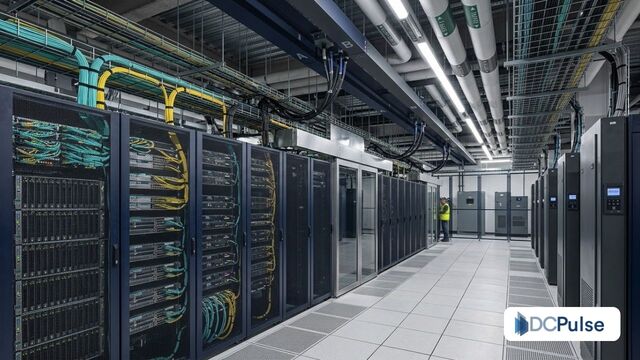
The July agreement was announced against the backdrop of a larger development plan for Duos’ Columbus campus. At the time, the company said its existing contract at the site covered 10 MW, with billing expected to begin by the end of August 2026, and that a further 10 MW was planned for installation between October and November. Those dates were forward-looking expectations at announcement, not confirmation that all capacity had already been installed or commissioned.
A subsequent July 16 announcement added a separate five-year, 10 MW colocation agreement with an investment-grade hyperscaler, which Duos said was valued at more than $111 million in contracted revenue. The company expected that capacity to become available in the fourth quarter of 2026 and said the Columbus campus was expected to reach 20 MW of critical IT-load capacity by the end of that quarter. This separate agreement illustrates the campus’s wider expansion, but its terms should not be treated as part of Nistar’s 2 MW contract.
Duos also disclosed on July 14 that it had purchased a building and related land in Columbus for use as a data center. The filing reported a $15 million cash purchase price plus a contingent earnout note tied to specified power-delivery milestones. The acquisition provides additional context for the company’s strategy of developing owned infrastructure, although the filing alone does not establish which specific contract uses each part of the property.
Deployment Status and Commercial Considerations
In its August 17, 2026, earnings call, Duos management said the Nistar project continued to be expected to progress in line with the parties’ planned deployment schedule. Management also noted that recurring colocation revenue would depend on capacity coming online and customer utilization ramping up. This distinction is important: signing a services agreement establishes a commercial commitment, but revenue timing depends on delivery, commissioning, operational commencement, and the terms of the contract.
The broader business has continued to evolve. On October 5, Duos announced the sale of its GPU-as-a-Service entity to Axe Compute as part of a shift toward an AI colocation-focused platform. The company said a Columbus customer would continue without interruption under a new five-year agreement, but the announcement did not identify this as a change to Nistar’s specific 2 MW Master Services Agreement.
For developers and operators, the Nistar project highlights the importance of aligning power availability, physical infrastructure, network connectivity, and customer equipment schedules. A facility can be technically prepared for service while still requiring coordinated work across server installation, commissioning, and operational testing before it can support production workloads.
AI Power Demand Raises the Value of Ready Capacity
The deal also sits within a wider market where AI workloads are increasing attention on data center electricity supply and capacity planning. The International Energy Agency’s Energy and AI report examines how the growth of AI computing could affect electricity demand, energy infrastructure, and emissions. Its analysis reinforces why power availability and efficient facility design are central considerations in new AI data center deployments.
For Duos Edge AI and Nistar, the announced 2 MW deployment is a targeted project rather than a disclosure of a fully commissioned facility. Its significance lies in the attempt to match a defined high-density compute requirement with infrastructure designed to be ready for server installation, supported by redundant power and cooling. The next meaningful milestones are therefore the completion of deployment, commissioning, and confirmation that the planned capacity is operational.
The project’s progress will help show how effectively smaller, power-focused campus expansions can serve specialized AI and HPC requirements. As the Columbus campus develops, the distinction between contracted capacity, installed infrastructure, and live operational load will remain essential for assessing its actual contribution to the AI data center market.