DCPulse
The global data center chillers market is projected to reach $6.4 billion by 2035, supported by growing investment in data center capacity, rising computing density, and the increasing importance of efficient thermal management. As cloud services, artificial intelligence (AI), and high-performance computing expand, cooling infrastructure is becoming a central consideration for operators planning new facilities and upgrading existing sites.
Chillers play an important role in many data center cooling architectures by removing heat from circulating fluids and supporting temperature control across critical computing environments. Their performance affects operational reliability, energy consumption, and the ability of facilities to accommodate changing workloads. The market's projected growth reflects the need for cooling systems that can support increasingly demanding digital infrastructure.
The forecast also highlights a shift in how operators evaluate cooling investments. Equipment selection is no longer determined solely by initial cost or cooling capacity. Energy efficiency, water availability, maintenance requirements, redundancy, and compatibility with newer cooling technologies are increasingly relevant to long-term infrastructure planning.
AI Expansion Increases Demand for Advanced Cooling
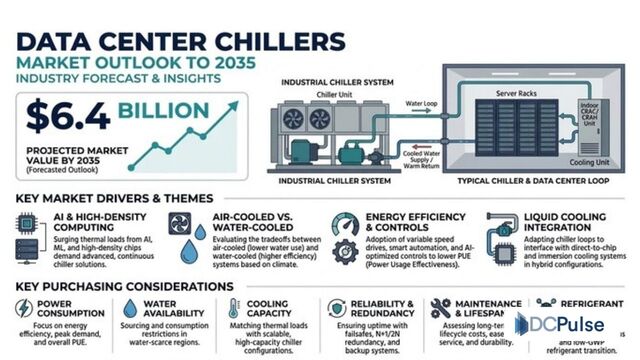
The expansion of AI infrastructure is creating new thermal management challenges for data center operators. AI training and inference workloads can rely on high-performance processors that generate substantial heat, particularly when large numbers of accelerators operate within densely configured server racks.
Traditional enterprise and cloud workloads also require dependable cooling, but high-density computing can concentrate heat in smaller physical areas. These conditions place greater demands on cooling distribution, heat exchangers, pumps, and temperature monitoring systems.
For developers, cooling decisions increasingly form part of the initial facility design process. Rack density, power distribution, equipment layout, and thermal management must be considered together to ensure that a data center can support its intended computing loads.
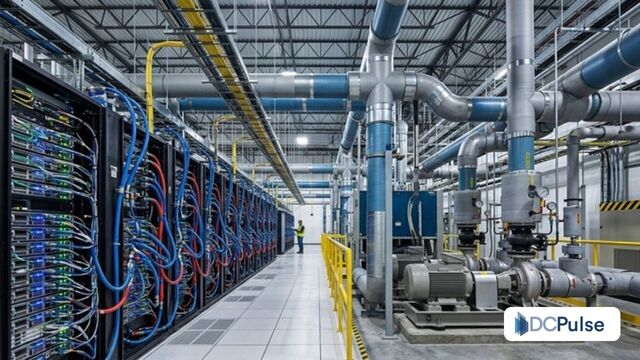
Chillers can help address these requirements by supplying chilled water or other cooling fluids to systems that transfer heat away from server environments. Depending on the design, they may work with computer room air handlers, air-handling units, heat exchangers, or liquid-cooling infrastructure.
New construction is not the only source of demand. Existing data centers may also require cooling upgrades when operators introduce higher-density computing equipment or expand their capacity. Retrofitting these facilities can involve additional engineering considerations because new cooling requirements must be accommodated within existing electrical, mechanical, and structural limits.
Air-Cooled and Water-Cooled Chillers Serve Different Applications
The choice between air-cooled and water-cooled chillers depends on local climate, site conditions, water availability, energy costs, and the cooling requirements of the facility. Both technologies serve important roles in the data center market, but their operating characteristics differ.
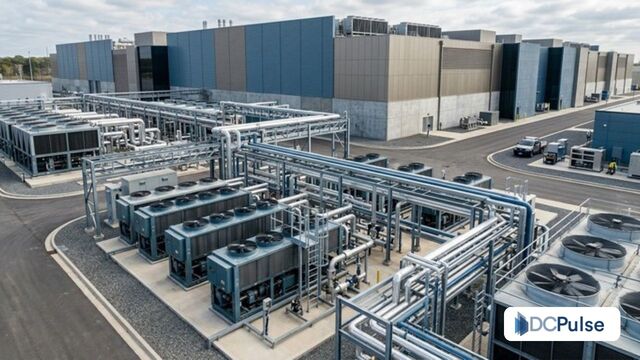
Air-cooled chillers reject heat directly to the outdoor air. Their configurations generally avoid the need for cooling towers, potentially reducing water-related requirements and simplifying certain installations. However, performance can be affected by outdoor temperatures, particularly in hot climates.
Water-cooled chillers typically transfer heat through a water circuit and operate alongside cooling towers or other heat-rejection equipment. These systems can provide attractive efficiency in large installations, depending on plant design and operating conditions, but they require careful consideration of water consumption, maintenance, and associated infrastructure.
Neither configuration is universally superior. Operators must assess the complete cooling system, including pumps, fans, heat exchangers, and controls, rather than evaluating chiller performance in isolation.
Site-specific conditions are particularly important for hyperscale campuses. A facility with access to suitable water resources and favorable operating conditions may adopt a different cooling architecture from a project located in a water-constrained region.
For equipment suppliers, this diversity creates opportunities to provide systems tailored to different facility sizes, climates, and operational priorities. Flexible configurations and integration with broader cooling infrastructure can be important considerations for developers seeking to accommodate future expansion.
Energy Efficiency Becomes a Key Investment Consideration
Electricity consumption remains a major consideration for data center operators. Cooling equipment uses power directly, while associated pumps, fans, and heat-rejection systems contribute to the overall energy requirements of a facility.
Improvements in chiller efficiency can help reduce operating expenses and support broader facility efficiency objectives. However, the results depend on the operating environment, system configuration, cooling load, and control strategy.
Technologies such as variable-speed drives, advanced compressors, and automated controls can help cooling systems adjust output to changing requirements. Rather than operating at a fixed level, appropriately configured equipment can respond to variations in computing demand and outdoor conditions.
The complete cooling plant is equally important. Poor coordination between chillers, pumps, and air-handling equipment can limit the benefits of efficient individual components. Integrated controls and effective monitoring help operators identify performance issues and adjust equipment operation to changing conditions.
Reliability remains essential alongside efficiency. Data centers support services that require continuous availability, so cooling infrastructure must be designed to maintain appropriate conditions during maintenance activities and equipment failures. Redundant equipment, monitoring systems, and established maintenance procedures can help manage operational risks.
As a result, purchasing decisions increasingly involve the total cost of ownership. Initial equipment costs remain relevant, but operators also consider electricity consumption, service requirements, equipment lifespan, and the financial consequences of cooling interruptions.
Liquid Cooling Changes Chiller System Design
Liquid cooling is gaining importance as data center operators deploy processors with increasingly demanding thermal requirements. Technologies such as direct-to-chip cooling transfer heat through liquid circulating near major heat-generating components, reducing reliance on air movement alone.
In these systems, coolant distribution units and heat exchangers can transfer heat from equipment-level cooling loops to facility infrastructure. The precise arrangement depends on the technology, required temperatures, and overall cooling architecture.
Chillers can remain part of these systems, although their role varies by design. Some liquid-cooling configurations can use warmer water and may take advantage of favorable outdoor conditions to reject heat without relying continuously on mechanical refrigeration.
This approach can create opportunities to reduce energy consumption, but the benefits are not automatic. Operators must assess the temperature requirements of their computing equipment, the efficiency of heat-rejection systems, and the performance of the complete cooling loop.
The transition also creates new requirements for engineering coordination. Chillers, pumps, coolant distribution units, heat exchangers, and control systems must operate together to maintain suitable temperatures and flow rates.
Conventional air cooling will continue to serve many enterprise and colocation environments. Some campuses may adopt hybrid configurations in which different cooling methods support different rack densities or workload types. Such arrangements can help operators accommodate evolving computing requirements without redesigning every part of a facility.
Water Management and Refrigerant Selection Influence Procurement
Environmental considerations are increasingly relevant to cooling system selection. Water-cooled plants that use cooling towers can require ongoing water consumption, while air-cooled systems generally avoid cooling-tower water demand. The overall environmental impact depends on factors including local climate, electricity consumption, and the source of power.
Water availability can therefore influence data center development decisions. In areas facing water constraints, operators may consider air-cooled equipment or alternative heat-rejection approaches, even where other configurations could offer different efficiency advantages.
Refrigerants are another important consideration. Chiller manufacturers must account for equipment performance, safety requirements, and applicable environmental regulations when selecting refrigerants. The transition toward alternatives with lower global warming potential can also influence equipment design and long-term maintenance planning.
These factors reinforce the importance of evaluating cooling infrastructure early in the development process. Utility availability, climate conditions, water resources, and environmental requirements can influence both capital expenditure and the long-term operating profile of a data center.
Suppliers Face Opportunities and Execution Challenges
The projected growth of the data center chillers market creates opportunities for manufacturers, engineering firms, and cooling technology providers. New hyperscale campuses, colocation developments, and upgrades to existing facilities can all generate demand for cooling equipment.
However, suppliers must address differing technical requirements across projects. Large campuses may require centralized cooling plants with substantial capacity, while modular facilities may prioritize compact equipment, standardized installation, and the ability to add capacity in phases.
Integration and service capabilities are also important. Data center customers need equipment that can be commissioned reliably, integrated with facility monitoring systems and maintained without compromising availability. Long-term service support can therefore form an important part of supplier relationships.
The market's projected expansion is not guaranteed. Construction schedules, financing conditions, equipment availability, local infrastructure constraints and changes in cooling technology can influence the pace of investment. Forecasts may also vary between research providers because of differences in market definitions and methodologies.
For buyers, careful evaluation of suppliers and system designs will remain essential. The most suitable solution will depend on the facility's operating requirements, local conditions and plans for future capacity rather than market growth projections alone.
Cooling Infrastructure Will Shape the Next Phase of Data Center Growth
The expected expansion of the data center chillers market reflects the growing importance of thermal management across digital infrastructure. AI computing, cloud services and high-density server deployments are increasing the need for cooling systems that combine reliable operation with efficient energy use.
Chillers will continue to serve a range of data center designs, although their configuration and integration with other cooling technologies will evolve. Liquid cooling, advanced controls and alternative heat-rejection methods are changing how operators plan and operate thermal infrastructure.
For data center developers, the priority is to select systems that meet current cooling requirements while retaining the flexibility to accommodate future workloads. Power availability, water management, reliability and lifecycle costs will remain important considerations.
The projected $6.4 billion market value by 2035 points to the commercial significance of cooling infrastructure as data center investment continues. Ultimately, the industry's growth will depend not only on demand for new equipment but also on the ability of manufacturers and operators to deliver efficient, reliable and adaptable cooling systems.