DCPulse
Duos Edge AI, a subsidiary of Duos Technologies Group, has signed a five-year colocation agreement covering 10 MW of critical IT load at its data center campus in Columbus, Georgia. The agreement is valued at more than $111 million in contracted revenue over its initial term, with the additional capacity expected to become available in the fourth quarter of 2026.
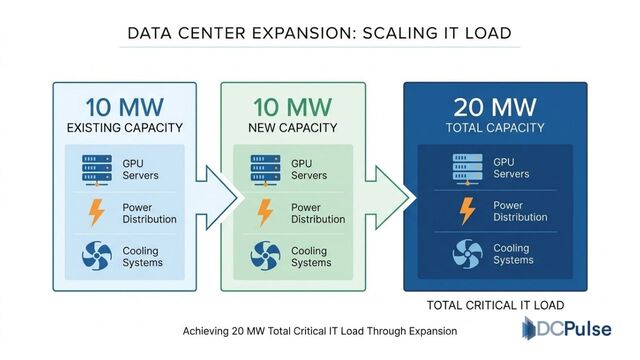
The agreement adds another large committed workload to a campus that Duos is developing around high-density AI infrastructure. The company said its previously announced initial 10 MW deployment at the Columbus site was expected to begin generating revenue in August 2026. Together, the deployments are expected to bring the campus to 20 MW of critical IT load by the end of the fourth quarter.
Columbus Campus Becomes a Larger AI Infrastructure Site
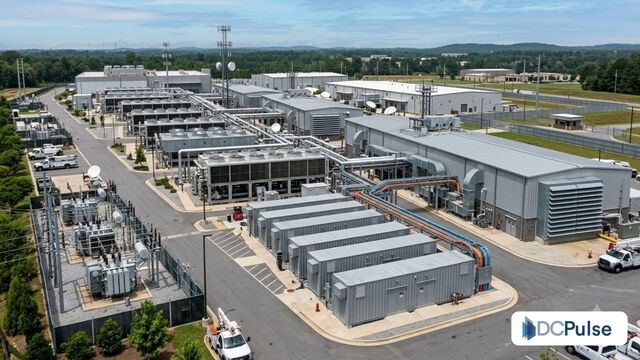
The Columbus agreement gives Duos a substantial contracted deployment in a single U.S. market. The company has positioned the campus as part of its Edge Data Center strategy, which focuses on modular and scalable infrastructure for AI and other high-density computing requirements.
The newly contracted 10 MW is specifically described as critical IT load capacity. That distinction matters because IT load represents the power available to computing equipment rather than the total electrical demand of a data center, which also includes cooling, power conversion, and other facility systems.
The planned increase to 20 MW therefore represents a meaningful expansion of computing capacity at the Columbus site. The additional deployment is expected to become available during the fourth quarter of 2026, subject to the project schedule and required infrastructure readiness.
The customer was initially described by Duos as an investment-grade hyperscaler. Subsequent disclosures identified the customer as Axe Compute, a neocloud AI infrastructure company focused on dedicated GPU computing and large-scale AI cluster deployments.
Five-Year Contract Provides Long-Term Capacity Commitment
The agreement's five-year structure provides Duos with a contracted commitment tied to a defined amount of data center capacity. The company reported contracted revenue of more than $111 million over the initial term.
The value is not an upfront payment. It represents contracted revenue associated with the five-year arrangement, making the deployment dependent on the successful delivery and operation of the contracted infrastructure.
Duos later disclosed that its agreements with Axe Compute had expanded substantially beyond the original Columbus commitment. On August 17, the companies announced agreements covering 55 MW of additional AI data center capacity across multiple U.S. locations, valued at more than $500 million in aggregate contractual base payments over their initial five-year terms. Those agreements are separate from, and in addition to, the 10 MW Columbus deployment.
The broader relationship illustrates how an initial data center deployment can become a foundation for additional capacity commitments when infrastructure providers can meet requirements for power, deployment timing, and facility readiness.
AI Workloads Are Increasing Requirements for Data Center Capacity
AI infrastructure is creating demand for data centers capable of supporting higher density computing equipment. GPU-based systems require substantial electrical capacity and generate significant heat, making power and cooling infrastructure central to deployment planning.
Duos has positioned its Edge Data Center model around modular and scalable infrastructure. The company has previously described its strategy as targeting markets where customers require high-density power and faster deployment options.
The Columbus project is therefore relevant beyond its contracted megawatt figure. The deployment demonstrates the type of infrastructure arrangement emerging around AI computing, where a data center provider supplies the physical environment and critical infrastructure while a specialized AI platform deploys computing capacity for customers.
Axe Compute's business model centers on dedicated enterprise GPU compute capacity. Its disclosures describe the company as a neocloud AI infrastructure platform, meaning the underlying data center capacity can support specialized computing deployments rather than conventional enterprise colocation alone.
Power Access Remains Central to Deployment
Power availability is an important consideration for the Columbus development. Duos has described power availability, deployment speed, and operational flexibility as key factors in its strategy for high-density AI infrastructure.
The company's broader capital plans also reflect the infrastructure requirements associated with these deployments. Duos completed a $55 million registered direct offering in 2026, with proceeds intended in part to support the acquisition of its Columbus facility and related infrastructure investments.
The relationship between power infrastructure and AI capacity is increasingly important across the data center sector. A site may have sufficient land and network connectivity, but large-scale AI deployment also requires electrical infrastructure capable of supporting sustained high-density loads.
For developers, that makes power access a central component of site selection and expansion planning rather than simply an operating consideration after construction.
Modular Infrastructure Supports a Different Delivery Model
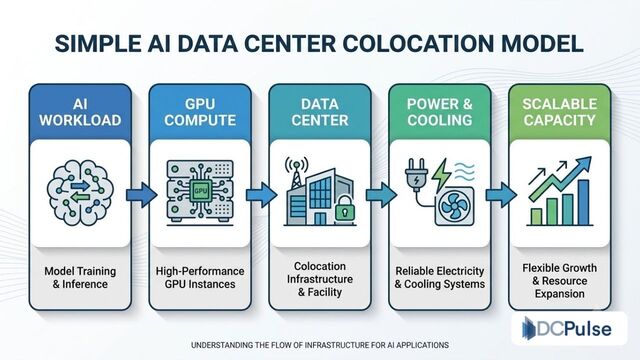
Douglas is pursuing an infrastructure model that relies on modular and scalable edge data center deployments. The approach is designed to support capacity additions without treating every project as an entirely independent construction program.
The model can be particularly relevant for AI infrastructure because computing requirements can change rapidly as GPU platforms, cluster configurations, and customer workloads evolve.
Modular infrastructure does not remove conventional development requirements. Land, utility connections, permitting, network connectivity, cooling systems, and commissioning remain necessary. The potential difference lies in how much of the infrastructure can be standardized, manufactured, and deployed as repeatable components.
Duos has previously outlined a strategy targeting deployments in underserved Tier 3 and Tier 4 markets, where it believes customers can benefit from additional AI infrastructure outside the largest traditional data center markets.
Columbus Fits Into a Broader U.S. Expansion
The 10 MW agreement is part of a wider expansion of Duos' AI infrastructure business. The company's August disclosures stated that it had 25 MW of contracted capacity planned for deployment in 2026.
The subsequent 55 MW agreement with Axe Compute expands the potential project pipeline across multiple U.S. locations. Duos said initial readiness for those additional projects was targeted to begin in late 2026 and continue into early 2027, subject to construction, commissioning, performance testing, and customer acceptance.
That development gives the Columbus agreement a broader significance within Duos' infrastructure strategy. The site is not being developed solely as a standalone colocation facility; it is also part of a wider effort to establish repeatable infrastructure for AI workloads across multiple markets.
Implications for the Data Center Market
The agreement highlights the growing importance of contracted AI capacity in data center development. A five-year commitment for 10 MW gives an infrastructure provider a defined customer requirement around which power, cooling, equipment, and facility investments can be planned.
For AI infrastructure customers, the arrangement provides access to dedicated capacity without requiring the customer to develop the entire physical data center itself. That structure can allow specialized computing companies such as neocloud providers to concentrate on GPU infrastructure, software platforms, and customer services while relying on a data center operator for the underlying facility.
The Columbus development also demonstrates how AI demand is creating opportunities beyond traditional Tier 1 data center markets. Duos is specifically targeting locations where power availability, infrastructure costs, and deployment flexibility can support its modular model.
The broader Axe Compute relationship reinforces that direction. The companies' later agreements cover 55 MW across multiple U.S. locations and more than $500 million in aggregate contractual base payments, showing how a single customer relationship can develop into a larger infrastructure pipeline.
For the data center industry, the Columbus project reflects a broader transition toward infrastructure designed around AI's power density and deployment requirements. The combination of long-term capacity commitments, modular infrastructure, and specialized AI compute providers is creating a different pathway for bringing new capacity online.
The next stage for the Columbus campus will depend on delivery of the additional infrastructure and the scheduled fourth quarter 2026 availability of the newly contracted 10 MW. Its progress will provide a practical indication of how quickly modular data center capacity can be converted from contracted demand into operational AI infrastructure