DCPulse
Dallas-Fort Worth has become one of the most closely watched data center markets in the United States, with hyperscale, cloud and AI infrastructure driving a substantial development pipeline. New campuses are increasingly associated with large power requirements, expansive land parcels and long-term capacity commitments.
That growth creates a less visible question for the market: where does the mid-market fit?
Enterprise customers, regional businesses, managed service providers and organizations with more moderate infrastructure requirements do not necessarily need hyperscale campuses. Their requirements can include smaller colocation deployments, hybrid infrastructure, disaster recovery capacity, private connectivity and gradual expansion.
The availability of infrastructure designed around those requirements could become an important part of DFW's next stage of development.
DFW's Expansion Is Increasingly Built Around Scale
The geography of the DFW data center market is changing as developers look for combinations of land, electrical capacity and network connectivity that can support large facilities.
South Dallas-area locations including Lancaster, Red Oak, Midlothian and Grand Prairie have attracted major development activity, while established locations such as North Dallas and Richardson continue to retain connectivity and interconnection value. ROC Telecom identifies power availability and scalable land as major factors behind the movement toward these emerging corridors.
The scale of current development is closely connected to AI and cloud infrastructure requirements. JLL's 2026 global data center outlook says AI and cloud demand is contributing to continued sector growth while also highlighting power constraints as a major development consideration.
Large campuses can make economic sense when customers require substantial capacity over long periods. The same development model, however, does not automatically address every enterprise requirement.
The Mid-Market Has Different Infrastructure Needs
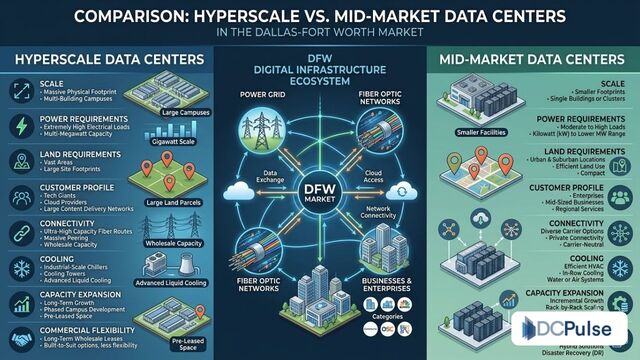
Mid-market data center demand is not necessarily defined by a single facility size. The segment can include enterprises that need additional colocation space, regional IT infrastructure, backup environments, hybrid-cloud connectivity or facilities closer to their existing operations.
Those customers may value flexibility as much as raw capacity.
A company migrating part of its infrastructure to the cloud, for example, may still require physical servers, networking equipment or disaster recovery systems. A regional technology provider may need incremental rack space rather than an entire powered campus.
These requirements create a different operating profile from hyperscale deployments.
For operators, that distinction matters because facility design, power provisioning, cooling systems, network architecture and commercial models can all be configured differently depending on the customer base.
Power Availability Changes the Equation
Power has become one of the central considerations in DFW data center development.
JLL's 2026 outlook points to longer grid-connection timelines in major data center markets and describes growing interest in behind-the-meter power and battery storage.
The issue is particularly relevant to a market where new developments are increasingly moving toward locations capable of supporting large electrical loads.
For mid-market operators, the challenge is not simply finding electricity. Timing, reliability, expansion capacity and the commercial structure of that power supply can influence whether a facility can serve customers effectively.
A smaller customer may not require hundreds of megawatts, but the facility still needs dependable electrical infrastructure, resilient backup systems and sufficient capacity for future growth.
Network Connectivity Remains a Core Requirement
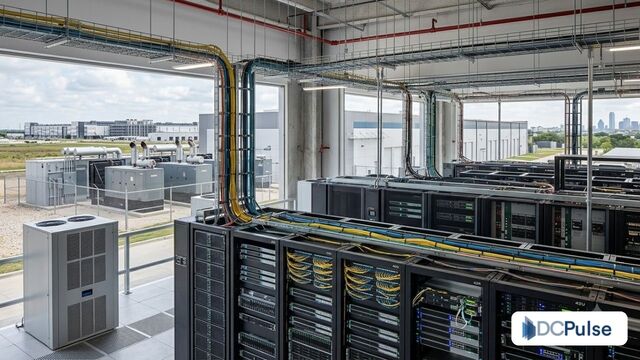
Power is only one component of a usable data center ecosystem.
Enterprise customers also depend on carrier access, cloud connectivity, low-latency connections, diverse network routes and access to regional business centers. DFW's established data center clusters have developed around these connectivity advantages, creating infrastructure that can support a broad range of digital services.
The challenge for newer developments is maintaining that connectivity while moving toward locations where land and power may be more readily available.
Network architecture therefore becomes increasingly important as the market expands geographically. A facility with available electrical capacity but limited carrier diversity may not provide the same value to an enterprise customer as a well-connected colocation environment.
That consideration could make connectivity a differentiator for mid-market facilities operating alongside much larger campuses.
Cooling Requirements Are Also Becoming More Diverse
AI is changing the conversation around data center cooling, but not every customer has an AI-scale workload.
Traditional enterprise applications, databases, private cloud environments and general-purpose computing can have different rack-density and thermal requirements from high-density AI deployments. As a result, a market dominated by AI-driven construction still has room for facilities designed around conventional enterprise workloads.
At the same time, operators cannot ignore the direction of hardware development.
Facilities serving mid-market customers may increasingly need infrastructure that can accommodate higher-density deployments over time. Flexible cooling architecture, sufficient electrical distribution and adaptable rack configurations can help reduce the risk of a facility becoming unsuitable as customer hardware evolves.
The requirement is therefore not necessarily to build every facility around the highest possible density. It is to create enough flexibility to support changing workloads.
Commercial Flexibility Could Become a Differentiator
Large-scale data center projects often involve substantial commitments and long planning cycles. Mid-market customers can have different procurement requirements.
Colocation contracts, managed infrastructure, hybrid-cloud services and incremental capacity can provide businesses with ways to expand without committing to infrastructure designed for much larger deployments.
That model can also create opportunities for operators that specialize in serving multiple customer types rather than depending on a small number of very large tenants.
The economics are different, however. Smaller deployments can require more customer management, more varied technical configurations and potentially more complex capacity planning. Operators therefore need to balance flexibility with standardized infrastructure and efficient operations.
DFW's Existing Infrastructure Can Support Multiple Market Segments
The development of hyperscale capacity does not necessarily mean that enterprise infrastructure becomes irrelevant.
In fact, the expansion of power, fiber, carrier networks, cloud connectivity and supporting services can strengthen the broader digital infrastructure ecosystem. The question is how those resources are packaged for different customers.
Fort Worth provides an example of the market's existing diversity. The city's official data center information says facilities have operated there for more than two decades and identifies developments ranging from individual buildings to larger campuses.
That history illustrates that DFW's data center market is not exclusively a new hyperscale phenomenon. Enterprise and other infrastructure requirements have been part of the region's digital ecosystem for years.
The Next Phase May Be About Infrastructure Variety
The DFW boom is clearly creating additional capacity, but capacity alone does not describe the entire data center market.
Hyperscale and AI projects require enormous amounts of power, land and specialized infrastructure. Mid-market customers require reliability, connectivity, flexibility and a pathway to grow. Those requirements can overlap, but they are not identical.
For developers and operators, the opportunity may therefore extend beyond building ever-larger campuses. Infrastructure that combines resilient power, strong network access, adaptable cooling and commercially flexible capacity could address a different layer of demand.
DFW's continued growth will depend on more than the number of megawatts brought online. The composition of that capacity will also determine which businesses can access the region's expanding digital infrastructure.
As power constraints increasingly influence where and how data centers are built, the mid-market segment may become an important test of whether DFW's infrastructure expansion can serve a broad enterprise ecosystem rather than only the largest users.