DCPulse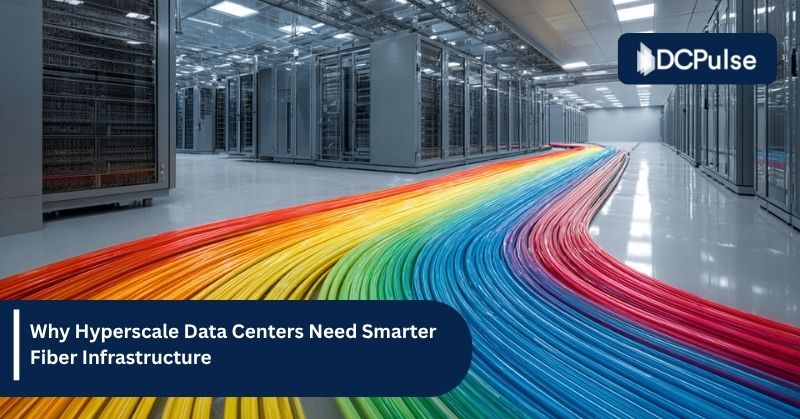
Hyperscale data centers are entering an operating environment where computing capacity is increasingly tied to network performance. AI workloads, distributed computing architectures, cloud platforms, and large-scale data movement require data center networks that can support high bandwidth, predictable performance, and rapid deployment.
Fiber infrastructure sits at the center of this requirement. Within large data center campuses, fiber connects servers, switches, buildings, network rooms, external carriers, cloud environments, and other facilities. As AI infrastructure expands, the way these connections are designed and deployed is becoming an increasingly important part of data center development.
The concept of plug-and-play fiber addresses this challenge by emphasizing pre-engineered, modular, and deployment-ready connectivity. Rather than treating every fiber connection as a separate installation exercise, operators can design connectivity infrastructure as a scalable system that can be expanded as computing requirements change.
AI Workloads Are Changing Network Requirements
AI infrastructure creates a different relationship between computing and networking. Large AI systems rely on clusters of computing resources that must communicate efficiently, making the network an important component of overall infrastructure performance.
Traditional data center connectivity can involve extensive planning, cabling, testing, and configuration whenever new equipment or capacity is introduced. A rapidly expanding AI environment can make these processes more difficult to manage when deployments occur across multiple halls or buildings.
Fiber provides the physical foundation for these high-capacity connections. The challenge for operators is increasingly about how quickly and consistently that fiber can be deployed, expanded, tested, and maintained.
A plug-and-play approach can provide a structured framework in which fiber assemblies, connectivity modules, and distribution systems are prepared for deployment before they are required. The result is a connectivity architecture designed around repeatability rather than one-off installation.
Plug-and-Play Fiber Moves Connectivity Toward Modularity
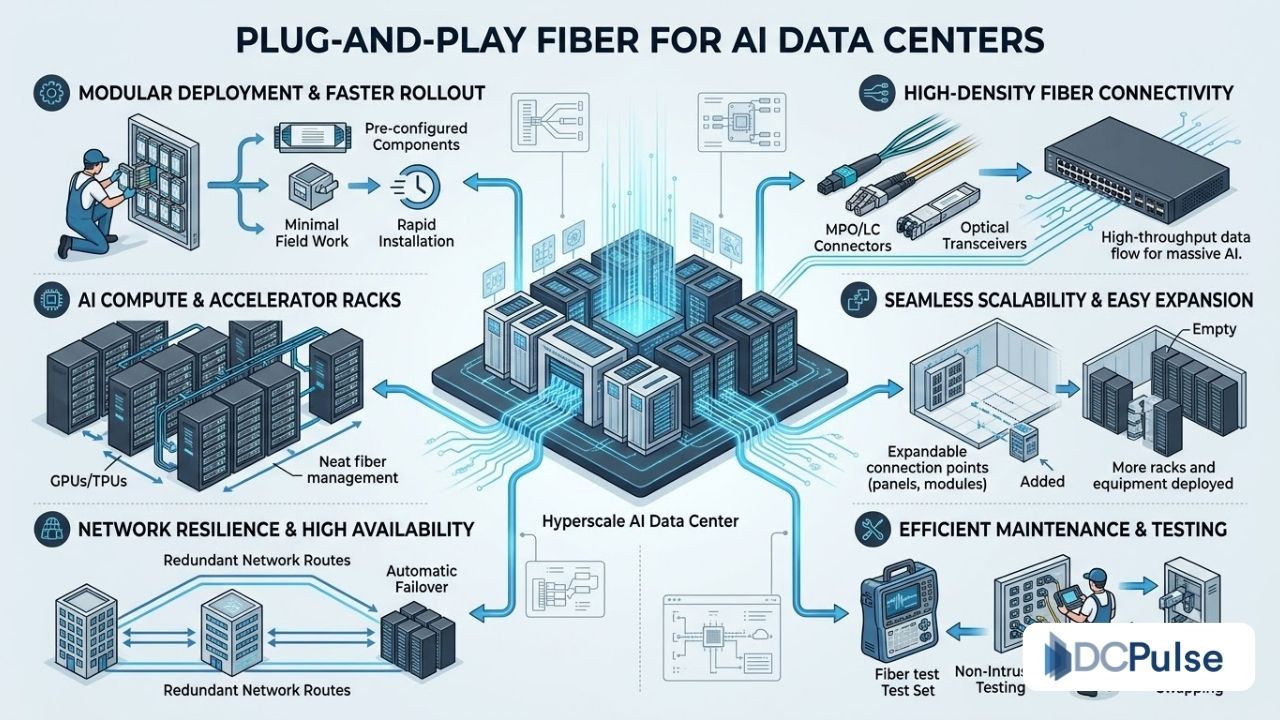
Modularity is becoming increasingly important across data center infrastructure. Electrical systems, cooling equipment, data halls, and power distribution can all be designed with expansion in mind. Fiber connectivity can follow the same principle.
Pre-terminated fiber assemblies and modular connectivity systems can reduce the amount of field work required during deployment. Instead of performing every termination and connection at the installation site, operators can use standardized components that are prepared and tested before installation.
The approach can be particularly relevant for hyperscale environments where multiple data halls or buildings may require similar connectivity architectures.
Standardization can also simplify expansion. A data center operator can establish defined pathways, connection points, and distribution architectures that allow additional capacity to be introduced without redesigning the entire network infrastructure.
Faster Deployment Depends on More Than Fiber
Plug-and-play fiber does not eliminate the broader engineering requirements associated with data center networking. Pathway design, cable routing, rack layouts, optical performance, connector compatibility, network architecture, and physical protection remain important.
The value of modular fiber therefore depends on how well it fits into the overall facility design.
A connectivity system that is standardized from the beginning can support more predictable deployment. Clear labeling, defined connection points, documented configurations, and pre-tested assemblies can also simplify installation and maintenance activities.
For hyperscale operators, those characteristics can become increasingly relevant as construction programs involve multiple phases and large quantities of network infrastructure.
Fiber Density Is Becoming a Data Center Design Consideration
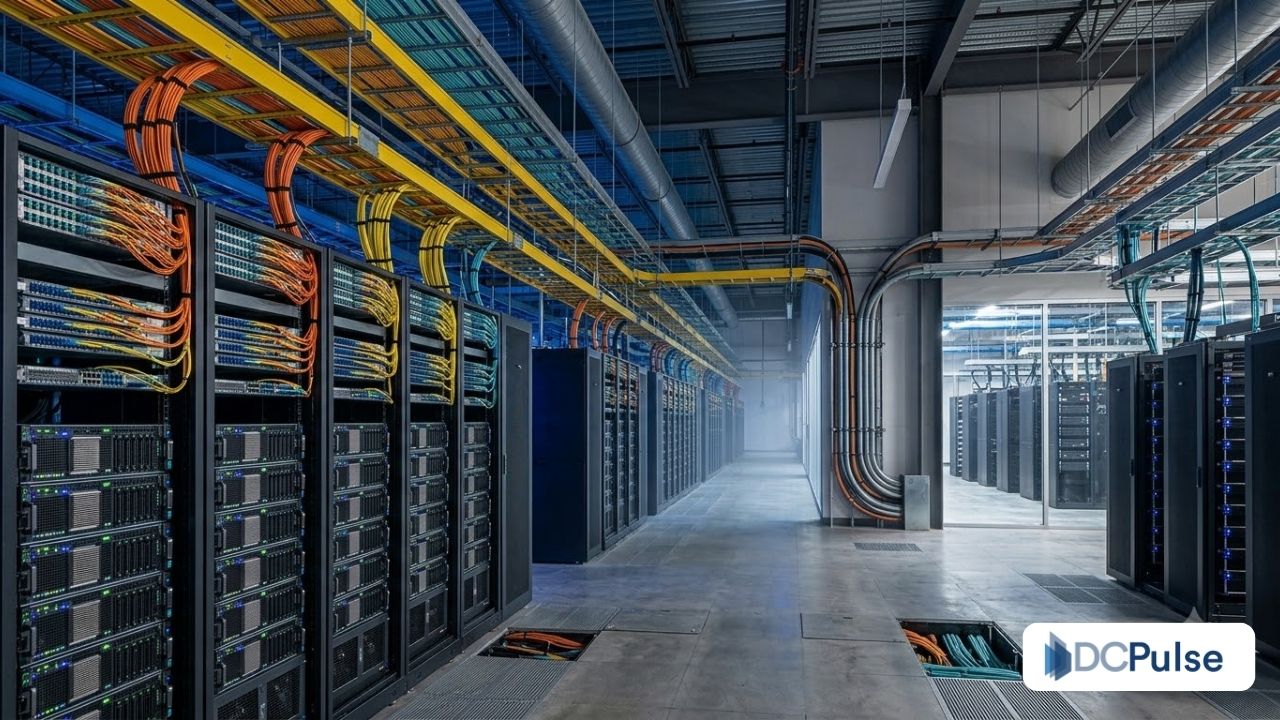
The physical volume of fiber inside a data center can increase as network requirements expand. Large numbers of connections can create challenges around cable management, pathway capacity, bend-radius requirements, airflow, accessibility, and maintenance.
AI-oriented environments can intensify these considerations because high-performance computing clusters can require extensive interconnection between computing and networking equipment.
A scalable fiber architecture needs to account for both current connections and future expansion. Sufficient pathway capacity and organized distribution can help prevent connectivity infrastructure from becoming difficult to manage as the facility grows.
The design challenge is therefore not simply about installing more fiber. It is about creating a physical network environment that remains accessible and adaptable as connection density changes.
Hyperscale Campuses Need Connectivity That Scales Across Buildings
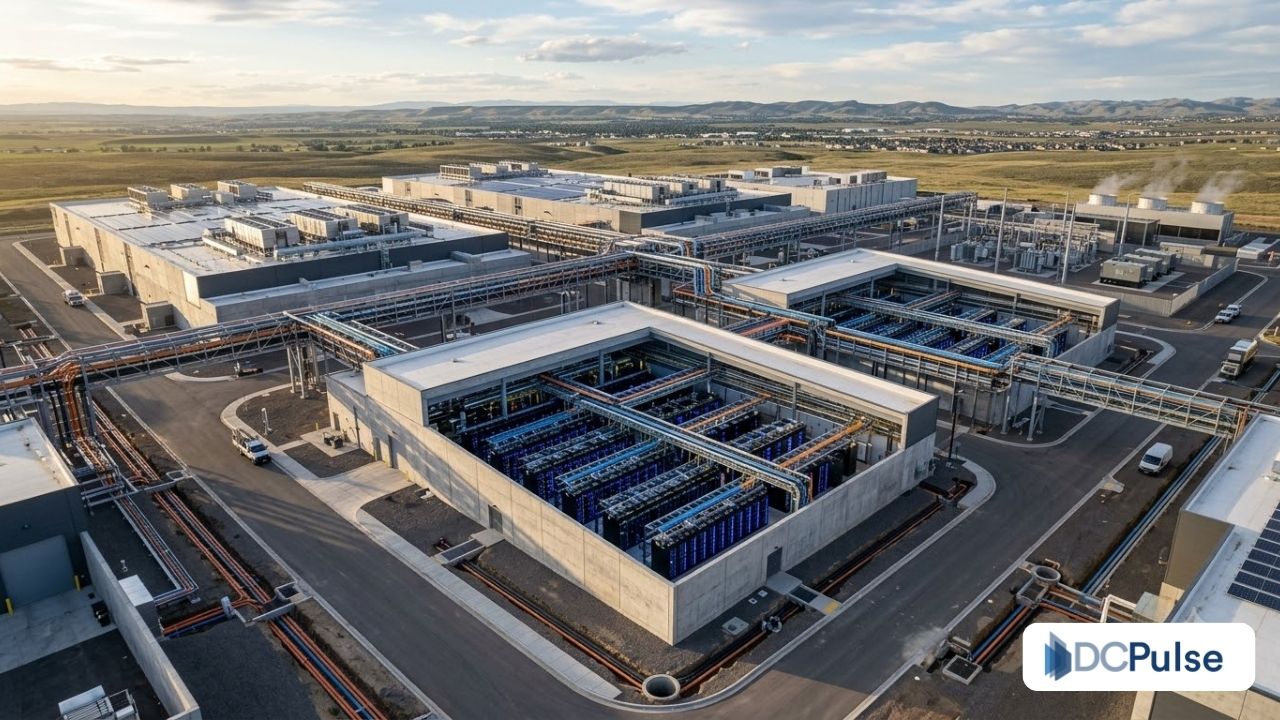
Large data center campuses increasingly involve multiple buildings, data halls, utility areas, and network facilities. Fiber connectivity can link these components into a single operational environment.
Inter-building connectivity introduces additional planning considerations. Diverse routes, physical separation, pathway availability, and protection against infrastructure failures can all influence network resilience.
A modular approach can help establish repeatable connectivity patterns across campus developments. New buildings can potentially follow established architectures rather than requiring entirely different connectivity designs.
Such standardization can also support operational consistency. Network teams working across several facilities can benefit when fiber infrastructure follows common naming, labeling, testing, and documentation practices.
Network Resilience Remains a Critical Requirement
Speed of deployment is only one consideration for hyperscale connectivity. Network resilience remains essential because a fiber failure can affect communication between critical systems.
Diverse physical routes can reduce dependence on a single pathway. Redundant connections between network locations can provide additional protection, while careful separation of routes can reduce the risk that one physical incident affects multiple network paths.
Plug-and-play infrastructure should therefore be viewed as a deployment model rather than a substitute for network engineering.
The physical connectivity system still needs to reflect the redundancy and availability requirements of the data center. Modular components can support that architecture when they are incorporated into a broader resilience strategy.
The Operational Benefits Extend Beyond Construction
Fiber deployment decisions can influence data center operations long after construction is complete. Network teams need to identify connections, troubleshoot faults, perform maintenance, and introduce new equipment throughout the facility's operating life.
Standardized connectivity can make those tasks more structured. Consistent components and documentation can help teams understand how different parts of the fiber infrastructure are connected.
Maintenance requirements also become more important as facilities operate at a larger scale. An architecture that allows technicians to access, replace, or expand connectivity components without extensive disruption can provide operational flexibility.
The benefit is therefore not limited to construction speed. A well-designed modular fiber system can become part of the facility's long-term operating model.
Fiber Infrastructure Must Adapt to AI's Changing Architecture
AI infrastructure is not static. Computing platforms, accelerator configurations, networking architectures, and workload requirements can change as technology develops.
That uncertainty creates a planning challenge for hyperscale operators. Infrastructure needs to support today's requirements while leaving room for future configurations.
Fiber systems designed with modularity and expansion in mind can provide greater adaptability. Additional connections, new network equipment, and changes to data hall configurations can be incorporated into an architecture that anticipates modification.
The objective is not to predict precisely what future AI infrastructure will look like. Instead, the network can be designed to accommodate multiple potential configurations without requiring fundamental changes to the underlying facility.
Plug-and-Play Fiber Becomes Part of the AI Infrastructure Strategy
The increasing importance of AI networking places fiber infrastructure closer to the center of hyperscale data center planning. Computing capacity, power availability, cooling architecture, and network connectivity increasingly need to be considered together.
For operators, plug-and-play fiber represents one potential approach to making that connectivity layer more modular and repeatable. Pre-engineered components, standardized deployment methods, scalable pathways, and structured documentation can support the demands of large and evolving facilities.
The broader implication is that fiber is no longer simply a cabling requirement added during data center construction. In AI-focused hyperscale environments, connectivity is becoming an infrastructure layer that needs to be designed for scale, resilience, operational efficiency, and future change.
As hyperscale campuses continue to evolve, the ability to deploy and adapt network infrastructure alongside computing capacity will remain an important consideration in how digital infrastructure is designed and operated.