Pranav Hotkar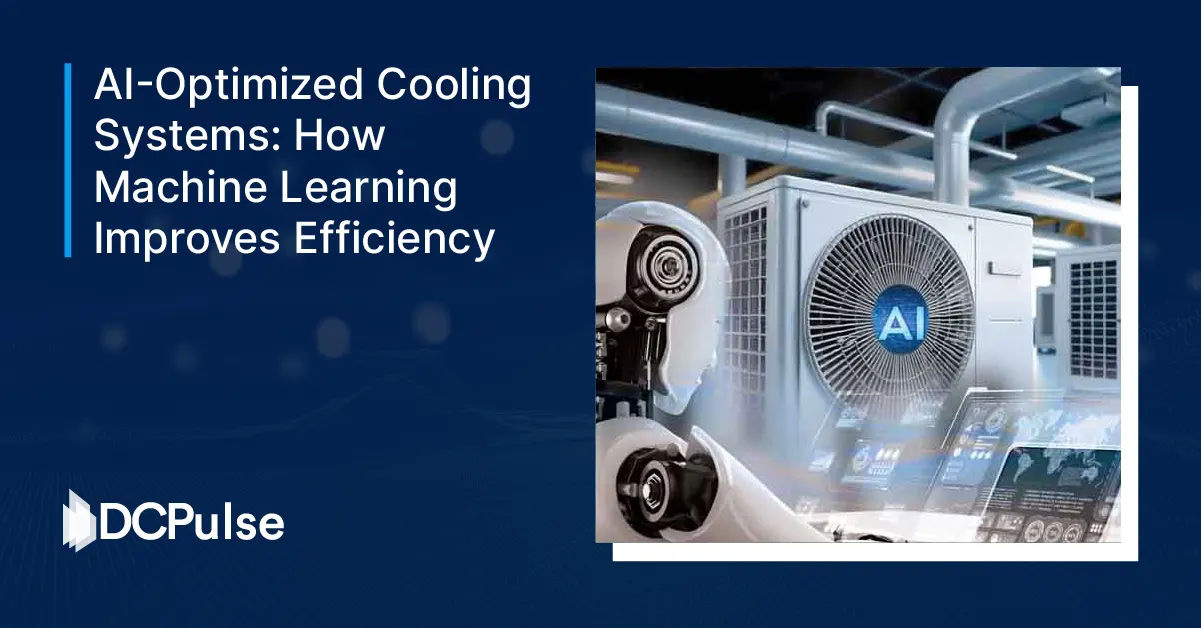
Cooling is no longer a background function in data centers; it is becoming a critical constraint on performance and efficiency.
As AI workloads scale, heat generation is rising sharply. High-density GPU clusters produce significantly more heat than traditional compute environments, pushing cooling systems beyond their original design limits. In many facilities, cooling already accounts for a substantial share of total energy use, and inefficiencies in thermal management directly translate into higher operational costs and reduced system reliability.
The problem is not just capacity; it is adaptability. Most cooling systems still operate on static rules and predefined thresholds, reacting to temperature changes rather than anticipating them. This creates inefficiencies, especially in environments where workloads and heat output can fluctuate rapidly.
As a result, operators are facing a new challenge: how to maintain optimal temperatures without overcooling or wasting energy.
This is where machine learning is beginning to play a role.
Instead of reacting to heat, AI-driven systems can predict, optimize, and dynamically adjust cooling in real time, transforming thermal management from a fixed process into an intelligent, adaptive system.
Are Traditional Cooling Systems Failing Under AI Workloads?
Traditional cooling systems were designed for predictable, lower-density workloads, not the extreme thermal demands created by AI infrastructure.
This gap is becoming increasingly visible. Cooling alone can account for 30-40% of total data center energy consumption, making it one of the largest operational cost drivers.
Data Center Energy Consumption Breakdown (2025-2026 Estimates)
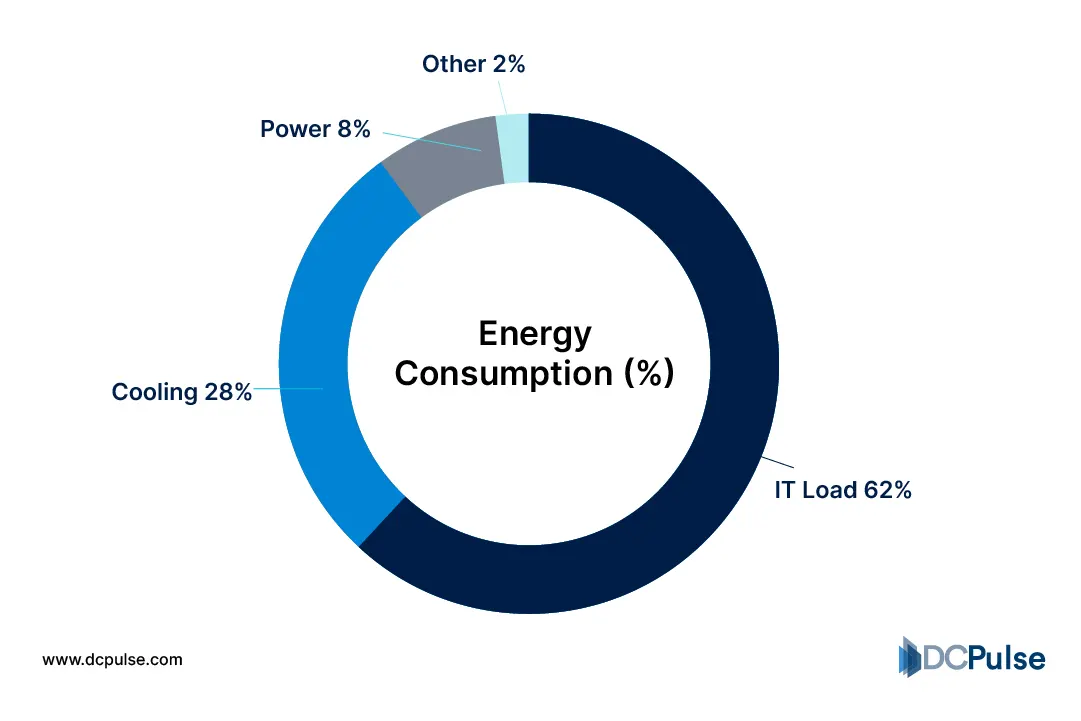
The challenge intensifies with AI workloads. High-density GPU clusters generate significantly more heat per rack, pushing conventional air-cooling systems toward their limits. In many facilities, cooling systems must operate at higher capacity, increasing energy usage and reducing efficiency.
Rack Density and Thermal Load Growth (2020-2027)
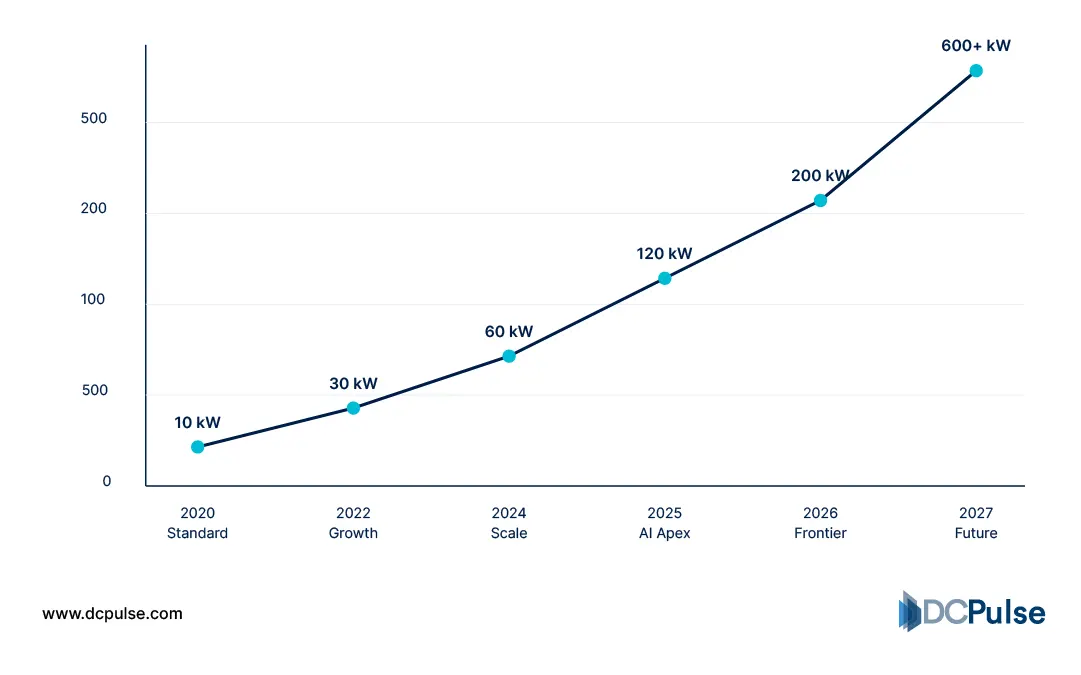
Another structural issue is static cooling logic. Traditional systems rely on fixed thresholds and manual tuning, which cannot adapt to real-time workload fluctuations. This often leads to overcooling, wasting energy, or undercooling, risking system performance.
Cooling inefficiency is widely recognized as a major issue, with studies showing it can account for over 40% of operational energy use in some facilities.
Data Center Cooling Inefficiency vs. Energy Waste (1MW IT Load)
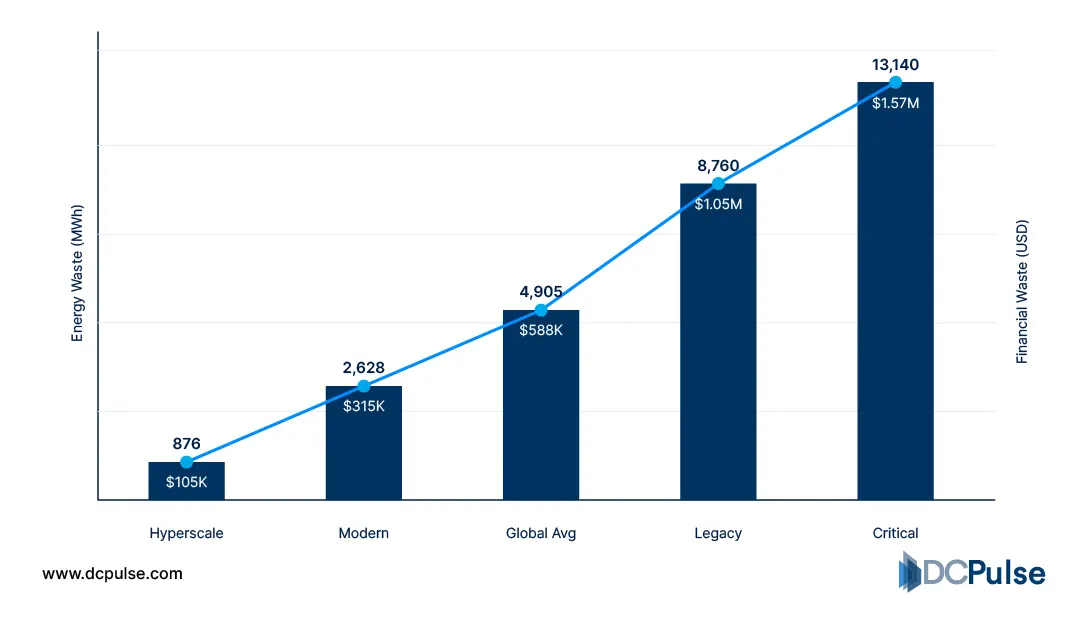
The result is a clear structural mismatch.
Cooling systems designed for stability are struggling in environments that now demand dynamic, high-density, and rapidly fluctuating thermal management.
How Is AI Transforming Data Center Cooling Systems?
AI is shifting cooling from a reactive system to a predictive and adaptive process, fundamentally changing how thermal management operates inside data centers.
At the core of this transformation is machine learning. Instead of relying on fixed thresholds, AI models analyze real-time data, temperature, workload distribution, and equipment performance to predict heat patterns and optimize cooling dynamically. A well-documented case from Google shows that applying DeepMind’s AI reduced cooling energy usage by up to 40% in its data centers.
This improvement comes from predictive control. AI systems forecast future thermal conditions and adjust cooling parameters in advance, rather than reacting after temperatures rise. These models process thousands of variables, including weather, workload intensity, and system behavior, to continuously optimize performance.
AI is also enabling real-time autonomous control. Instead of manual tuning, machine learning systems can continuously adjust fans, pumps, and cooling infrastructure to maintain optimal efficiency across dynamic environments.
The shift is fundamental.
Cooling is no longer a static infrastructure layer; it is becoming an intelligent, self-optimizing system that adapts in real time to changing workloads.
Who Is Deploying AI-Optimized Cooling, and What Are the Results?
AI-driven cooling is no longer experimental; it is being actively deployed by hyperscalers and infrastructure operators, delivering measurable efficiency gains.
One of the most prominent examples is Google, which has operationalized AI-based cooling across its data centers. By integrating machine learning into control systems, Google achieved up to 40% reduction in cooling energy usage and improved overall energy efficiency.
Cooling Energy Reduction (Google AI Case Study)
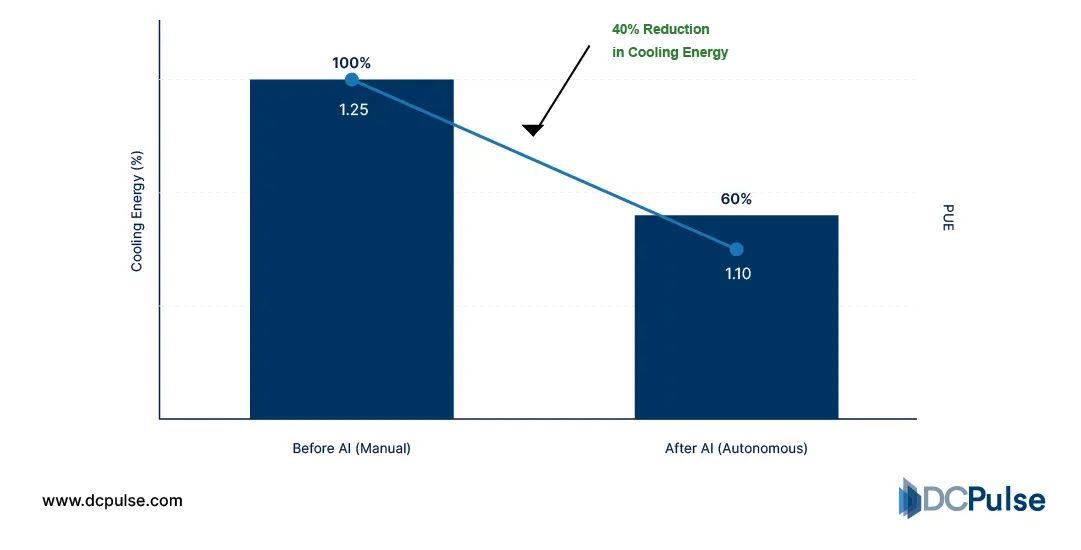
Beyond individual cases, the broader impact is visible in efficiency metrics. AI-driven optimization contributes to lower Power Usage Effectiveness (PUE), a key benchmark for data center efficiency. Leading operators are now achieving PUE values close to 1.1 or lower, compared to higher averages in traditional facilities.
PUE Improvement Trend with AI Optimization
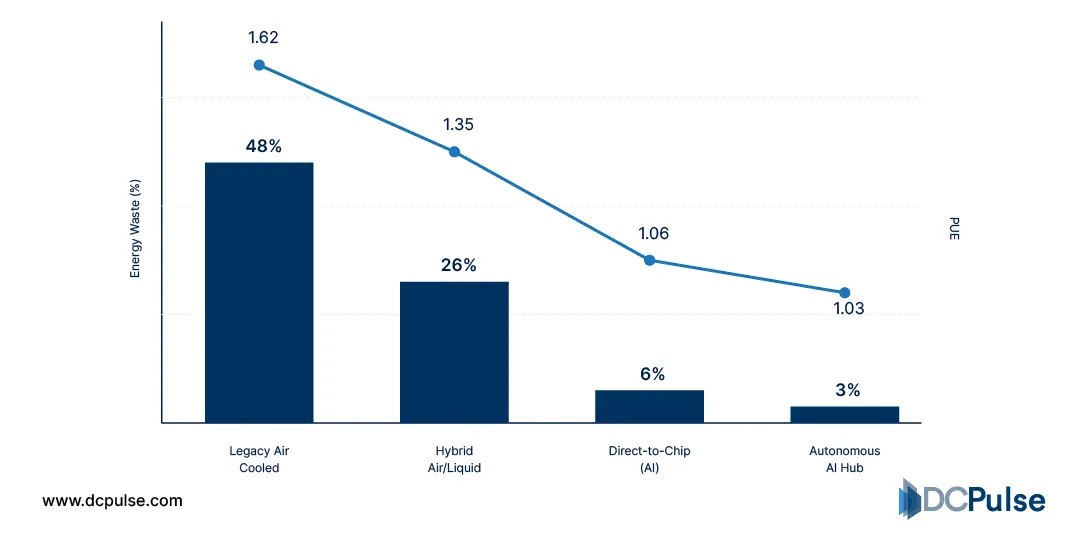
Adoption is also expanding beyond hyperscalers. Data center operators and colocation providers are beginning to integrate AI-based thermal management tools to handle increasing workload variability and density.
Adoption of AI in Data Center Operations (2021–2026)
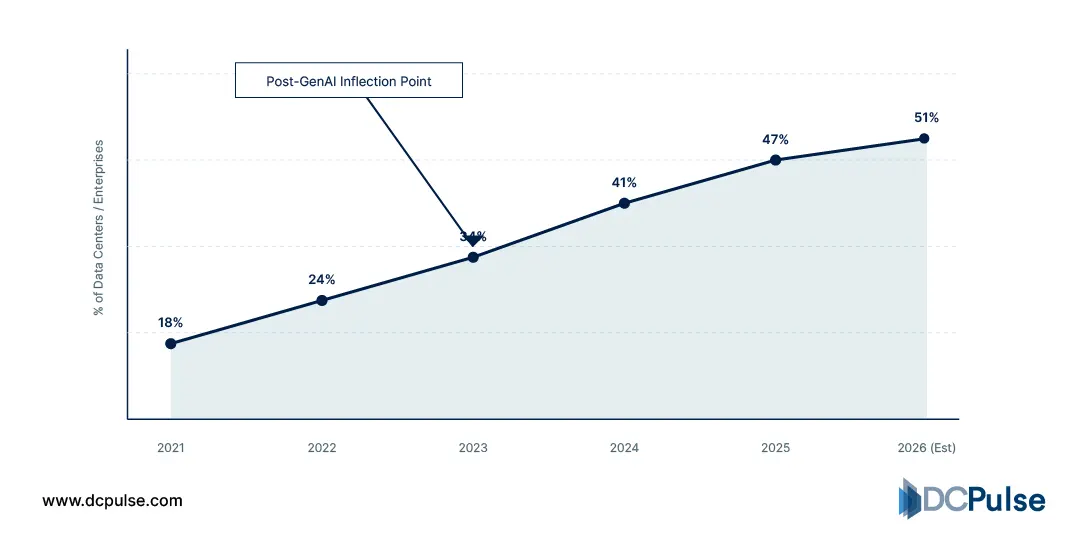
The driver is clear: efficiency at scale. As energy costs rise and sustainability targets tighten, even marginal improvements in cooling efficiency translate into significant cost savings.
The shift is already underway.
AI is moving from a competitive advantage to a standard operational layer in high-performance data center cooling.
Will AI Become the Standard for Data Center Cooling Management?
AI-optimized cooling is rapidly moving from an efficiency tool to a core operational requirement in modern data centers.
As workloads become more dynamic and heat densities continue to rise, static cooling approaches are proving insufficient. AI systems offer the ability to continuously adapt, optimize energy use, and maintain performance under fluctuating conditions, capabilities that are becoming essential rather than optional.
However, adoption is not without challenges. Implementing AI-driven cooling requires high-quality data, integration with existing infrastructure, and trust in automated decision-making. For many operators, especially those with legacy systems, this transition can be complex and resource-intensive.
What is emerging is not a complete replacement but a progressive shift toward automation. Operators are increasingly layering AI on top of existing cooling systems, gradually moving toward fully autonomous thermal management.
The direction is clear.
AI is not just improving cooling efficiency; it is redefining how data centers manage thermal performance, pushing the industry toward intelligent, self-optimizing infrastructure