Pranav Hotkar
Data centers are built for speed, but that speed comes at a cost few talk about: waste.
Behind every AI breakthrough and cloud expansion is a constant cycle of hardware upgrades. Servers, storage systems, and networking equipment are routinely replaced every few years to keep up with performance demands. While this keeps infrastructure competitive, it also creates a growing stream of electronic waste, much of it still functional but no longer considered efficient enough for modern workloads.
This is where the idea of a circular economy is gaining traction.
Instead of the traditional “use and discard” model, circular strategies aim to extend the life of hardware through reuse, refurbishment, and recycling. The goal is simple: extract more value from existing resources while reducing environmental impact.
But applying this model to data centers is not straightforward.
Performance requirements, reliability concerns, and rapid innovation cycles make reuse more complex than in other industries. As sustainability targets become increasingly stringent, the question is no longer whether e-waste is a problem.
The question is whether data centers can realistically transition from linear consumption to circular systems without compromising performance.
The Growing E-Waste Problem in Data Centers
The e-waste challenge in data centers is part of a much larger global trend: electronics are being replaced faster than they can be reused or recycled.
According to the World Health Organization, the world generated around 62 million tonnes of e-waste in 2022, making it one of the fastest-growing waste streams globally.
Global E-waste Generation Trajectory (2021-2026)
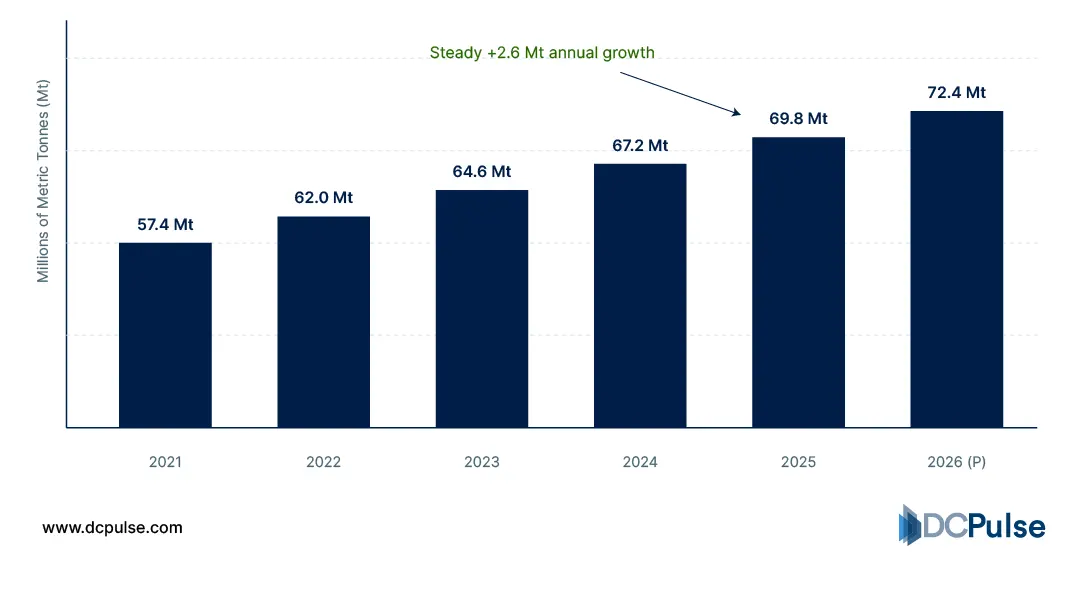
This volume is expected to keep rising. Data from the UN’s Global E-waste Monitor shows that e-waste could reach 82 million tonnes by 2030, growing much faster than recycling capacity.
For data centers, this trend is amplified by short hardware refresh cycles. Servers and networking equipment are often replaced every few years to meet performance and efficiency demands, especially with AI workloads accelerating obsolescence.
What makes this more critical is that recycling is not keeping pace. Only about 22% of global e-waste is formally collected and recycled, meaning the majority is either lost, improperly processed, or ends up in landfills.
At the same time, discarded electronics contain valuable materials like copper, gold, and rare earth elements, resources that are increasingly critical for digital and energy infrastructure.
The current landscape reflects a clear imbalance: rapid hardware turnover vs slow, inefficient recovery systems.
As data center capacity continues to scale, this gap is becoming a structural sustainability challenge, not just an operational one.
From Disposal to Reuse: Building a Circular Hardware Ecosystem
As e-waste continues to grow, the data center industry is beginning to shift from disposal toward recovering value from existing infrastructure.
One of the clearest developments is the rise of large-scale reuse programmes. Major operators are no longer treating decommissioned hardware as waste but as reusable assets. For example, Microsoft has built dedicated circular centers that refurbish and redeploy servers and components. The company reported achieving a 90.9% reuse and recycling rate for its data center hardware, demonstrating that circular models can work at scale.
Beyond full-system reuse, component-level recovery is becoming more common. Processors, memory, and storage devices are increasingly extracted and reused, reducing both waste and the need for new raw materials.
Recycling is also evolving into a material recovery strategy. Instead of basic disposal, modern approaches focus on extracting valuable resources such as rare earth elements from decommissioned drives and components. In Microsoft’s case, tens of thousands of pounds of hard drives have been processed to recover critical materials.
At the same time, the broader industry is adopting circular design principles, including reusable packaging and modular systems that reduce waste across the supply chain.
These developments mark a clear transition: data center hardware is no longer viewed as disposable infrastructure but as part of a continuous lifecycle where reuse, recovery, and redesign are becoming standard practice. Who’s Leading Circular Data Center Strategies?
Circularity in data centers is no longer theoretical; major players are actively building operational systems to reuse and recover hardware at scale.
Microsoft is leading this shift with its global network of Circular Centers. These facilities process decommissioned servers, extracting usable components for internal reuse, resale, or recycling. The company reported achieving a 90.9% reuse and recycling rate for servers and components in 2024, exceeding its own sustainability targets ahead of schedule.
Hyperscaler Circular Economy (2026 Adoption Rates)
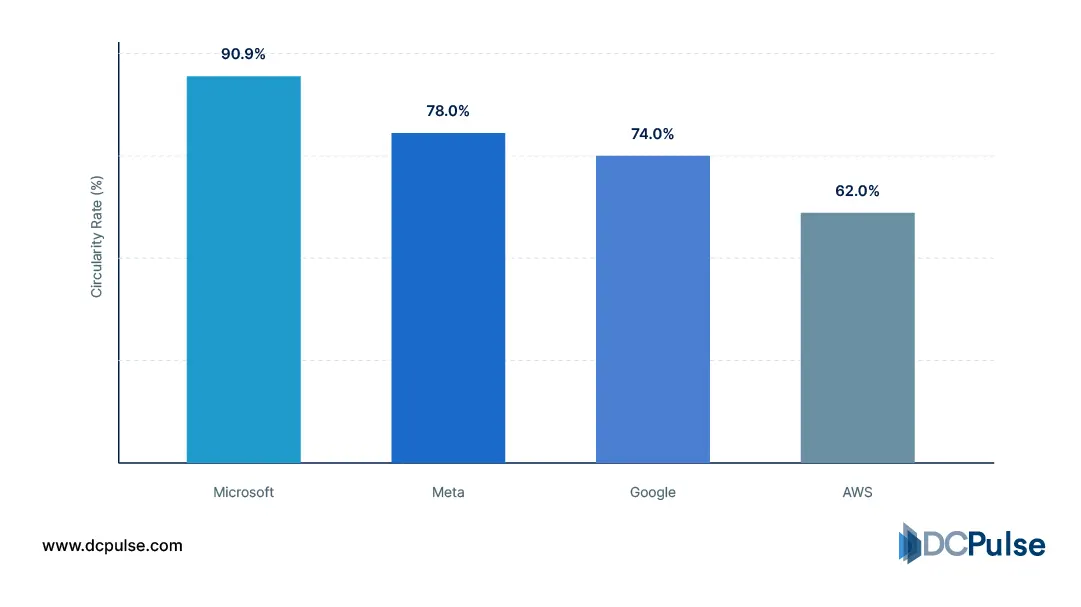
These centers are not small pilots; they operate at scale. A single facility can process thousands of servers monthly, while globally, millions of components are being kept in circulation rather than discarded.
Beyond reuse, the focus is shifting toward material recovery. Microsoft and its partners are extracting rare earth elements and precious metals from retired hardware, feeding them back into the supply chain and reducing dependence on new mining.
Estimated Material Recovery Value per Metric Tonne (2026)
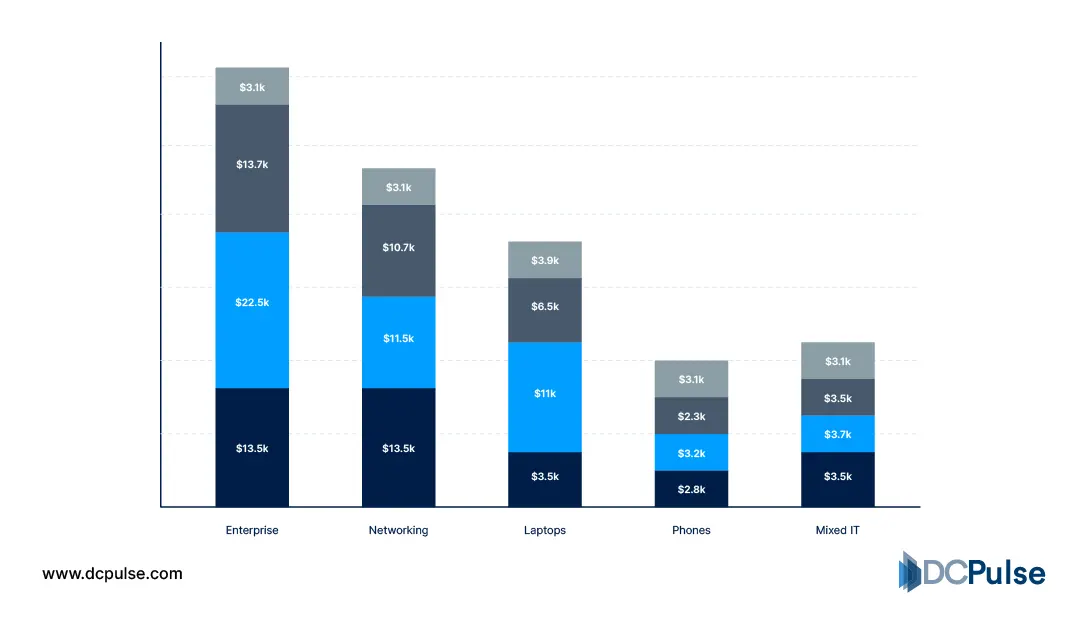
Other hyperscalers, including Google, are also incorporating refurbishment and internal reuse into their operations, signaling a broader industry move toward circular models.
At the same time, new facilities are being built specifically for circular processing. For instance, Microsoft is expanding its infrastructure with dedicated recycling centers attached to data center campuses, designed to handle hardware at end-of-life and redirect it into reuse pathways.
The trend is clear: circularity is moving from sustainability messaging to core infrastructure strategy, with hyperscalers leading and the rest of the industry beginning to follow.
Can Data Centers Become Truly Circular?
A fully circular data center model is achievable, but not completely and not everywhere.
The industry is clearly moving in the right direction. Large operators are proving that high rates of reuse and recycling are possible, and the economic case for extending hardware lifecycles is becoming stronger. Refurbishment, secondary markets, and material recovery are no longer niche practices; they are evolving into standard operational strategies.
However, full circularity faces structural limits.
Performance requirements will continue to drive frequent hardware upgrades, especially with AI workloads accelerating innovation cycles. Not all components can be reused without compromising efficiency, and some materials remain difficult or costly to recover at scale. In addition, global recycling infrastructure is uneven, creating gaps in how effectively hardware can be processed across regions.
The most realistic outcome is partial circularity.
Leading data center operators will achieve high reuse and recovery rates within controlled environments, while the broader industry adopts these practices more gradually. Circularity will become a competitive advantage rather than a universal standard.
Data centers may never be fully circular, but they can become significantly more efficient, reducing waste while maintaining the performance needed to support digital growth.