Pranav Hotkar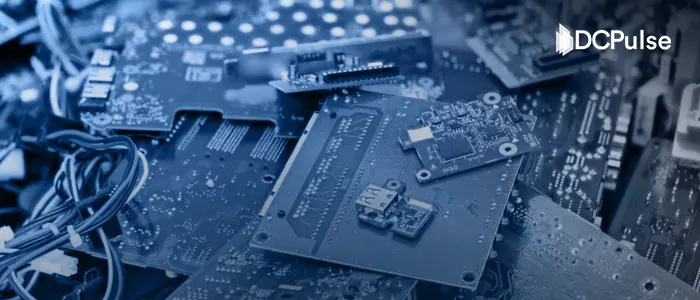
Every year, millions of tons of hardware, from servers and storage systems to consumer devices, reach the end of their lifecycle, often long before their true value is exhausted. What follows is rarely efficient. A significant portion of this discarded equipment enters the global e-waste stream, where only a fraction is properly recycled, and even less is recovered for high-value materials.
According to the United Nations–backed Global E-waste Monitor, global e-waste continues to grow at an alarming pace, driven by rapid technology refresh cycles and increasing digital demand. Yet, much of this hardware still contains recoverable components, precious metals, reusable modules, and functional subsystems that are often lost due to inefficient recycling practices.
For data centers and hardware manufacturers, this is no longer just an environmental issue. It represents a missed economic opportunity and a growing operational challenge. As sustainability pressures mount and supply chains tighten, the industry is beginning to rethink hardware not as disposable infrastructure but as part of a circular lifecycle where reuse, recovery, and regeneration become essential.
The Reality of Hardware Recycling Today
Despite growing awareness, global hardware recycling remains highly inefficient and fragmented, with most discarded equipment still following a linear “use-and-dispose” lifecycle. According to the Global E-waste Moniter, the world generated over 60 million metric tons of e-waste, yet less than a quarter is formally collected and recycled through regulated channels. This gap highlights a systemic issue: while hardware production is highly optimized, end-of-life management is not.
At the infrastructure level, data centers and enterprises are among the largest contributors to hardware turnover. Rapid upgrade cycles, driven by performance demands, energy efficiency goals, and evolving workloads, mean servers, storage systems, and networking equipment are often retired within a few years. However, much of this hardware still retains recoverable value, including rare earth metals like cobalt, lithium, and gold, as well as reusable components such as memory modules and power supplies.
Global E-Waste Generation vs. Formal Recycling (2010-2030)
.webp)
Regulatory frameworks are beginning to address this imbalance. The European Union, through directives like the Waste Electrical and Electronic Equipment (WEEE) regulation, has introduced stricter collection and recycling targets. Meanwhile, countries in Asia and North America are gradually tightening compliance requirements, pushing manufacturers and operators to adopt more responsible disposal practices.
Still, major challenges persist. Informal recycling sectors dominate in several regions, leading to environmental hazards and material loss, while the lack of standardized processes limits large-scale recovery of high-value components.
As a result, the current landscape reflects a critical imbalance: the volume of discarded hardware is accelerating faster than the industry’s ability to sustainably recover and reuse it.
What Innovations Are Transforming Hardware Recycling into a Circular System?
Hardware recycling is shifting from basic disposal to high-value material recovery, driven by innovations that directly target the extraction of critical resources embedded in modern systems. One of the most impactful developments is rare earth recovery from data center hardware, particularly hard disk drives. A collaboration between Microsoft and Western Digital has demonstrated the ability to recover rare earth elements such as neodymium and dysprosium from decommissioned drives using an acid-free dissolution process, achieving recovery rates of up to 90% while significantly reducing environmental impact.
Beyond industrial pilots, research is advancing the science of material recovery itself. Studies show that e-waste is a viable secondary source of rare earth elements, with structured recycling processes involving collection, dismantling, and advanced separation techniques to recover both precious and critical materials. However, scaling these processes remains a challenge due to the complexity of electronic components and the lack of standardized recovery methods.
At the operational level, hyperscalers are redefining recycling through circular infrastructure models. Microsoft’s “Circular Centers,” for example, enable large-scale reuse and recovery of server components, achieving over 90% reuse and recycling rates and recovering millions of components annually. These facilities prioritize component-level reuse before material recycling, maximizing economic value while minimizing waste.
Economic Value Retention by Data Center Disposition Type (2026)
.webp)
Together, these innovations signal a clear shift: hardware recycling is no longer an end-of-life process but a strategic supply chain function, where recovering critical materials and extending component lifecycles are becoming essential to both sustainability and infrastructure resilience.
How Companies Are Operationalizing Hardware Recycling
The shift toward sustainable hardware recycling is being actively driven by major technology companies, which are embedding circular practices directly into their operations. Apple, for instance, has developed advanced disassembly robots like Daisy, capable of recovering valuable materials from iPhones at scale. The company reports increasing use of recycled materials across its product lines, including rare earth elements in magnets and recycled aluminum in enclosures.
Recycled Material Usage by Major OEMs (2025/2026 Reporting)
.webp)
In parallel, Microsoft is advancing circularity through its Circular Centers, which focus on reusing servers and components before recycling materials. These facilities are designed to extend hardware lifecycles and recover high-value components at scale, supporting Microsoft’s broader goal of achieving zero waste across its operations.
Google is also integrating sustainability into its hardware lifecycle, with a strong emphasis on server reuse and refurbishment across its data centers. The company reports that a large share of its decommissioned hardware is either reused internally or recycled through certified partners, forming a key part of its circular economy strategy.
Map - Global Data Center Recycling & Refurbishment Hubs (2026)
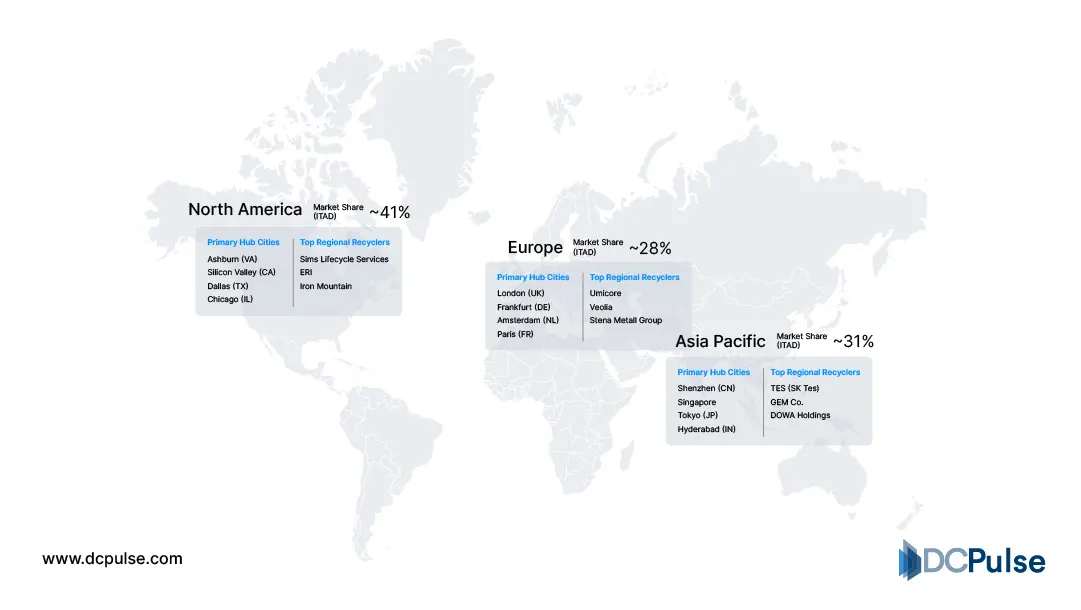
Beyond individual initiatives, the industry is seeing the emergence of closed-loop supply chains, where recovered materials are reintegrated into manufacturing processes. These efforts are often supported by partnerships between OEMs, recyclers, and material processors, enabling more efficient recovery of critical resources like cobalt, lithium, and rare earth elements.
Together, these industry moves demonstrate that hardware recycling is no longer a peripheral activity. It is becoming a core operational strategy, where sustainability, cost efficiency, and supply chain resilience intersect.
Will Hardware Recycling Become a Core Pillar of Future Infrastructure?
Hardware recycling is rapidly moving from a sustainability initiative to a strategic necessity within digital infrastructure. As demand for compute continues to rise, the pressure on raw material supply chains, particularly for rare earth elements and critical metals, is intensifying. In this context, recycling is no longer just about waste reduction; it is becoming essential for resource security and cost stability.
The transition toward circular hardware systems will depend on how effectively companies integrate recyclable-by-design principles, scalable recovery processes, and component-level reuse into their operations. Organizations like Microsoft and Google are already demonstrating that extending hardware lifecycles can deliver both environmental and economic benefits, reducing dependency on new manufacturing while maintaining performance standards.
However, challenges remain. Standardization across hardware design, global recycling infrastructure gaps, and the economics of large-scale material recovery will shape the pace of adoption.
Despite these barriers, the trajectory is clear. Hardware recycling is evolving into a core infrastructure capability, where the ability to recover, reuse, and reintegrate materials will define long-term competitiveness in the digital economy.