Pranav Hotkar
Power, not compute, is emerging as the defining constraint for the next generation of data centers.
As AI workloads scale, energy demand is rising at a pace that traditional infrastructure struggles to match. Training large models and running continuous inference requires not just massive compute clusters but also a stable, high-density power supply. In many regions, data center expansion is already being delayed, not due to lack of capital or technology, but because the grid cannot deliver power fast enough.
This shift is forcing operators to rethink a long-standing assumption: that energy will always be available on demand. Instead, power availability is becoming a strategic variable, shaping where and how data centers can be built.
Against this backdrop, Small Modular Reactors (SMRs) are gaining attention. Designed to provide reliable, scalable nuclear energy with a smaller footprint, SMRs promise consistent, carbon-free power that could operate independently of grid constraints.
The question is no longer just how to scale compute.
It is whether power itself needs to be re-engineered alongside it.
Is Power the Biggest Constraint for Data Center Growth Today?
Power availability is rapidly becoming the primary bottleneck for data center expansion, surpassing even land and hardware constraints.
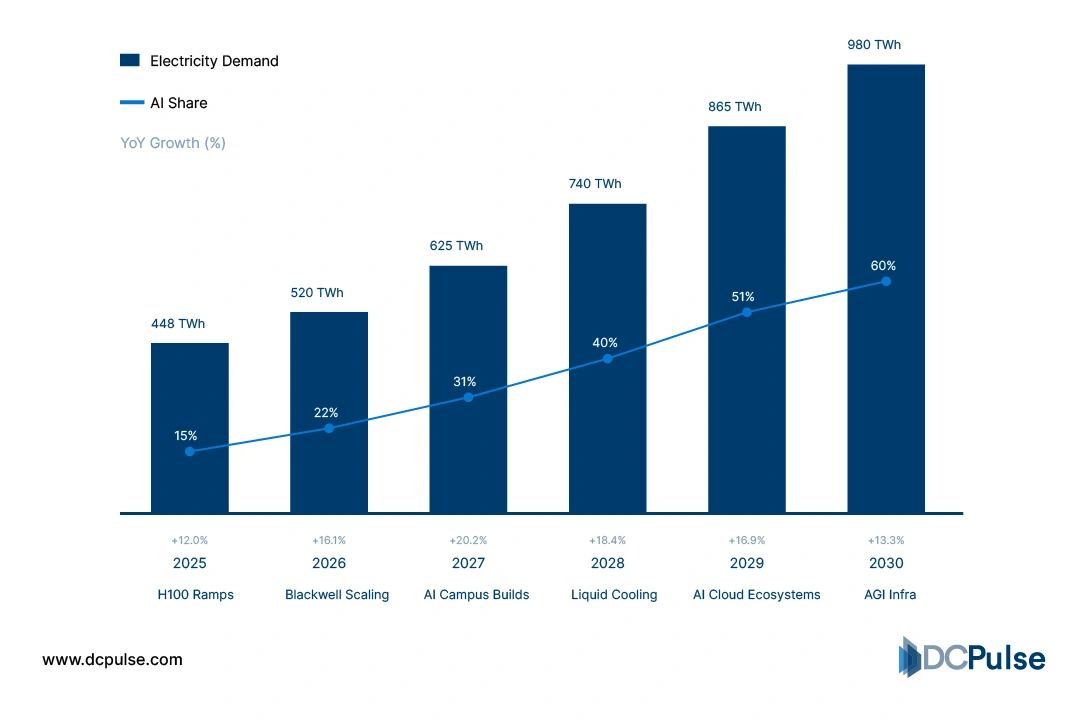
The scale of demand is accelerating sharply. According to Gartner, global data center electricity consumption is projected to grow from 448 TWh in 2025 to 980 TWh by 2030, effectively more than doubling within five years due to AI-driven workloads.
Global Data Center Electricity Demand Forecast (2025–2030)
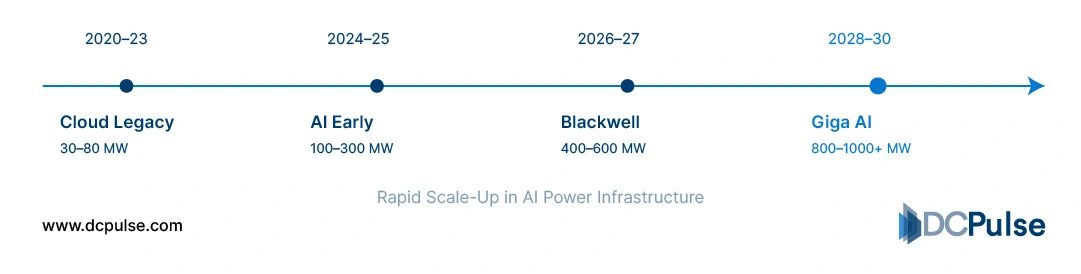
At the same time, infrastructure is becoming significantly more power-intensive. Statista reports that hyperscale data centers now require 100+ MW per facility, with overall consumption expected to more than double in the near term due to AI adoption.
Hyperscale Data Center Power Requirements (MW per Facility)
This surge is colliding with real-world constraints. The U.S. Department of Energy notes that electricity demand is rising again after years of stagnation, driven by AI, data centers, and electrification putting increasing pressure on grid capacity and infrastructure planning.
The challenge is not just scale, but timing. Data centers require continuous, high-density, always-on power, which existing grids struggle to deliver quickly and reliably.
The result is a structural shift:
Power is no longer a background utility; it is becoming a critical constraint shaping where and how data centers can scale.
How Can Small Modular Reactors Change Data Center Power Infrastructure?
Small Modular Reactors (SMRs) introduce a fundamentally different approach to powering data centers, shifting from grid dependency to localized, high-reliability energy generation.
Unlike traditional nuclear plants, SMRs are designed to be factory-built, modular, and scalable, allowing deployment closer to demand centers. According to the International Atomic Energy Agency, SMRs typically generate up to 300 MW per unit, with the ability to scale capacity incrementally based on demand.
SMRs vs. Traditional Nuclear Power Plants (2025–2026)
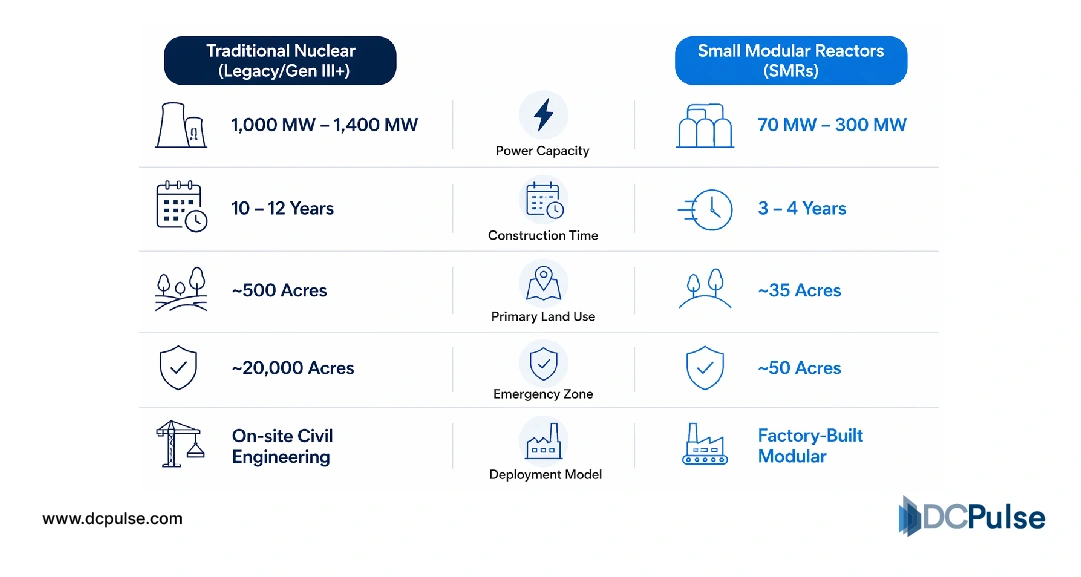
This modularity aligns well with data center growth patterns. Instead of waiting years for grid upgrades or large-scale plants, operators could deploy SMRs in phases, matching power capacity with compute expansion.
Reliability is another key advantage. Unlike renewable sources such as solar or wind, SMRs provide continuous, baseload power, making them well-suited for AI workloads that require an uninterrupted energy supply.
Safety and deployment models are also evolving. Modern SMR designs incorporate passive safety systems and reduced physical footprints, making them more adaptable to industrial use cases. The World Nuclear Association notes that SMRs are being developed specifically for applications requiring reliable, on-site power, including data centers and industrial facilities.
The shift is strategic.
SMRs could move data centers from power consumers to power-secured infrastructure, reducing reliance on constrained grids.
Who Is Investing in SMRs for Data Centers, and Why?
Investment in nuclear-powered infrastructure for data centers is no longer theoretical; it is being driven by large-scale, real-world deals from hyperscalers.
One of the most concrete examples is the agreement between Microsoft and Constellation Energy to restart the Three Mile Island Unit 1 reactor. The deal involves a 20-year power purchase agreement to supply electricity for AI data centers, with the plant expected to deliver around 835 MW of capacity once operational.
Nuclear Power Revival for Data Centers (2019–2030)
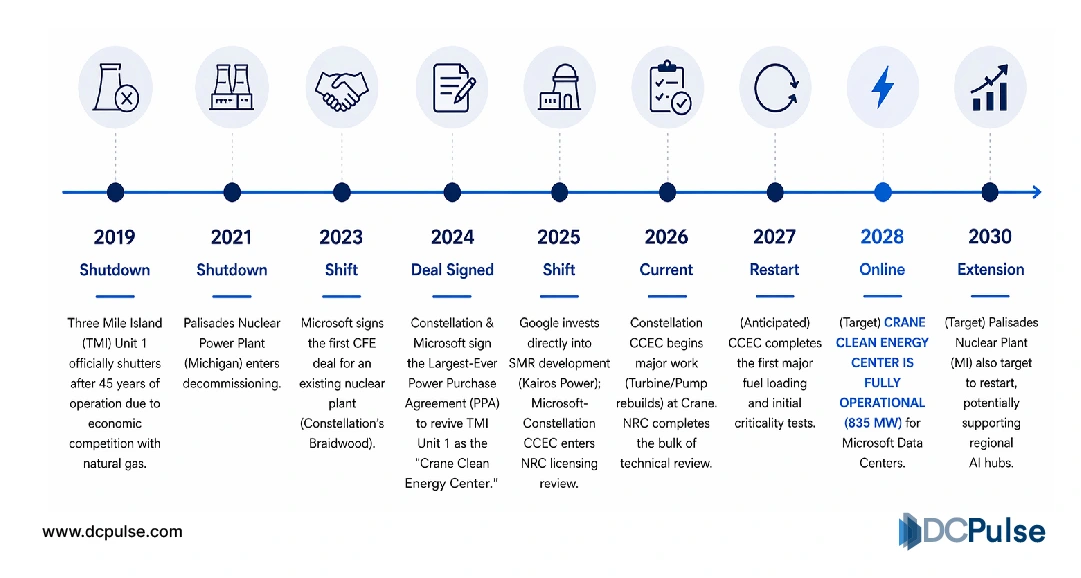
This is not an isolated move. Across the industry, hyperscalers are rapidly securing nuclear energy to support AI infrastructure. Multiple companies, including Microsoft, Google, Amazon, and Meta, have collectively committed nearly 10 GW of nuclear capacity for future data center operations, reflecting the scale of anticipated demand.
The rationale is clear: energy security at scale. AI workloads require continuous, high-density power that existing grids struggle to provide reliably. Nuclear, particularly SMRs and advanced reactors, offers 24/7 baseload power, aligning directly with these requirements.
At the same time, these investments signal a structural shift. Tech companies are no longer just buying electricity; they are actively shaping energy infrastructure, entering long-term agreements and backing new generation capacity.
The transition is already underway.
Nuclear energy, including SMRs, is moving from a future concept to a strategic pillar of data center power planning.
Are SMRs a Real Solution or a Long-Term Bet?
Small modular reactors offer a compelling answer to one of the biggest challenges facing data centers: reliable, scalable power. Their ability to deliver continuous, carbon-free energy aligns directly with the needs of AI-driven infrastructure.
However, their impact will not be immediate. SMRs are still in early stages of deployment, with regulatory approvals, construction timelines, and cost uncertainties slowing widespread adoption. For most operators, they remain a medium- to long-term option rather than a near-term solution.
In the short term, data centers will continue to rely on a mix of grid power, renewables, and transitional solutions to meet growing demand. But as power constraints intensify, the appeal of localized, always-on energy sources will only increase.
What is emerging is not a replacement, but a strategic layer in the energy mix, one that could redefine how large-scale digital infrastructure is powered.
The takeaway is clear.
SMRs are not yet a universal solution, but they represent a fundamental shift toward energy-secured data centers, where power availability is engineered rather than assumed.