DCPulse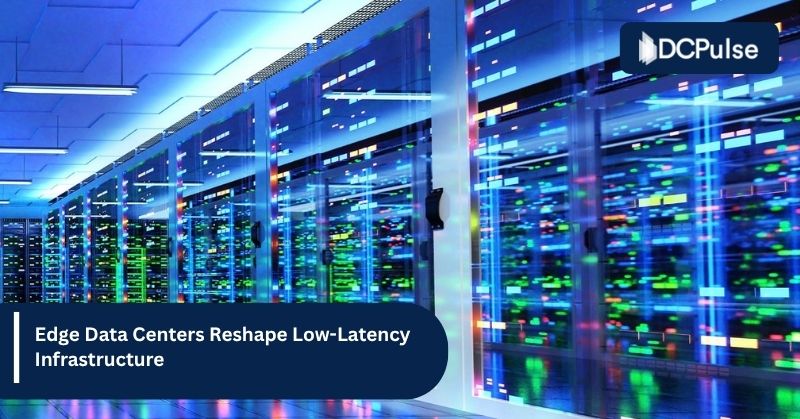
Edge data centers are becoming an increasingly important layer of digital infrastructure as applications move closer to the users, devices, and locations generating data. Instead of relying exclusively on centralized facilities, organizations can distribute computing, storage, and networking resources across locations closer to the network edge.
The shift is particularly relevant for workloads where response time, local processing, connectivity, or data residency can influence infrastructure design. Edge computing brings applications closer to data sources, which can reduce the distance that information needs to travel between users, devices, and computing resources.
Edge Infrastructure Moves Computing Closer to Users
Traditional cloud architectures often concentrate computing resources in large regional or hyperscale data centers. That model remains important for applications requiring substantial centralized computing and storage, but some workloads benefit from processing closer to where data is generated or consumed.
Edge data centers provide a distributed infrastructure layer between centralized cloud facilities and end-user devices. These facilities can support workloads at locations such as network hubs, telecommunications sites, enterprise facilities, industrial environments, and other areas close to data generation.
The European Commission describes edge nodes as computing resources positioned closer to intended users than centralized cloud infrastructure, with low-latency applications representing a key use case.
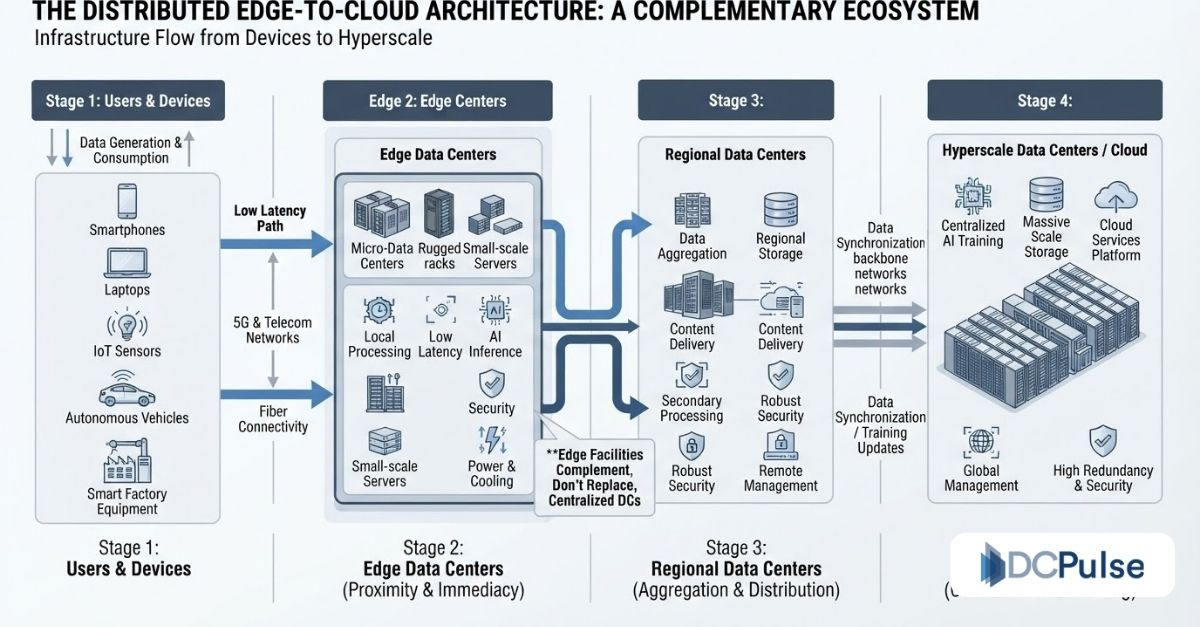
The resulting architecture creates a broader computing continuum in which workloads can be distributed between devices, edge facilities, regional data centers, and large centralized campuses.
Low Latency Becomes an Infrastructure Requirement
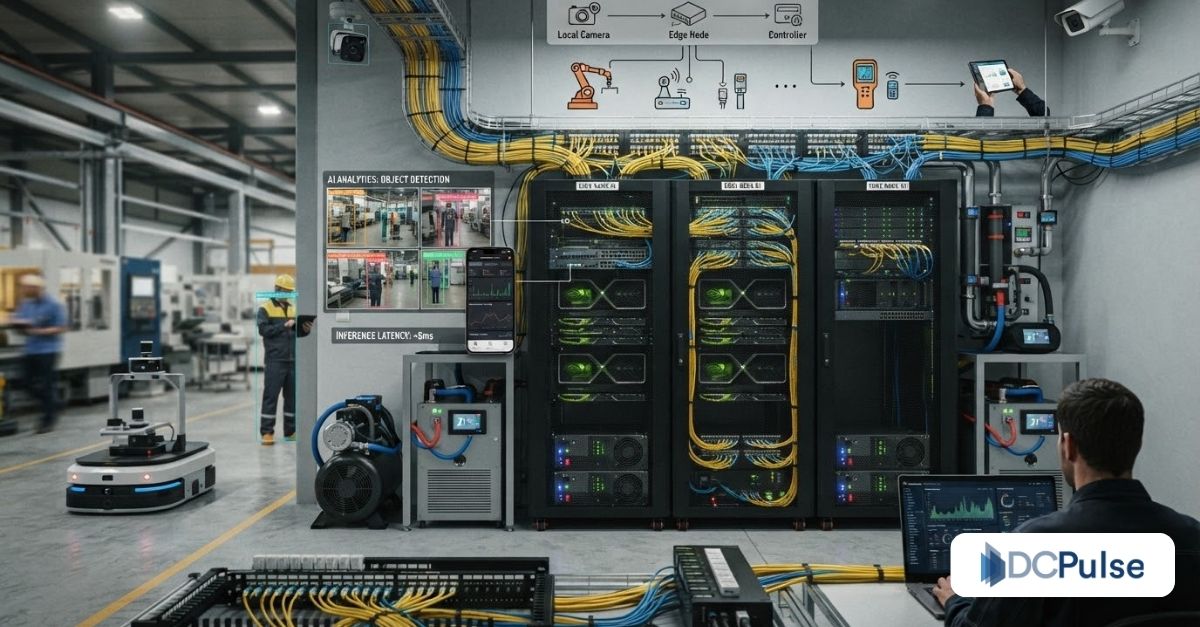
Latency is becoming an important consideration as applications increasingly depend on real-time or near-real-time processing. Industrial automation, computer vision, telecommunications, financial applications, connected devices, and interactive AI services can place different demands on infrastructure than conventional batch workloads.
Google Cloud's distributed infrastructure documentation identifies latency-sensitive workloads as a use case for bringing infrastructure closer to where data is generated. Its distributed cloud architecture supports applications running at data centers and edge locations while maintaining a connection to centralized cloud services where required.
Network distance is one component of application responsiveness. Fewer network hops and shorter physical paths can help reduce communication delays, although the actual performance depends on application architecture, network conditions, processing requirements, and the location of other application components.
That distinction is important because edge deployment does not automatically improve every application. Google Cloud's architecture guidance notes that distributed deployment can help reduce user latency when applications can answer requests locally, while applications requiring frequent round trips to centralized backends may receive less benefit.
AI Inference Is Expanding the Edge Opportunity
Artificial intelligence is adding another dimension to edge infrastructure. Training large AI models generally requires substantial centralized computing resources, but inference can take place in multiple environments depending on the application's requirements.
S&P Global identifies AI inference as an area where edge computing can become more important, particularly for applications that require real-time responses. The company also identifies security and data sovereignty as reasons enterprises may consider processing AI workloads closer to their operations.
The infrastructure implications are significant. Edge facilities may need to support accelerated computing, high-performance networking, storage, and thermal management within smaller physical footprints than conventional hyperscale campuses.
Google's distributed cloud infrastructure similarly supports AI capabilities at data centers and edge locations, allowing organizations to deploy AI-oriented infrastructure closer to where data is generated and consumed.
The resulting architecture does not replace centralized AI infrastructure. Instead, edge facilities can complement large data centers by handling selected inference, preprocessing, filtering, analytics, and other workloads closer to end users or connected devices.
Networking Becomes Central to Edge Data Centers
Connectivity is one of the defining requirements of an edge data center. A facility located close to users or devices provides limited value if it lacks the network infrastructure needed to exchange data efficiently with customers, telecom networks, cloud platforms, and regional facilities.
The relationship between edge facilities and telecommunications infrastructure is therefore becoming increasingly important. Carrier networks, fiber infrastructure, internet exchanges, 5G deployments, and cloud connectivity can influence where edge capacity is deployed.
Google Cloud's distributed infrastructure model illustrates this relationship by combining edge infrastructure with cloud-backed management and connectivity. Its platform is designed for applications such as computer vision and local AI inference while allowing relevant data or insights to move toward regional cloud environments.
This architecture can also change the role of the network. Instead of treating connectivity simply as a path between users and a centralized data center, network infrastructure becomes an integrated component of distributed computing.
Smaller Facilities Create New Power and Cooling Requirements
Edge deployments introduce different physical infrastructure considerations. A centralized hyperscale campus can consolidate power, cooling, security, and operations across a large facility, while distributed edge infrastructure requires many smaller sites to provide comparable geographic coverage.
Power availability therefore becomes a location-specific consideration. Edge facilities may need reliable electrical infrastructure in urban, industrial, telecommunications, or remote environments where space and utility conditions vary considerably.
Cooling requirements also depend on the computing density and equipment deployed at each site. Higher-density AI and accelerated-computing workloads can increase thermal requirements, making efficient cooling important even when an edge facility occupies a relatively small footprint.
Uptime Institute identifies modular and micromodular data centers, close-coupled cooling, distributed resiliency, and microgrid power among technologies associated with edge computing infrastructure.
Distributed Infrastructure Changes Data Center Operations
A larger number of geographically distributed facilities can create operational challenges alongside the benefits of localized computing. Monitoring, physical security, remote management, maintenance, software updates, power systems, cooling systems, and network connectivity must operate consistently across multiple locations.
Centralized management platforms can become important in this environment because operators need visibility across facilities without requiring large on-site teams at every location. Google Distributed Cloud, for example, provides a common management model across data center and edge environments.
Security also becomes a broader infrastructure consideration. More physical locations can create additional environments that require access controls, monitoring, network protection, and operational policies.
The distributed model therefore shifts some complexity from the individual facility to the overall infrastructure architecture.
Edge Data Centers Are Complementing Hyperscale Campuses
The emergence of edge data centers does not signal the end of centralized data center development. Large campuses remain essential for cloud platforms, AI training, enterprise applications, storage, and workloads that benefit from concentrated computing resources.
Edge facilities instead provide another layer within the broader infrastructure ecosystem. Centralized facilities can handle resource-intensive workloads, while edge locations can process selected data closer to users and devices before sending information to regional or hyperscale environments.
Google's global infrastructure architecture similarly combines regions and zones to provide geographic distribution, redundancy, and lower-latency access to users.
The result is a more distributed data center landscape in which infrastructure location becomes increasingly tied to workload characteristics.
The Next Phase of Digital Infrastructure
The development of edge data centers reflects a broader change in how computing infrastructure is being designed. Application requirements are increasingly influencing where computing resources are placed, rather than concentrating every workload in a small number of large facilities.
Low latency, AI inference, data sovereignty, local processing, connectivity, and operational resilience are among the factors shaping this transition. The European Union's Edge Observatory, for example, links edge infrastructure with low-latency services and positions edge nodes within the broader network infrastructure.
For data center operators, the opportunity also comes with a different development model. Instead of building only large centralized campuses, operators can deploy smaller facilities across strategic network locations and connect them to regional and hyperscale infrastructure.
Edge data centers are therefore becoming an important component of the digital infrastructure stack. Their long-term role will depend on workload requirements, network architecture, power availability, cooling design, security, and the economics of operating distributed facilities. As AI and real-time applications continue to influence infrastructure planning, the physical distance between computing resources and the users or devices they serve is becoming an increasingly important part of data center strategy.