Pranav Hotkar
Air cooling has been the backbone of data center thermal management for decades, but its limits are now being tested.
As compute workloads evolve, particularly with the rise of AI and high-performance computing, heat density inside racks is increasing rapidly. Traditional air-based systems, designed for lower and more predictable thermal loads, are struggling to keep up with modern infrastructure demands. In many cases, simply increasing airflow is no longer enough to maintain optimal operating temperatures without significantly increasing energy consumption.
The challenge is not just about cooling capacity; it is about efficiency and scalability. As rack power densities climb beyond traditional thresholds, air cooling systems require more space, more energy, and more complex airflow management, creating diminishing returns.
This raises a critical question for operators:
At what point does air cooling stop being viable?
The answer is driving a growing shift in the industry.
Liquid cooling, once considered a niche solution, is now being evaluated as a necessary alternative for handling next-generation workloads, signaling a potential transition in how data centers manage heat at scale.
When Does Air Cooling Reach Its Limits in Modern Data Centers?
Air cooling does not fail at a single point, but its limits become clear as rack power densities move beyond ~20-25 kW per rack.
Recent industry analysis shows that traditional air-cooling systems can handle up to ~20-25 kW per rack under optimal conditions, beyond which thermal management becomes increasingly inefficient and difficult to scale.
Cooling Efficiency vs. Rack Density (2026 Benchmarks)
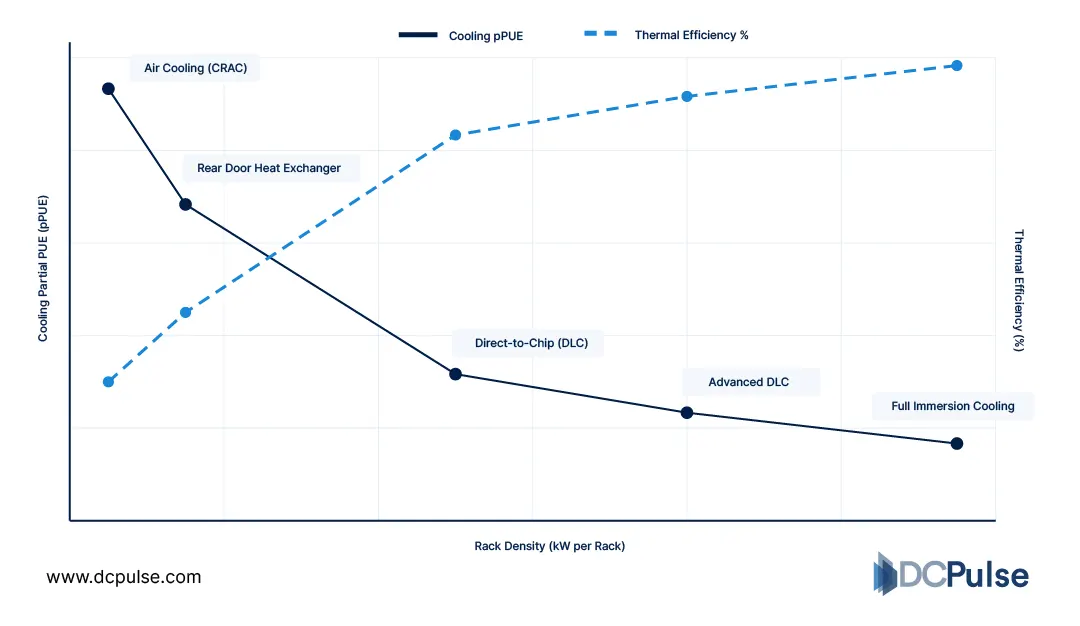
This aligns with academic research showing that as rack density exceeds ~12 kW, thermal loads begin to increase nonlinearly, leading to airflow imbalance and localized overheating risks.
The underlying limitation is physical. Air has a low heat capacity, meaning significantly larger volumes are required to remove heat as density rises. As a result, higher-density environments demand more airflow, more energy, and tighter airflow control, creating diminishing returns.
The gap becomes critical with AI workloads. Modern GPU racks can reach 60-80 kW or higher, far exceeding what air cooling can efficiently support.
Rack Density Growth - Traditional vs. AI Workloads (kW/Rack)
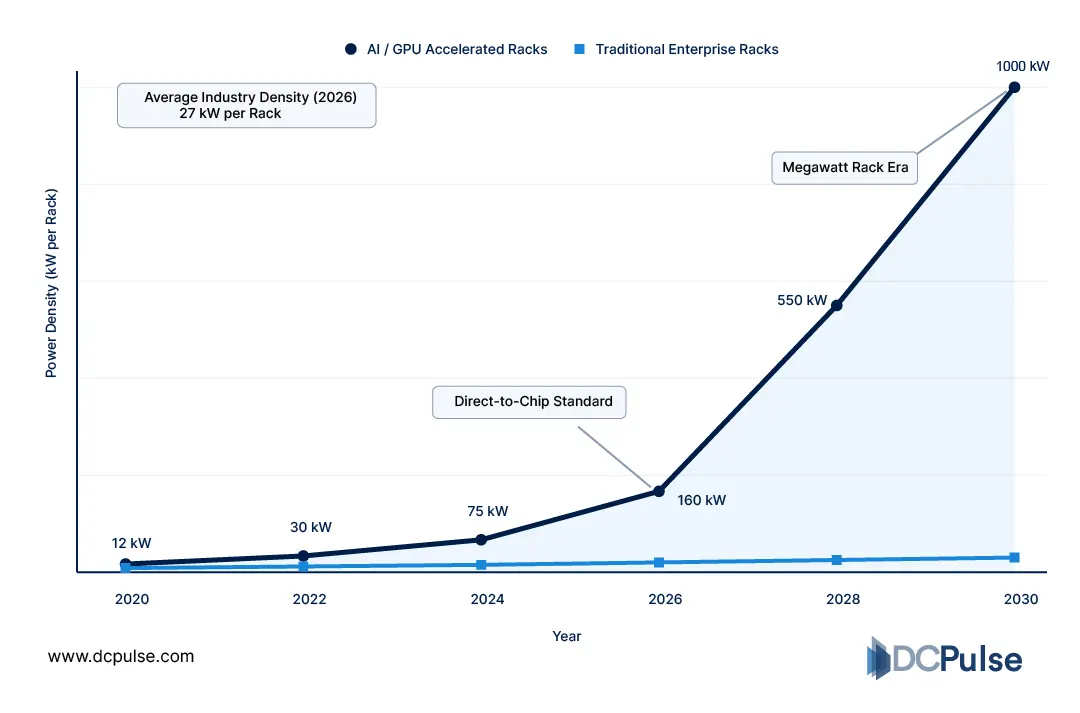
At these levels, operators face escalating issues like hotspots and uneven cooling, rising energy consumption, and Increasing infrastructure complexity
The conclusion is clear.
Air cooling does not suddenly stop working, but beyond certain density thresholds, it becomes thermally constrained, energy-inefficient, and operationally unsustainable, forcing a transition toward liquid-based cooling solutions.
What Innovations Are Enabling the Shift Toward Liquid Cooling?
The shift toward liquid cooling is being driven by innovations that directly address the fundamental thermal limits of air-based systems.
One of the most important advances is direct-to-chip liquid cooling, where coolant is delivered directly to high-heat components such as CPUs and GPUs. This approach removes heat at the source and avoids the inefficiencies of moving large volumes of air. Industry analysis shows that liquid cooling can be 50 to 1,000 times more efficient at heat transfer than air, making it far more suitable for high-density environments.
Heat Transfer Properties (Air vs. Liquid Cooling)
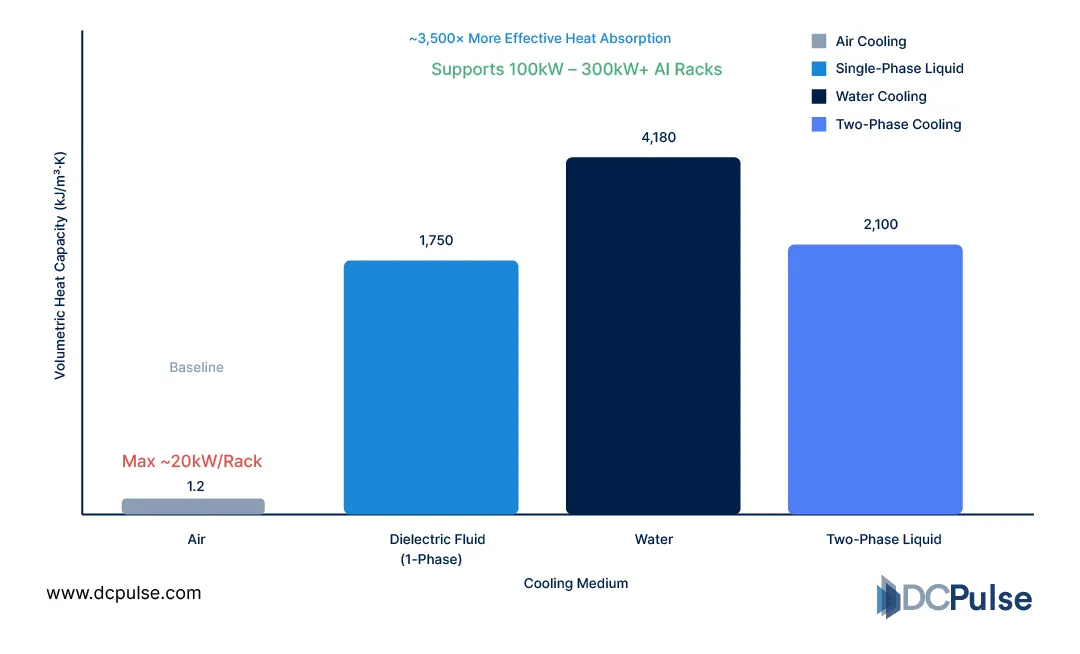
Another key innovation is immersion cooling, where servers are submerged in thermally conductive fluids. Research shows that immersion cooling can reduce overall energy consumption by around 50% while supporting significantly higher rack densities due to the higher heat capacity of liquids.
At the same time, the industry is moving toward hybrid cooling architectures, combining air and liquid systems. This allows operators to deploy liquid cooling selectively for high-density racks while continuing to use air cooling for standard workloads, creating a more flexible transition path.
These innovations are not incremental; they represent a structural shift. As compute density increases, cooling is no longer just a facility concern but an integrated part of server and rack design.
The direction is clear;
Liquid cooling is no longer experimental; it is becoming a necessary and scalable solution for managing the thermal demands of modern high-density data centers.
Who Is Adopting Liquid Cooling, and What Does It Signal for the Industry?
The adoption of liquid cooling is being led by hyperscalers and high-performance computing operators, where thermal density and efficiency constraints are most severe.
Industry data shows that hyperscale data centers account for the largest share of liquid cooling investments, driven by the need to support AI and high-density workloads. These operators are integrating liquid cooling early in the design phase, rather than treating it as a retrofit solution, signaling a structural shift in infrastructure planning.
Liquid Cooling Adoption by Data Center Type (2026 Benchmarks)
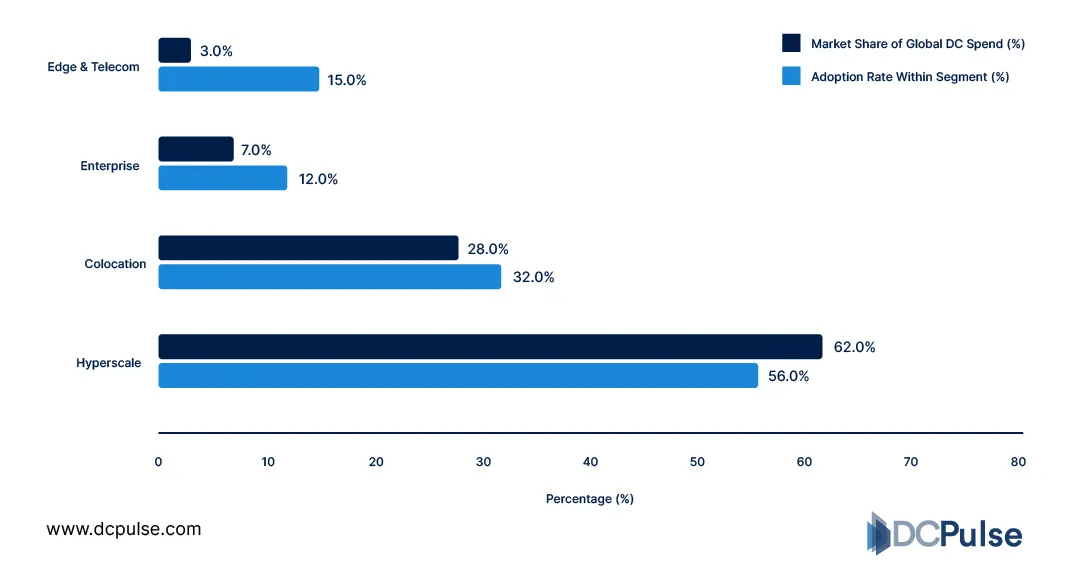
This transition is closely tied to the rise of AI infrastructure. As rack power densities move beyond 40 kW and toward 100 kW+, liquid cooling is becoming standard for new deployments, particularly in AI-focused data centers.
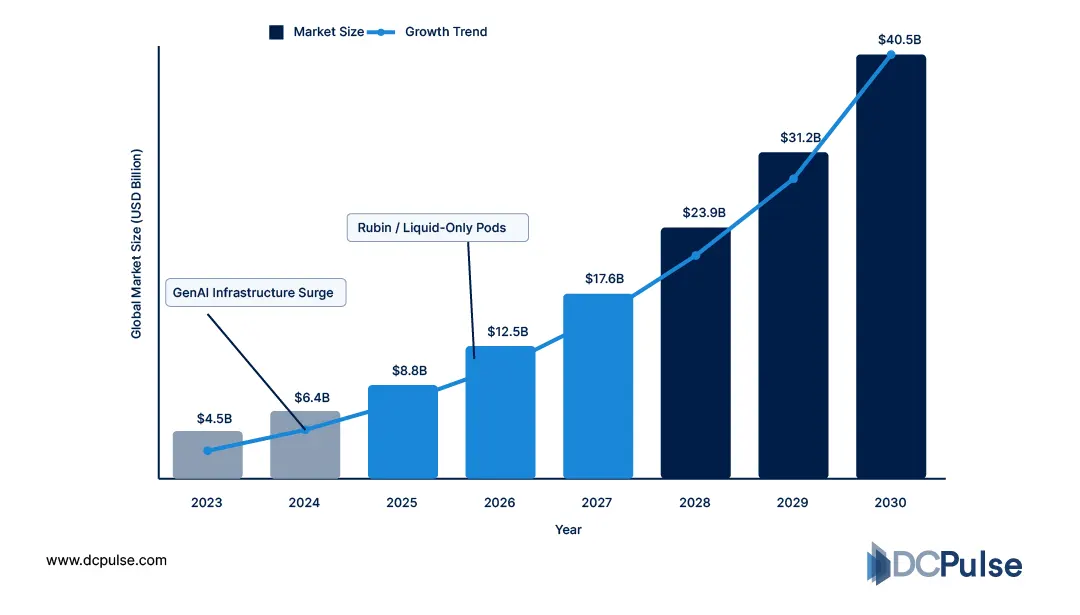
The scale of this shift is reflected in market growth. The global data center liquid cooling market, valued at ~USD 2.6 billion in 2023, is projected to reach ~USD 9.5 billion by 2030, driven largely by hyperscale and AI demand.
Data Center Liquid Cooling Market Size (2023-2030)
At the same time, adoption is influencing the broader ecosystem. Hardware vendors, infrastructure providers, and cooling technology firms are aligning their designs around liquid-based systems, embedding cooling directly into compute architecture.
The signal is clear;
Liquid cooling is no longer a niche or experimental solution; it is becoming a default requirement for next-generation, high-density data centers, led by hyperscalers and accelerated by AI-driven demand.
When Will Liquid Cooling Become a Standard Requirement in Data Centers?
Liquid cooling is no longer a forward-looking option; it is steadily becoming a practical requirement for high-density data center operations.
As rack power densities continue to rise, particularly with AI and high-performance workloads, the limitations of air cooling are becoming increasingly difficult to manage at scale. While air-based systems remain viable for lower-density environments, their efficiency declines sharply as thermal loads increase, creating operational and economic constraints.
However, the transition to liquid cooling is not immediate or universal. Many operators are adopting hybrid approaches, deploying liquid cooling selectively for high-density workloads while maintaining air cooling for general-purpose infrastructure. This reflects both the cost of retrofitting existing facilities and the need for gradual integration.
What is emerging is a phased shift. New data center designs are increasingly being built with liquid cooling readiness, even if not fully deployed from day one. Over time, as densities continue to rise, liquid cooling will move from selective deployment to broader standardization.
The direction is clear: liquid cooling will not replace air entirely, but it will become a core component of modern data center design, particularly where performance and density requirements demand it.