DCPulse
The AI infrastructure buildout is putting pressure on a part of the technology stack that rarely receives the same attention as GPUs, networking, or cloud platforms: the physical data center itself.
For Steve Altizer, president and CEO of Compu Dynamics, that pressure is changing the way data centers are designed and delivered. Altizer has spent more than two decades focused on data center infrastructure and in 2025 founded Compu Dynamics Modular (CDM), a business centered on modular infrastructure for AI environments.
In a July 2026 episode of NEDAS Live!, Altizer discussed the growing role of factory-built infrastructure, the requirements of high-density computing, and the constraints facing conventional construction. His comments point to a broader shift: modular construction is increasingly being considered not simply as an alternative building technique, but as a way to make data center capacity more repeatable and adaptable.
AI Is Changing the Physical Data Center
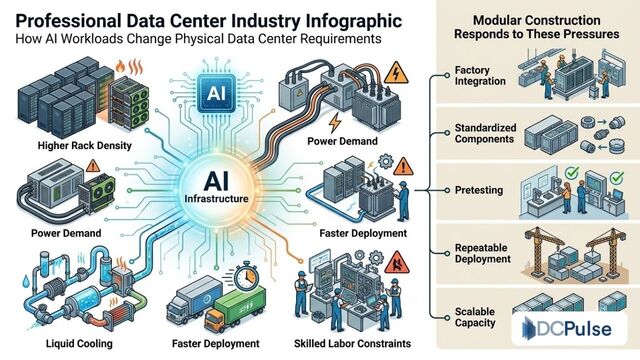
The underlying challenge is straightforward. AI workloads are placing new demands on power delivery, thermal management, physical space, and deployment schedules.
Traditional data centers were generally designed around relatively stable assumptions about rack power, cooling, and schedules. cooling and equipment life cycles. AI systems can alter those assumptions much faster. The result is greater pressure on operators and developers to build infrastructure that can accommodate higher densities and changing technology without requiring an entirely new construction strategy each time.
The American Society of Heating, Refrigerating, and Air-Conditioning Engineers (ASHRAE) now recommends an integrated approach in which power, cooling, and architecture are considered together, with adaptive planning and modular construction among the principles.
Altizer's position reflects that systems-level view. In a separate 2026 discussion, he described the data center fundamentally as the environment surrounding IT: infrastructure provides power, removes heat, and supplies connectivity. As the IT equipment changes, he argues, the surrounding infrastructure has to change with it.
That relationship is particularly important for AI facilities, where liquid cooling and higher-density power systems are becoming central design considerations.
From Construction Site to Factory Floor
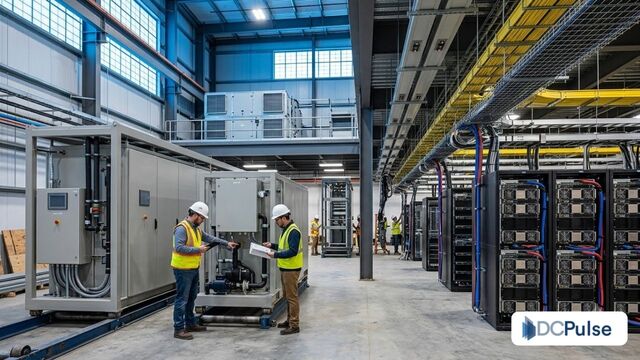
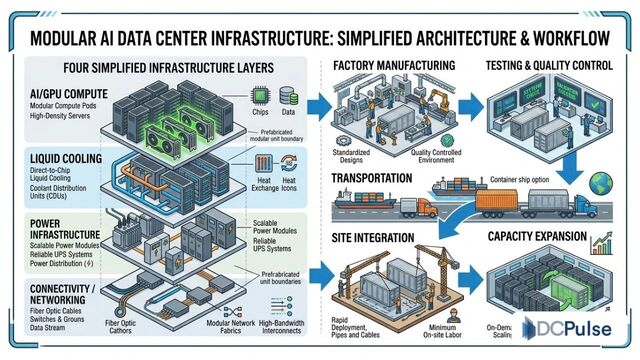
Modular construction moves some of that work away from the data center site and into controlled manufacturing environments.
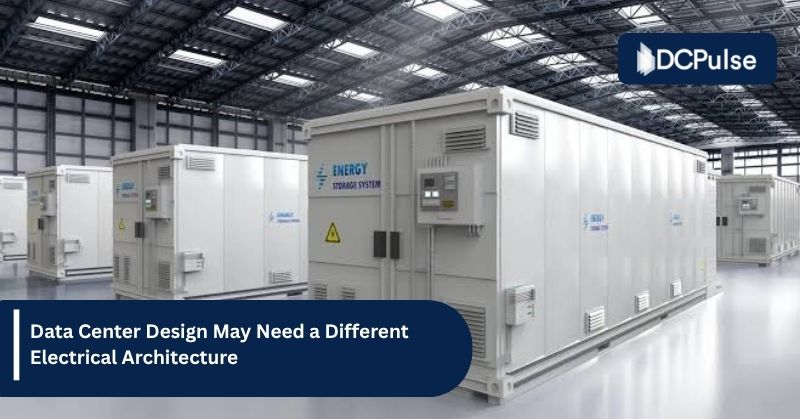
Instead of assembling every subsystem sequentially at the project location, components can be engineered, integrated, and tested before they arrive. Depending on the architecture, modules can encompass power distribution, cooling, integrated controls, and IT space, or combinations of those systems.
The approach does not eliminate site work. Power availability, permitting, foundations, network connectivity, and other site-specific requirements remain critical. But factory integration can change how much of the infrastructure has to be assembled and coordinated in the field.
That distinction matters as the industry confronts a shortage of skilled construction labor. An August-September 2026 survey from the Associated General Contractors of America and NCCER found that 58% of firms working on data center projects said those projects had increased competition for skilled workers, while 37% identified worker or subcontractor availability as their biggest challenge in pursuing or delivering data center work. An associated field.
For modular proponents, moving repeatable work into a manufacturing environment is therefore as much about capacity and workforce management as it is about speed.
Standardization Meets AI's Need for Flexibility
The central tension in modular data center design is standardization versus customization.
Data center operators have different sites, grid conditions, climates, workloads, and reliability requirements. AI infrastructure can also evolve rapidly as processor generations, rack configurations, workloads, configurations, and cooling requirements change.
Altizer's vision, as described by NEDAS, is to make standardized, fully integrated data center infrastructure configurable enough to address those differences. The objective is not necessarily to make every facility identical but to create repeatable building blocks that can be assembled into different configurations.
That model is becoming visible across the broader market. Gartner's April 2026 research identified renewed interest in prefabricated modular data centers as organizations confront the power and cooling requirements of AI and seek faster capacity expansion.
Compu Dynamics Modular has also expanded its own product strategy. In September 2026, the company announced a portfolio ranging from a 750-kilowatt module through multi-megawatt configurations and a turnkey AI factory, with designs intended to support incremental expansion. Those are company-reported capabilities rather than independently verified market benchmarks, but they illustrate how vendors are attempting to turn modular infrastructure into a repeatable product category.
Cooling Is Part of the Architecture
The modular discussion cannot be separated from cooling.
AI systems are pushing data centers toward higher rack densities, making thermal management a core infrastructure consideration rather than a secondary engineering decision. Liquid cooling is consequently becoming more prominent in AI-oriented designs, alongside conventional air cooling where appropriate.
For modular facilities, that creates an additional integration challenge. Pumps, piping, coolant distribution units, controls, heat rejection, and electrical systems must work together, often before the equipment reaches the final site.
ASHRAE's AI data center framework specifically calls for cooling strategies to be matched to workload density and recommends planning for liquid cooling in high-density AI and HPC environments.
The implication for modular builders is significant: a module is not simply a prefabricated room. Increasingly, it can function as an integrated thermal, electrical, and IT subsystem.
Speed Still Depends on the Site
The attraction of modular construction is often summarized as speed, but faster factory assembly does not automatically solve every data center bottleneck.
A project can still be constrained by grid interconnection, transformers and switchgear, permitting, land preparation, fiber connectivity, or the availability of cooling resources. Energy infrastructure in particular is becoming a major consideration as AI campuses grow.
Recent industry developments illustrate the point. Reuters reported in September that power and cooling suppliers are seeing increased demand as AI data center investment accelerates, while utilities and developers in multiple markets are confronting the infrastructure requirements associated with new facilities.
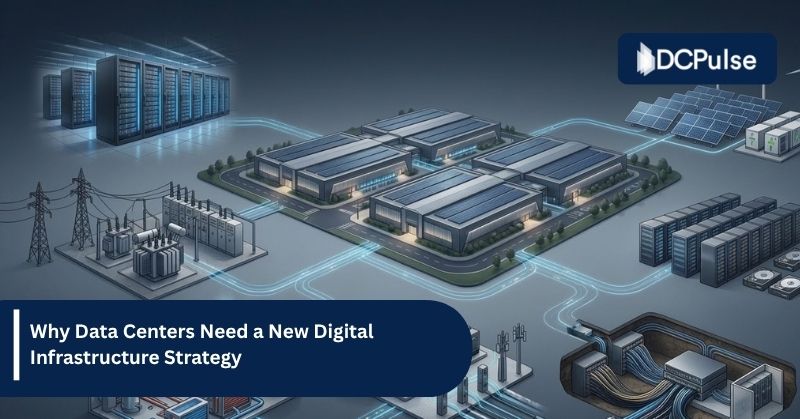
Modular construction can therefore address one part of the delivery equation without removing the need for coordinated planning across the entire digital infrastructure ecosystem.
A Different Model for Scaling Capacity
Altizer's argument ultimately extends beyond prefabrication. The more consequential change may be the attempt to treat data center infrastructure as something that can be designed, manufactured, and deployed with a degree of repeatability more familiar to industrial production than conventional construction.
That could have implications for hyperscale campuses, AI infrastructure providers, edge deployments, and enterprises seeking incremental capacity. Repeatable designs may make phased expansion easier to plan, while factory testing can move more integration work earlier in the project lifecycle.
The model also introduces new requirements. Standardized architectures need to remain adaptable as compute platforms change. Manufacturers must maintain quality and supply-chain discipline at scale. Operators must ensure that modular systems integrate cleanly with site infrastructure and long-term operating strategies.
For the data center industry, the significance of the modular movement may therefore lie less in the physical module itself than in the delivery philosophy behind it.
AI is accelerating demand for capacity while simultaneously making that capacity more complex. The emerging response is to rethink how the infrastructure is engineered from a one-off construction project toward a repeatable system that can be manufactured, tested, deployed, and expanded.
For Altizer, that is the opportunity presented by the current AI buildout. The next generation of data centers may not simply be larger versions of today's facilities. They may increasingly be assembled from standardized infrastructure designed around the pace, density, and uncertainty of modern computing.
Sources include NEDAS Live's July 2026 interview listing, Compu Dynamics' public materials, ASHRAE's AI data center framework, Gartner research, and current construction-industry reporting.