DCPulse
Education has continually evolved alongside industrial progress, adapting to changes in how societies produce goods, communicate, and organize work. From mechanized manufacturing to artificial intelligence, each industrial revolution has reshaped the skills required by workers and the systems used to develop them. Today, the relationship between technological innovation and education extends beyond classrooms and digital learning platforms. Data centers, cloud computing, high-speed connectivity, and AI infrastructure increasingly support the digital environments through which students learn, educators teach, and institutions manage information. As education becomes more connected and data-intensive, the infrastructure supporting these services is becoming an important part of the wider technological transformation.
The historical relationship between industrial development and education also offers insight into the challenges facing modern digital infrastructure. Technological progress can expand access to knowledge, but its benefits depend on the availability of reliable systems, appropriate skills, and institutions capable of adapting to change. The transition toward digitally enabled education therefore involves not only new teaching methods but also the underlying computing, networking, energy, and security systems required to sustain them.
From Mechanization to Mass Education

The First Industrial Revolution introduced mechanized production and transformed labor requirements, particularly in manufacturing and transportation. As economies changed, education gradually assumed a greater role in preparing people for industrial employment. Literacy, numeracy, technical instruction, and formal schooling became increasingly important in societies where economic opportunities were shifting beyond traditional agricultural activities.
The Second Industrial Revolution brought electricity, mass production, telecommunications, and more complex industrial processes. These developments increased the importance of specialized technical knowledge and more structured approaches to workforce training. Educational institutions increasingly had to prepare learners for environments shaped by engineering, industrial management, and scientific progress.
The relationship between technological change and education was never uniform. Access to schooling, the pace of industrialization, and the availability of technical training varied across countries and communities. Nevertheless, successive industrial transitions demonstrated that education systems needed to respond to changing economic and technological conditions rather than remain fixed around earlier models of work.
The expansion of computing during the later twentieth century introduced another major shift. Computers became tools for research, administration, communication, and instruction, while the internet expanded opportunities to distribute educational materials beyond physical classrooms. These developments established the foundations for the connected learning environments now supported by cloud platforms and modern digital infrastructure.
The Digital Revolution Changes How People Learn
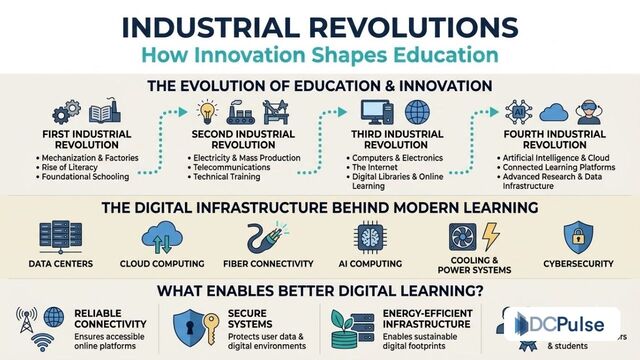
The Third Industrial Revolution, often associated with electronics, information technology, and digital communications, created new ways to produce, store, and distribute knowledge. Online learning resources, digital libraries, educational software, and virtual classrooms gradually expanded the range of learning environments available to students and teachers.
The Fourth Industrial Revolution has intensified this transformation through the convergence of AI, connected devices, cloud computing, automation, and advanced data analytics. Educational platforms can now support remote instruction, collaborative projects, digital assessments, and increasingly personalized learning experiences. AI-enabled tools also create opportunities to assist with research, language learning, and the preparation of educational materials, although their effectiveness depends on appropriate implementation and human oversight.
Behind these applications lies a substantial digital infrastructure ecosystem. Data centers process and store information, cloud platforms provide computing resources, and telecommunications networks connect users with educational services. Content delivery networks and distributed computing systems can help deliver digital materials efficiently across different locations, while identity management and cybersecurity technologies support the protection of institutional systems and user information.
For educational institutions, these systems are no longer simply administrative tools. They increasingly form part of the operating environment through which teaching, assessment, research, and collaboration take place. Their reliability can influence the availability of learning platforms, access to digital resources, and continuity of instruction when physical attendance becomes difficult.
Data Centers Become Part of the Education Ecosystem
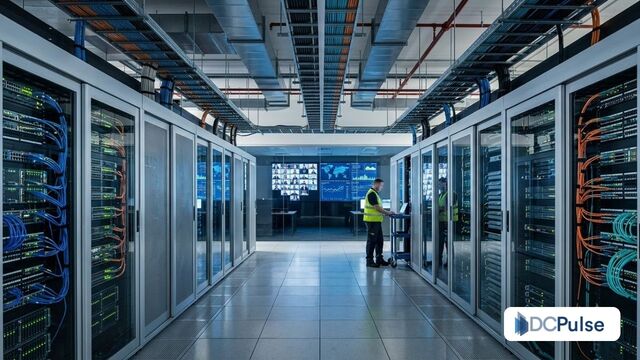
The growth of digital education creates infrastructure requirements that extend well beyond individual schools and universities. Learning management systems, video conferencing, online examinations, digital repositories, research computing, and AI-assisted applications depend on computing capacity and network connectivity. Data centers provide the underlying resources required to host these services and manage the information they generate.
Cloud infrastructure allows educational organizations to access computing and storage resources without necessarily building and operating every component themselves. This approach can help institutions accommodate changing workloads, support collaboration across campuses, and deploy services to geographically dispersed users. The practical benefits, however, depend on service design, network performance, security arrangements, and the institution's ability to manage its technology environment.
Research-intensive universities have additional requirements. Scientific simulations, engineering applications, large datasets, and AI research can require substantial computing resources that differ from the needs of ordinary learning platforms. High-performance computing facilities, specialized processors, and scalable cloud environments can support these activities, connecting education more directly with the infrastructure developments associated with AI and advanced research.
Network connectivity remains equally important. A well-equipped data center cannot deliver an effective learning experience if users lack reliable access to the services it hosts. Fiber networks, broadband connections, mobile infrastructure, and suitable campus networks help bridge the distance between computing resources and learners. Latency, bandwidth, and connection reliability can be especially relevant for interactive lessons, remote laboratories, and applications that process information in real time.
The resulting relationship is reciprocal. Educational demand encourages investment in digital services and computing infrastructure, while improvements in that infrastructure create opportunities for new forms of teaching, learning, and research.
AI Education Raises New Infrastructure Requirements
Artificial intelligence is adding another dimension to the relationship between education and industrial innovation. AI-enabled learning applications can support adaptive exercises, automated feedback, translation, tutoring assistance, and content discovery. Research institutions can also use AI computing resources to explore scientific questions, analyze complex datasets, and develop new technologies.
These applications have different infrastructure needs. A basic educational platform may rely primarily on conventional cloud computing, while large AI models and research workloads can require specialized accelerators, high-speed networking, and substantial computing capacity. Training and operating AI systems also involve storage, data movement, and power consumption, making infrastructure planning an important consideration for service providers and institutions.
Data center operators face the challenge of supporting varied workloads while maintaining performance, availability, and operational efficiency. AI-related demand can influence decisions about server architecture, rack density, cooling design, power distribution, and capacity expansion. Liquid cooling may be appropriate for certain high-density computing environments, while other facilities continue to use established air-cooling configurations. The appropriate approach depends on equipment requirements, facility design, operating conditions, and commercial considerations.
Energy is another important factor. Digital education may reduce the need for some physical activities, but online services still rely on electricity for computing, networking, and cooling. Greater use of cloud platforms and AI tools therefore reinforces the importance of energy-efficient equipment, effective thermal management, and responsible power procurement. Renewable electricity strategies can contribute to reducing the emissions associated with data center operations, although outcomes depend on how energy is sourced and consumed.
For educational organizations and infrastructure providers, the objective is not simply to expand computing capacity. Sustainable development requires balancing performance, cost, reliability, and environmental considerations as digital learning and research workloads evolve.
Skills Development Must Keep Pace With Technology
The infrastructure supporting modern education also creates demand for new professional skills. Data centers depend on specialists in electrical systems, mechanical engineering, cooling, networking, cybersecurity, facilities management, and cloud operations. The expansion of AI infrastructure adds further requirements in areas such as high-performance computing, accelerator deployment, data engineering, and software optimization.
Education systems can help address these needs through technical courses, vocational training, university programs, professional certifications, and partnerships between employers and academic institutions. Practical training is particularly important for infrastructure roles, where knowledge of theoretical principles must be combined with operational procedures, equipment safety, and troubleshooting experience.
The relationship between education and industry can also operate in the opposite direction. Data center operators, technology companies, and cloud providers can contribute to workforce development through internships, training programs, research partnerships, and access to appropriate learning environments. Such collaboration can help align educational content with changing technical requirements without reducing education to short-term employment preparation.
Digital literacy remains essential beyond specialist careers. Students and educators need the ability to assess online information, understand basic cybersecurity practices, recognize limitations in AI-generated outputs, and protect personal information. These competencies become increasingly relevant as digital services influence everyday learning and professional activity.
Access, Reliability, and the Digital Divide
The benefits of technology-driven education depend on more than the availability of advanced platforms. Unequal access to broadband, suitable devices, electricity, and digital skills can limit the ability of students and educators to participate in connected learning environments. Rural communities and under-resourced institutions may face challenges that cannot be resolved through cloud computing alone.
Infrastructure location and network design can influence how effectively digital services reach different populations. Regional data centers, local connectivity infrastructure, and distributed cloud services may help improve access to digital resources, depending on deployment models and network conditions. However, affordability, last-mile connectivity, device availability, and institutional readiness remain important barriers.
Reliability and cybersecurity also require sustained attention. Educational institutions manage sensitive student records, research information, assessment results, and administrative data. Service interruptions can disrupt teaching and examinations, while security incidents may compromise personal information or institutional operations. Appropriate access controls, backup systems, disaster recovery planning, and security awareness are therefore essential components of digital education strategies.
AI adoption introduces additional considerations, including the accuracy of generated information, academic integrity, data privacy, and the need for human oversight. Effective implementation requires clear institutional policies and an understanding of the limitations of the technologies being used.
The Next Phase of Innovation
The historical pattern linking industrial revolutions with education suggests that technological change is most useful when infrastructure development and skills formation progress together. Earlier industrial transitions changed the nature of work and increased demand for new capabilities. Today's digital transformation is extending that process into learning environments, research institutions, and the systems that support knowledge exchange.
For data center developers and operators, education represents one part of a broader demand landscape shaped by cloud adoption, AI applications, scientific research, and enterprise digitalization. The sector's contribution extends beyond providing computing capacity: reliable connectivity, secure data handling, efficient cooling, and responsible energy management help determine whether digital services can operate effectively at scale.
Future developments will depend on how educational institutions, technology providers, governments, and infrastructure companies address these interconnected requirements. Investment in computing alone cannot guarantee better educational outcomes, just as access to online resources cannot replace effective teaching and appropriate learning support.
The enduring lesson of industrial revolutions is that innovation reshapes education by changing both the tools people use and the skills societies require. As AI and cloud technologies become more deeply integrated into learning and research, data centers and digital networks will remain important foundations of that transformation. Their long-term value will depend on delivering reliable, secure, and increasingly efficient infrastructure while supporting broader access to knowledge and the development of future technical capabilities.