DCPulse
The experience of Hurricane Helene and more recent grid disturbances is highlighting a less visible dependency in data center resilience: backup power is only as reliable as the fuel supply that supports it.
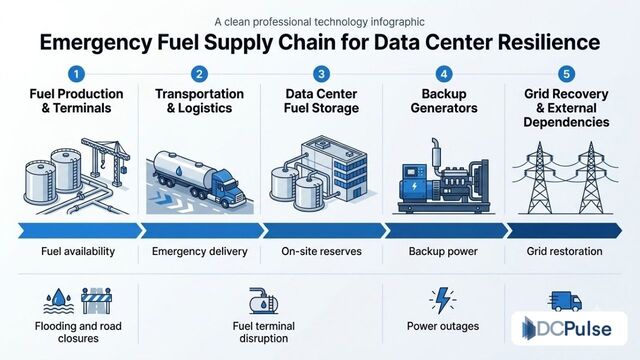
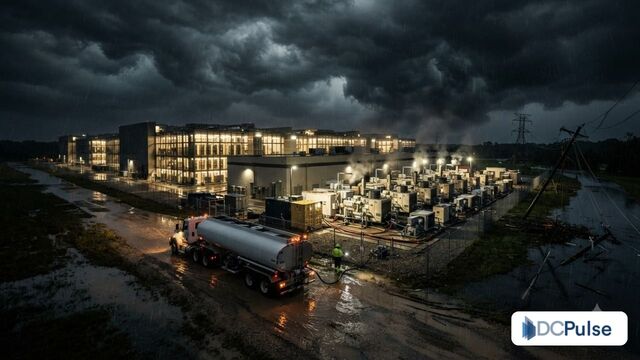
For facilities designed to operate through utility interruptions, diesel generators can provide an important layer of protection. Yet a prolonged outage changes the resilience equation. Fuel stored on-site can eventually run down, while the same storm, flooding, road closures, power failures, and infrastructure disruptions that affect the data center can also affect fuel terminals, transportation networks, and delivery operations.
That dependency is becoming more relevant as data centers support cloud platforms, AI workloads, telecommunications networks, and other services that are increasingly sensitive to prolonged interruptions.
Hurricane Helene Exposed the Wider Fuel Supply Chain
Hurricane Helene provides a useful example of how a regional disaster can affect several infrastructure systems at the same time.
The storm made landfall in Florida on September 26, 2024, before moving through several states across the southeastern United States and Appalachia. The U.S. Department of Energy reported that approximately 2.6 million customers remained without power on September 29, while flooding and debris were complicating access to damaged infrastructure.
The disruption extended beyond electricity networks. DOE reported that power outages were affecting retail fuel stations, bulk terminals, pipelines, and other oil and natural gas infrastructure in the affected region. That connection matters for data centers because emergency generators depend on a functioning fuel logistics chain when an outage lasts longer than the facility's initial fuel reserve.
Federal response operations also demonstrate the scale of fuel logistics required during a major disaster. The Defense Logistics Agency reported that its Hurricane Helene and Milton response had delivered hundreds of thousands of gallons of fuel and generators as part of broader emergency support by October 28, 2024.
The lesson for data center operators is not that fuel delivery necessarily fails during every major storm. The more relevant point is that fuel availability depends on infrastructure outside the data center's physical boundary.
Fuel Reserves Are Only One Layer of Resilience
On-site fuel storage remains an important component of generator planning, but storage capacity does not eliminate external dependencies.
A prolonged grid failure can extend beyond the period covered by a facility's stored fuel. At that point, operators need delivery vehicles, accessible roads, functioning fuel suppliers, available products at terminals, and safe access to the data center.
Uptime Institute has previously highlighted this dependency, noting that longer grid outages can exceed on-site fuel capacity and leave operators dependent on external vendors for resupply. The organization has also noted that fuel terminals may themselves be affected by a wide-area power outage.
CISA's infrastructure resilience guidance similarly identifies emergency contracts, multiple suppliers, additional storage, and continuity planning as approaches for reducing dependency on a single source of critical commodities such as fuel.
For data centers, the implication is straightforward: generator capacity and fuel tank capacity should be considered together with the availability and accessibility of the supply chain behind them.
Emergency Fuel Delivery Requires More Than a Contract
A fuel contract can establish a commercial relationship, but operational resilience depends on whether the supplier can actually reach the facility during an emergency.
Road closures represent one potential constraint. Flooding, damaged bridges, evacuation zones, and debris can prevent tanker trucks from reaching otherwise operational facilities. A fuel supplier may also face competing demand from hospitals, emergency services, telecommunications networks, utilities, and other critical infrastructure.
The location of fuel infrastructure therefore becomes part of the resilience assessment. A data center with multiple fuel vendors can still face a common disruption if those vendors depend on the same terminal, transportation corridor, or regional distribution network.
Supplier diversity is consequently more meaningful when it represents genuine infrastructure diversity rather than multiple contracts connected to the same underlying source.
Grid Failures Are Expanding the Resilience Conversation
Recent grid events are adding another dimension to the discussion.
In July 2026, a transmission-line issue in the U.S. Mid-Atlantic region prompted dozens of Northern Virginia data centers to switch to backup generation, according to Uptime Institute. The event demonstrated how a relatively localized grid problem can create complex interactions between large data center loads, backup generation, and grid recovery.
Uptime Institute's 2026 outage analysis also identifies power as a leading cause of impactful data center outages, while pointing to grid constraints, high-density workloads, and increasing external dependencies as evolving risks.
The significance for fuel planning is that backup generation is increasingly becoming part of a broader infrastructure response rather than simply an emergency mechanism used for short utility interruptions.
AI Infrastructure Raises the Stakes
AI infrastructure adds another consideration to emergency power planning.
High-density computing environments can place substantial demands on electrical infrastructure, while AI workloads can also increase the operational importance of maintaining stable power for specialized computing systems and associated cooling equipment.
Uptime Institute's 2026 global data center survey identifies high-density and AI-related workloads as important sources of continuing demand while also highlighting limited power availability, grid reliability, supply-chain constraints, and staffing challenges.
The combination means that fuel planning cannot be isolated from capacity planning. A facility may have sufficient generator capacity on paper, but the practical resilience of that capacity depends on fuel availability, cooling, electrical distribution, generator maintenance, and the ability of personnel and suppliers to operate during an extended emergency.
Data Center Operators Are Looking Beyond Generator Runtime
A more comprehensive emergency fuel strategy can include several layers.
On-site storage provides the first buffer against an interruption. Tank capacity, fuel quality, monitoring, and replenishment procedures become operational considerations rather than simply engineering specifications.
Supplier redundancy can reduce dependence on a single commercial provider. The value of redundancy increases when suppliers use different distribution routes or fuel sources.
Pre-arranged emergency delivery can establish response procedures before a disaster occurs. CISA specifically identifies emergency contracts for critical commodities as one resilience measure.
Access planning can address the physical route between fuel infrastructure and the data center. Alternative routes may become important when flooding, debris, or road restrictions affect normal transportation.
Operational coordination can connect facilities with suppliers, emergency management organizations, utilities, and internal incident-response teams. Clear communication can help operators determine when fuel replenishment needs to begin rather than waiting until reserves approach a critical level.
Resilience Extends Beyond the Data Center Fence
Hurricane Helene illustrates a broader principle for digital infrastructure: infrastructure resilience is increasingly determined by interdependencies outside the facility itself.
Electricity supports fuel infrastructure. Transportation enables fuel delivery. Communications support coordination. Data centers depend on all three during prolonged emergencies. CISA's infrastructure dependency analysis identifies transportation as a dependency for communications facilities that require diesel fuel for backup generators, reinforcing the interconnected nature of these systems.
For operators, emergency fuel planning therefore represents more than maintaining full tanks. The deeper question concerns whether the entire replenishment chain can continue functioning when a regional emergency simultaneously affects electricity, transportation, communications, and fuel infrastructure.
That perspective is particularly relevant as data center campuses become larger, power densities increase, and digital services become more deeply embedded in critical business and public infrastructure.
The practical lesson from major weather events and grid disturbances is that backup generation should not be treated as an isolated piece of equipment. Generator resilience ultimately depends on a complete operating chain, from fuel storage and monitoring to suppliers, transportation routes, emergency coordination, and grid recovery.
For the next generation of data centers, that chain is becoming an increasingly important part of the resilience architecture.