DCPulse
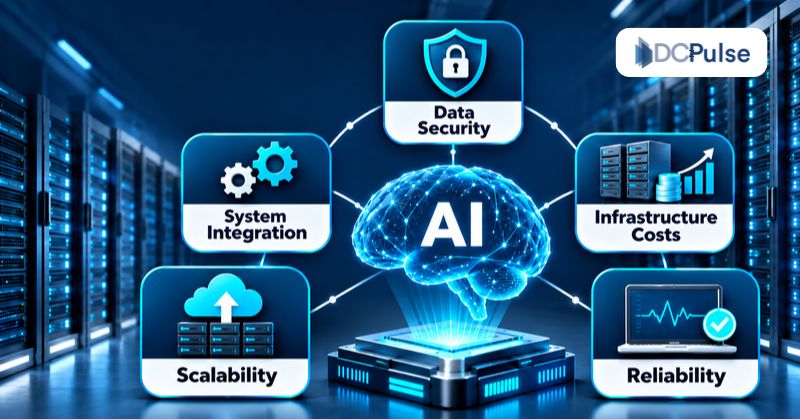
Artificial intelligence is becoming an important part of business operations, supporting everything from data analysis and customer service to software development, cybersecurity, and infrastructure management. As organizations explore new AI tools, the decision to adopt a particular platform involves more than evaluating its features or potential productivity benefits. Businesses must also consider data security, infrastructure requirements, integration capabilities, operational costs, and long-term scalability.
For companies operating in the data center and digital infrastructure sectors, these considerations are particularly important. AI applications can introduce additional computing demands, increase data movement, and create new dependencies across cloud environments, enterprise systems, and digital platforms. A poorly evaluated AI tool may introduce security risks, complicate existing workflows, or create unexpected infrastructure requirements.
A structured evaluation process can help organizations understand whether an AI solution meets their operational needs. Five important questions can guide businesses before onboarding a new AI tool.
1. What Business Problem Does the AI Tool Solve?
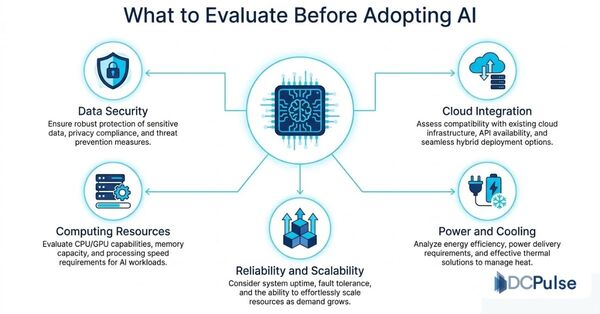
The first consideration should be the business problem that an AI tool is expected to address. Organizations often explore AI platforms because of growing interest in automation and intelligent applications. However, adopting technology without a clearly defined purpose can lead to unnecessary spending and limited operational value.
Businesses should identify the specific tasks they want to improve. These may include automating repetitive processes, analyzing large datasets, improving customer interactions, supporting software development, or optimizing infrastructure operations.
For data center operators, AI tools may support workload monitoring, predictive maintenance, energy management, capacity planning, and operational analytics. For example, an AI-based monitoring platform could help infrastructure teams identify unusual equipment behavior and investigate potential performance issues before they affect operations.
The expected outcome should also be measurable. Organizations can establish evaluation criteria based on processing time, operational efficiency, resource utilization, error reduction, or improvements in service delivery.
A clearly defined business requirement helps decision-makers distinguish between tools that offer practical benefits and platforms that add complexity without addressing an immediate operational need.
2. How Does the Tool Handle Data Security and Privacy?
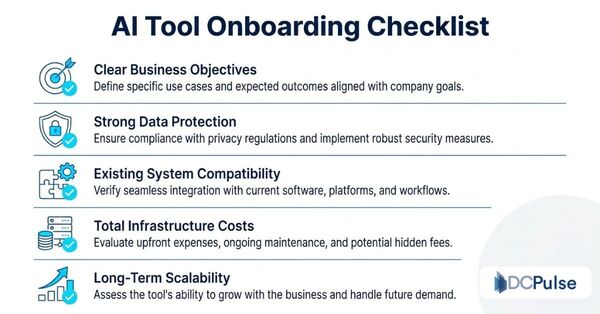
Data security is one of the most important considerations when introducing AI into business environments. Many AI applications require access to internal documents, customer information, operational records, source code, or other sensitive business data. The way this information is collected, processed, stored, and retained can create significant security and compliance considerations.
Before onboarding a tool, organizations should understand whether submitted data is used to train AI models, how long information is retained, and whether administrators can control data access and deletion. Businesses should also examine the provider's encryption practices, authentication options, access controls, and security documentation.
The deployment model is equally important. Some AI tools operate through public cloud services, while others support private cloud, dedicated environments, or locally hosted deployments. Each model has different implications for data governance, infrastructure control, and operational responsibility.
For data center and cloud infrastructure providers, these decisions can influence where workloads run, how information moves between environments, and what security measures are required. Organizations handling regulated or confidential information may need additional controls around data residency, network isolation, and access management.
Vendor security assessments, contractual data protection provisions, and compliance reviews should therefore form part of the onboarding process. A tool's functionality should not outweigh the need to protect sensitive business information.
3. Can the AI Tool Integrate With Existing Systems?
An AI platform may offer advanced capabilities, but its practical value depends partly on how effectively it works with existing business systems. Organizations should evaluate whether the tool can connect with their current software, databases, cloud platforms, identity management systems, and operational applications.
Integration requirements can vary considerably. Some platforms provide application programming interfaces (APIs), prebuilt connectors, and automation capabilities. Others may require custom development or additional middleware to exchange information with existing systems.
For data center operators, integration can involve infrastructure monitoring platforms, building management systems, data center infrastructure management (DCIM) software, IT service management tools, and energy monitoring applications. Reliable connections between these systems can help teams use operational information more effectively.
Compatibility should also be assessed at the infrastructure level. Businesses need to understand the tool's requirements for computing resources, storage, network connectivity, operating systems, and supported deployment environments.
Poor integration can create fragmented workflows, duplicate data, and additional maintenance responsibilities. It may also increase network traffic when AI applications continuously exchange information across different environments.
A technical evaluation involving IT, security, and infrastructure teams can help identify integration challenges before deployment. Testing the tool in a controlled environment can further establish whether it works reliably with existing systems.
4. What Are the Total Costs and Infrastructure Requirements?
The subscription price of an AI platform does not always represent its complete cost. Organizations should evaluate the total cost of ownership, including implementation, integration, licensing, computing resources, storage, networking, maintenance, and employee training.
AI applications can have different infrastructure requirements depending on their complexity and deployment model. Lightweight applications may operate through existing cloud services, while advanced AI workloads involving model training, inference, or large-scale data processing may require specialized computing resources.
Graphics processing units (GPUs), high-performance storage, memory capacity, and network bandwidth can become important considerations for resource-intensive deployments. Organizations using cloud-based AI services should also examine usage-based pricing, API consumption charges, data transfer fees, and potential costs associated with increased demand.
These requirements have wider implications for the data center industry. Growing adoption of AI applications can influence demand for high-density computing, advanced cooling systems, power capacity, and network infrastructure. However, the actual requirements depend on the workload, model size, deployment architecture, and utilization levels.
Businesses should estimate expected usage before committing to a platform. They should also consider whether costs could increase as more employees adopt the tool or as workloads become more complex.
A cost assessment that includes both software and infrastructure requirements can provide a more realistic picture of the investment involved.
5. Can the Tool Scale and Remain Reliable Over Time?
An AI solution should support current requirements while allowing room for future business growth. Organizations need to understand whether the platform can accommodate increasing workloads, additional users, larger datasets, and more demanding applications without creating operational difficulties.
Scalability involves more than adding users or increasing subscription capacity. Businesses should evaluate the provider's service availability, performance commitments, disaster recovery arrangements, support services, and ability to handle changing workloads.
For cloud-based AI platforms, service-level agreements (SLAs), regional availability, data portability, and dependency on external infrastructure providers deserve particular attention. Organizations should also understand what happens if a provider changes its pricing, discontinues a feature, modifies its service model, or experiences an extended outage.
Infrastructure resilience is another important factor. AI-dependent business processes may require reliable connectivity, backup arrangements, workload recovery capabilities, and alternative operating procedures. These requirements become especially relevant when AI tools support critical enterprise applications or data center operations.
Vendor flexibility should also be considered. Businesses may benefit from solutions that support standard interfaces, multiple deployment options, and integration with different infrastructure environments. Such flexibility can reduce dependence on a single provider and make future technology transitions easier.
A pilot deployment can help organizations evaluate performance, reliability, and scalability under realistic operating conditions before expanding adoption across the business.
Making AI Adoption a Strategic Infrastructure Decision
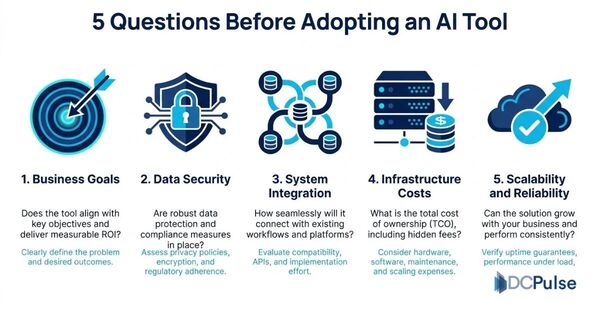
AI onboarding is increasingly connected to broader technology and infrastructure planning. The decision to introduce a new platform can affect data governance, cybersecurity, computing requirements, network architecture, operational processes, and long-term technology spending.
For data center operators, cloud providers, and digital infrastructure businesses, these considerations are particularly relevant as AI workloads become part of enterprise technology environments. The growing use of AI applications may require organizations to reassess computing capacity, power availability, cooling strategies, storage architecture, and connectivity.
The five questions provide a practical starting point for evaluating new AI tools. A clear business objective, strong data protection, reliable integration, transparent costs, and long-term scalability can help organizations make more informed decisions.
Ultimately, successful AI adoption depends on selecting technology that fits business requirements and can operate reliably within the existing digital infrastructure environment. A careful onboarding process can help businesses capture the benefits of AI while maintaining control over security, performance, and operational complexity.