DCPulse
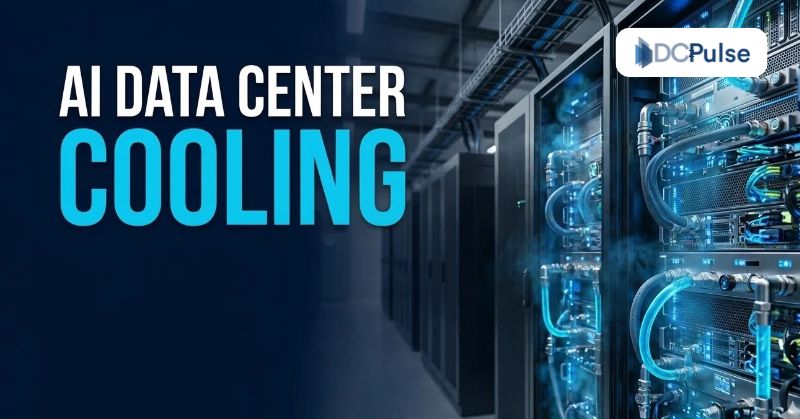
The rapid expansion of artificial intelligence is changing the requirements of data center infrastructure. AI workloads, particularly those involving model training, inference, and high-performance computing, can place different demands on cooling systems compared with conventional enterprise IT environments. As businesses seek colocation facilities to support AI deployments, cooling capacity is becoming an important consideration during site selection and lease negotiations.
For AI tenants, available power and rack space are no longer the only factors that determine whether a data center can support their infrastructure requirements. Cooling architecture, rack-level heat management, liquid cooling readiness, water availability, and operational reliability can directly influence deployment planning and long-term performance.
A facility may advertise high-density capabilities, but tenants need to understand what those capabilities mean in practical terms. Cooling capacity must be evaluated alongside electrical infrastructure, rack configurations, operating conditions, and the specific requirements of the intended workload.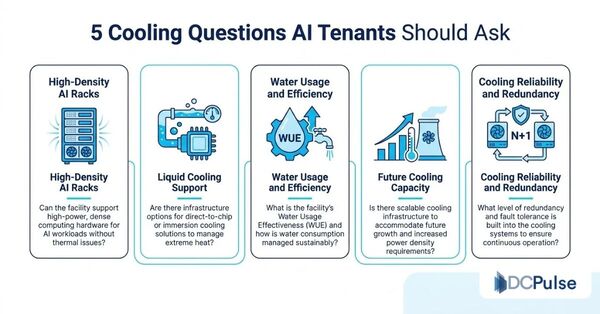
Before signing a colocation agreement, AI companies should examine several important cooling considerations to understand whether a facility can support their present and future computing requirements.
Can the Facility Support High-Density AI Racks?
Rack density is one of the first cooling considerations AI tenants should evaluate. Traditional data center environments often accommodate relatively moderate rack power requirements, while AI infrastructure can involve significantly higher-density deployments depending on the server configuration and workload.
AI servers equipped with multiple GPUs can generate substantial heat within a concentrated rack footprint. This creates additional demands on the facility's cooling distribution systems and requires careful coordination between electrical and mechanical infrastructure.
Tenants should ask operators about the maximum supported rack density, available cooling capacity per rack, and whether those figures represent standard configurations or specially engineered deployments.
The distinction between total facility capacity and individual rack capacity is particularly important. A data center may have substantial overall cooling infrastructure but limited capacity to support several high-density AI racks in a specific data hall.
Businesses should also understand whether the required density is available immediately or depends on future infrastructure upgrades. Cooling performance should be evaluated under the expected operating conditions rather than relying solely on advertised maximum capacities.
For AI tenants planning large GPU deployments, these discussions can help determine whether a facility can accommodate the intended hardware without requiring significant modifications after installation.
Does the Data Center Support Liquid Cooling?
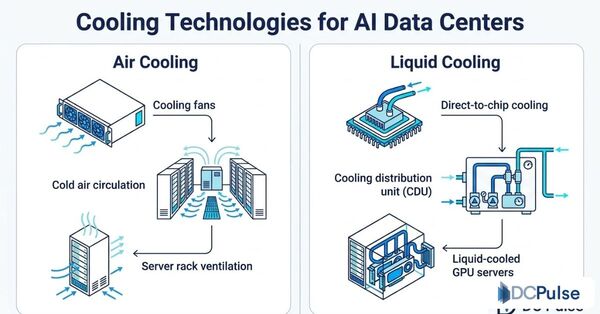
Liquid cooling is becoming an important infrastructure consideration for high-performance computing and AI deployments. As computing equipment generates more concentrated heat, conventional air-based cooling may become less suitable for certain high-density configurations.
Several liquid cooling approaches are available, including direct-to-chip cooling and immersion cooling. Direct-to-chip systems circulate liquid through cold plates attached to heat-generating components, while immersion cooling places compatible IT equipment in specially designed cooling fluids.
However, not every colocation facility supports every cooling technology. AI tenants should establish whether an operator offers liquid cooling infrastructure, supports customer-provided cooling systems, or can accommodate a hybrid arrangement combining air and liquid cooling.
Important technical considerations include cooling distribution units (CDUs), facility water loops, heat exchangers, piping connections, flow requirements, and monitoring capabilities. The responsibilities for installing, maintaining, and operating these components should also be clearly defined.
Compatibility with the tenant's chosen server equipment is equally important. Different GPU platforms and server configurations may have specific cooling requirements that influence the facility's design and operating procedures.
A clear understanding of liquid cooling capabilities can help tenants avoid selecting a facility that requires substantial retrofitting before their AI infrastructure can be deployed.
What Are the Water Usage and Cooling Efficiency Requirements?
Water availability and cooling efficiency are important considerations when evaluating data center locations. Different cooling architectures use different combinations of water, electricity, refrigerants, and ambient air to manage heat.
Some facilities use evaporative cooling technologies, which can involve water consumption, while others rely on air-cooled chillers, dry cooling, or hybrid systems. The choice of technology can influence operating costs, environmental considerations, and cooling performance under different weather conditions.
AI tenants should ask operators about the facility's cooling design, water sourcing arrangements, water consumption practices, and relevant efficiency metrics. Water Usage Effectiveness (WUE) can provide useful information about water consumption relative to IT energy usage, although its interpretation depends on the facility's reporting methodology and operating conditions.
Power Usage Effectiveness (PUE) is another relevant metric because cooling systems contribute to the total energy consumed by a data center. However, a single efficiency figure does not necessarily explain how effectively a facility supports high-density AI workloads.
The operating climate also matters. Outdoor temperatures, seasonal conditions, humidity, and local water availability can influence cooling system performance and operating strategies.
For companies planning long-term AI deployments, understanding these factors can help assess the operational and environmental implications of a colocation agreement.
Can the Cooling Infrastructure Scale With Future AI Requirements?
AI infrastructure requirements can change as businesses expand their computing capacity, introduce newer GPU platforms, or move from initial deployments to larger production environments.
A facility that supports a tenant's current rack density may not necessarily accommodate future requirements without additional cooling infrastructure. For this reason, scalability should be discussed before signing a lease.
Tenants should ask whether additional cooling capacity is available within the existing data hall, whether the operator has plans to upgrade its cooling infrastructure, and what lead times may apply to future expansion.
The availability of cooling distribution systems, chilled water capacity, piping infrastructure, and dedicated mechanical plant capacity can influence how easily a deployment can grow.
Flexibility within the data hall is also important. Some AI deployments may require a combination of conventional air-cooled racks and liquid-cooled systems. Operators should explain whether the facility can accommodate different cooling configurations without affecting neighboring tenants or existing operations.
The lease agreement should clearly address the process for requesting additional capacity, associated costs, infrastructure modifications, and delivery timelines.
A long-term cooling strategy can help AI companies avoid infrastructure limitations that could affect future deployment plans.
What Cooling Redundancy and Service-Level Guarantees Are Included?
Cooling reliability is essential for maintaining stable data center operations. AI workloads often involve expensive computing equipment and interconnected systems, making infrastructure interruptions an important operational concern.
Tenants should understand how the facility maintains cooling availability during equipment failures, maintenance activities, and unexpected operating conditions.
Questions should cover redundancy arrangements across chillers, pumps, cooling distribution units, heat exchangers, and other critical mechanical components. Businesses should also understand whether redundancy is provided at the facility level, cooling system level, or individual equipment level.
Different facilities may use configurations such as N+1 or 2N redundancy, but the actual protection depends on system design, equipment separation, distribution pathways, and operational procedures.
Service-level agreements (SLAs) deserve particular attention. AI tenants should examine whether cooling availability is explicitly covered, how environmental operating conditions are defined, and what procedures apply when cooling performance falls outside agreed parameters.
Monitoring and incident response capabilities are equally important. Operators should explain how temperature, humidity, coolant flow, and other relevant operating conditions are monitored. Tenants should also understand notification procedures, escalation processes, maintenance responsibilities, and access to operational information.
Clear contractual responsibilities can reduce uncertainty when cooling-related issues arise during the lease period.
Making Cooling a Priority in AI Colocation Decisions
Cooling infrastructure is becoming a central part of AI data center site selection and colocation planning. As GPU-intensive computing increases the demand for high-density environments, tenants need to evaluate facilities based on their ability to deliver suitable thermal management alongside power, connectivity, and physical infrastructure.
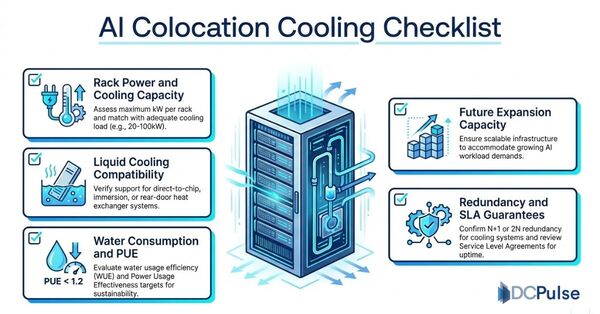
The five questions provide a starting point for assessing whether a colocation facility can support AI workloads. Rack density, liquid cooling compatibility, water usage, future scalability, and cooling reliability should all form part of technical due diligence.
For colocation providers, the growing requirements of AI tenants also create pressure to develop more flexible cooling architectures. Facilities may need to accommodate higher rack densities, liquid cooling technologies, advanced monitoring systems, and changing operational requirements.
Ultimately, a successful colocation agreement should establish more than the availability of rack space and electricity. A clear understanding of cooling capacity, infrastructure responsibilities, expansion options, and service-level commitments can help AI companies select facilities that support their computing requirements over the long term.