DCPulse
Harbor Link Holdings is expanding its underground fiber infrastructure into CoreSite’s DC2 data center in Washington, D.C., adding another network pathway to a regional data center environment used by enterprises, carriers, cloud providers, and network operators. The deployment is part of Harbor Link’s broader Mid-Atlantic network expansion and is intended to increase connectivity options across CoreSite’s Washington, D.C., and Northern Virginia footprint.
The project will provide connectivity into CoreSite’s DC2 facility and extend across the regional campus environment, including DC1 in Washington, D.C., and VA1, VA2, and VA3 in Northern Virginia. The expansion places underground fiber infrastructure directly within a data center ecosystem where network interconnection is an important component of digital infrastructure availability.
For data center customers, the significance extends beyond the addition of another fiber route. Greater carrier diversity can give organizations more options for connecting facilities, cloud environments, enterprise networks, and other digital infrastructure while supporting network resilience and flexibility.
Route Diversity Gains Importance in Dense Data Center Markets
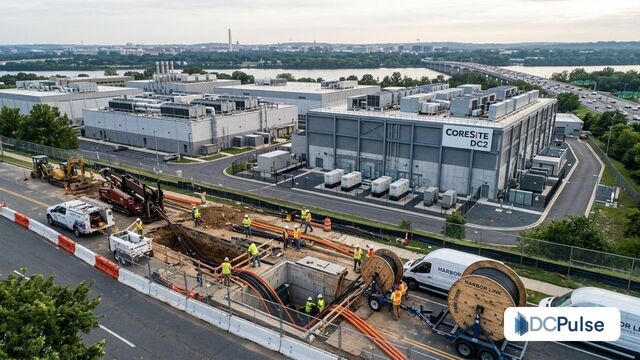
Washington, D.C., and Northern Virginia represent an established data center and connectivity environment where network infrastructure must operate across a complex metropolitan landscape. Harbor Link says its underground network is designed to pass beneath rivers, roadways, and major crossings, creating additional routes through a region where infrastructure availability can be constrained.
Underground routing can be relevant to data center operators because physical network paths form part of the resilience architecture connecting facilities to external networks. A data center may have substantial internal redundancy, but connectivity to carriers, cloud services, enterprises, and other facilities also depends on diverse external routes.
The Harbor Link deployment therefore adds another layer to the connectivity choices available within the CoreSite environment. The company describes its network as 100% underground and focused on high-capacity fiber infrastructure across the Mid-Atlantic region.
CoreSite’s Campus Model Supports Interconnection
CoreSite's carrier ecosystem already includes a broad range of network providers across its data center portfolio, with its carrier directory listing Harbor Link among providers available in the NOVA/DC market.
The addition of another network operator can matter at the campus level because customers increasingly require connectivity across multiple network environments rather than relying on a single transport path. Enterprises may need access to cloud providers, carriers, internet services, private networks, and other data center locations from the same infrastructure environment.
CoreSite’s Washington, D.C., campus therefore functions as more than a collection of individual buildings. Connectivity between facilities and the wider regional network can influence how effectively customers use colocation and interconnection infrastructure.
The Harbor Link expansion is designed to extend access across both DC2 and DC1, while the associated regional connectivity includes CoreSite’s Northern Virginia facilities.
Underground Infrastructure Can Strengthen Network Resilience
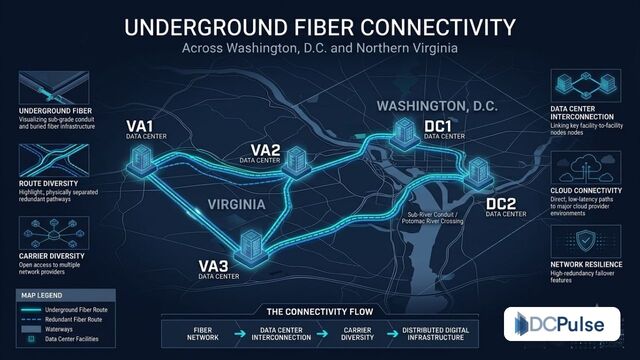
Physical route diversity is particularly relevant when organizations operate workloads that depend on continuous network access. Multiple pathways can reduce dependence on a single physical route, although the actual resilience provided by any network architecture depends on how routes are engineered, separated, monitored, and managed.
Harbor Link’s announcement specifically positions the deployment as additional route diversity for the Washington, D.C., and Northern Virginia markets. The company says the infrastructure is intended to support customers requiring scalable, low-latency connectivity across the region.
For data center customers, this can translate into additional options when designing connectivity architectures. Network planners can evaluate routes based on physical diversity, carrier selection, latency requirements, capacity needs, and connections to critical facilities.
Such considerations become increasingly important as applications become more distributed. Cloud services, enterprise systems, AI workloads, content platforms, and other digital applications can depend on connections between multiple facilities and network endpoints.
Connectivity Is Becoming a Data Center Design Consideration
Data center development increasingly involves more than power, buildings, cooling systems, and compute capacity. Network availability is also an important component of site selection and operational planning.
A facility with access to multiple fiber routes and network providers can offer customers more flexibility when establishing connectivity. The availability of diverse paths can also influence how organizations structure connections between primary sites, disaster recovery environments, cloud platforms, and other operational locations.
The Harbor Link project illustrates this relationship between external fiber infrastructure and data center ecosystems. Rather than treating connectivity as a service added after a facility is built, network infrastructure can become part of the physical architecture surrounding the campus.
This approach is particularly relevant in established markets where new physical routes can be more difficult to develop because of road crossings, waterways, existing utilities, permitting requirements, and limited rights of way.
Implications for Cloud and AI Infrastructure
The expansion also has implications for workloads that depend on connections between data centers and cloud environments. AI infrastructure, for example, can involve distributed compute, storage, networking, and data resources, although the specific network requirements vary considerably by workload architecture.
High-capacity interconnection can support data movement between infrastructure locations, but connectivity alone does not determine application performance. Latency, bandwidth, network architecture, compute placement, and application design all contribute to the overall outcome.
For cloud and enterprise customers operating across Washington, D.C., and Northern Virginia, additional network options can provide another building block for designing distributed infrastructure. The availability of multiple providers and routes can allow organizations to evaluate connectivity according to their individual performance and resilience requirements.
The broader direction is consistent with the evolution of data centers into interconnected infrastructure platforms rather than isolated computing facilities.
A Broader Mid-Atlantic Network Expansion
The CoreSite deployment forms part of Harbor Link’s wider underground fiber expansion across the Mid-Atlantic. The company specializes in conduit infrastructure as well as local and long-haul dark fiber networks, with its infrastructure designed to serve commercial and mission-critical connectivity requirements.
The company's latest expansion adds CoreSite DC2 to its network footprint and extends connectivity across the associated CoreSite campus environment. According to Harbor Link, the project is aimed at enterprises, carriers, cloud providers, and network operators seeking scalable and low-latency connectivity in the Washington, D.C., and Northern Virginia markets.
For the data center sector, the development highlights the role of independent fiber infrastructure in expanding the number of available network pathways around established campuses.
Network Diversity Becomes Part of Digital Infrastructure Strategy
The Harbor Link expansion reflects a broader infrastructure principle: data center capacity is only as useful as the connectivity supporting it. Compute, storage, cloud access, and enterprise applications depend on physical networks that connect facilities to customers and to other digital infrastructure.
Additional fiber routes do not eliminate network risks, and the practical value of any deployment depends on its physical separation, capacity, service design, and integration with customer networks. However, greater carrier and route choice can give data center operators and customers more flexibility when building connectivity architectures.
As digital infrastructure becomes increasingly distributed, those choices are likely to remain an important part of data center planning. The Harbor Link deployment into CoreSite’s Washington, D.C., campus demonstrates how underground fiber networks can become an integral component of the wider data center ecosystem, connecting individual facilities to a broader regional infrastructure fabric.