Pranav Hotkar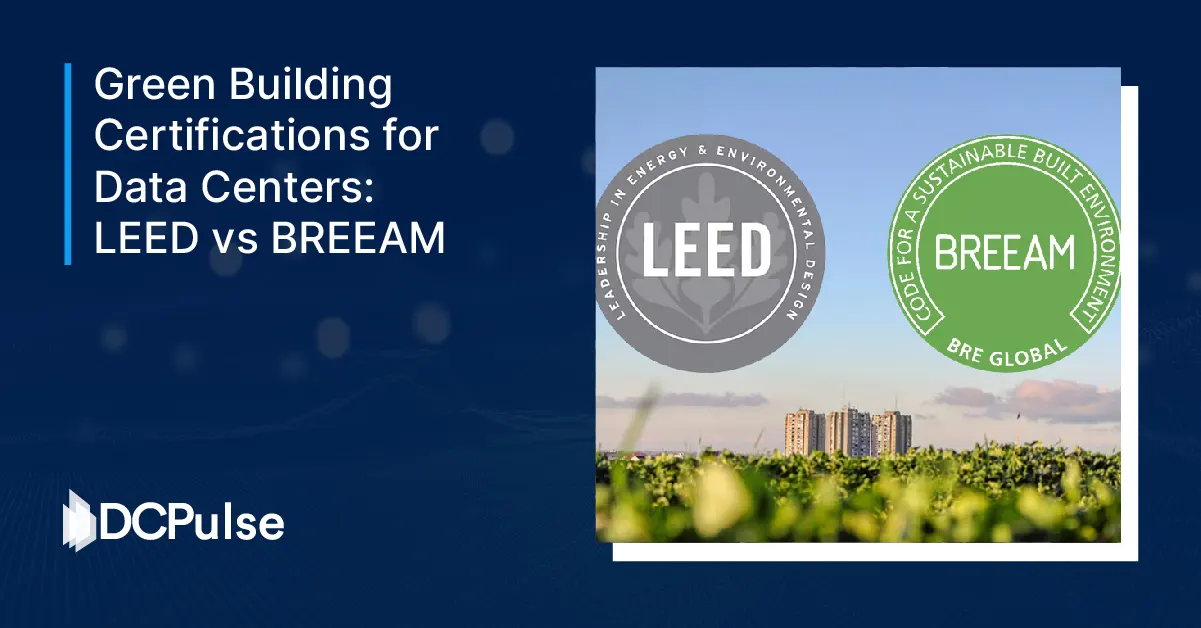
Sustainability in data centers is no longer just a goal; it’s something that must be measured, verified, and certified.
As operators face increasing pressure from regulators, investors, and customers, green building certifications have become a key way to demonstrate environmental performance. Among these, LEED (Leadership in Energy and Environmental Design) and BREEAM (Building Research Establishment Environmental Assessment Method) stand out as the most widely recognized standards globally.
Originally designed for commercial buildings, these certifications are now being applied to data centers, facilities that operate under very different conditions, with extreme energy demands and unique infrastructure requirements.
This raises an important question.
Do traditional building certifications accurately reflect sustainability in such high-performance environments, or are they being adapted to fit a use case they were not originally designed for?
The comparison between LEED and BREEAM is no longer just about scoring systems or regional preferences. It’s about whether these frameworks can meaningfully capture the environmental impact of modern digital infrastructure.
As data centers become central to the global economy, the credibility of these certifications is coming under closer scrutiny.
Why Do Certifications Matter in Data Centers?
Sustainability certifications are becoming a baseline requirement for modern data centers, driven by growing pressure from regulators, investors, and enterprise customers.
Frameworks like LEED, developed by the U.S. Green Building Council, provide a structured approach to designing energy-efficient and environmentally responsible facilities. LEED certification is applied across building types, including data centers, and focuses on reducing energy use, water consumption, and lifecycle costs while improving overall environmental performance.
LEED vs. BREEAM-Certified Data Centers by Region
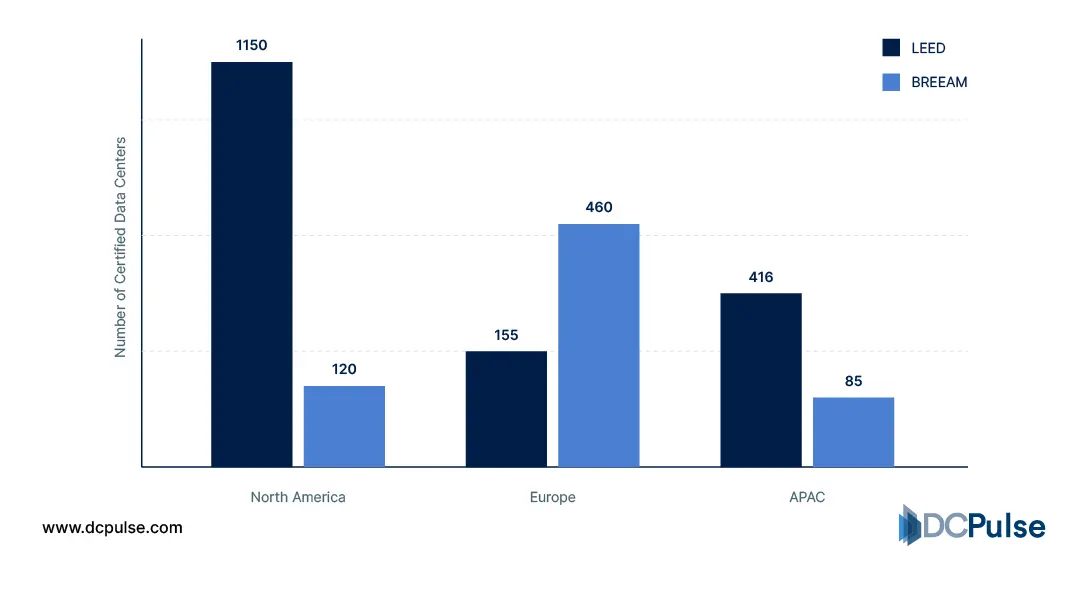
At the same time, BREEAM, developed by the Building Research Establishment, has gained strong traction, particularly in Europe. BREEAM evaluates buildings across multiple sustainability categories, including energy, materials, water, and ecological impact, offering a more holistic environmental assessment.
Adoption is no longer optional in many regions. Policy frameworks are beginning to link financial incentives and regulatory compliance to certification. For example, U.S. state programs now require data centers to achieve recognized sustainability certifications like BREEAM to qualify for incentives, signaling a shift toward enforced accountability.
Growth of sustainability regulations and certification-linked incentives (2015-2030)
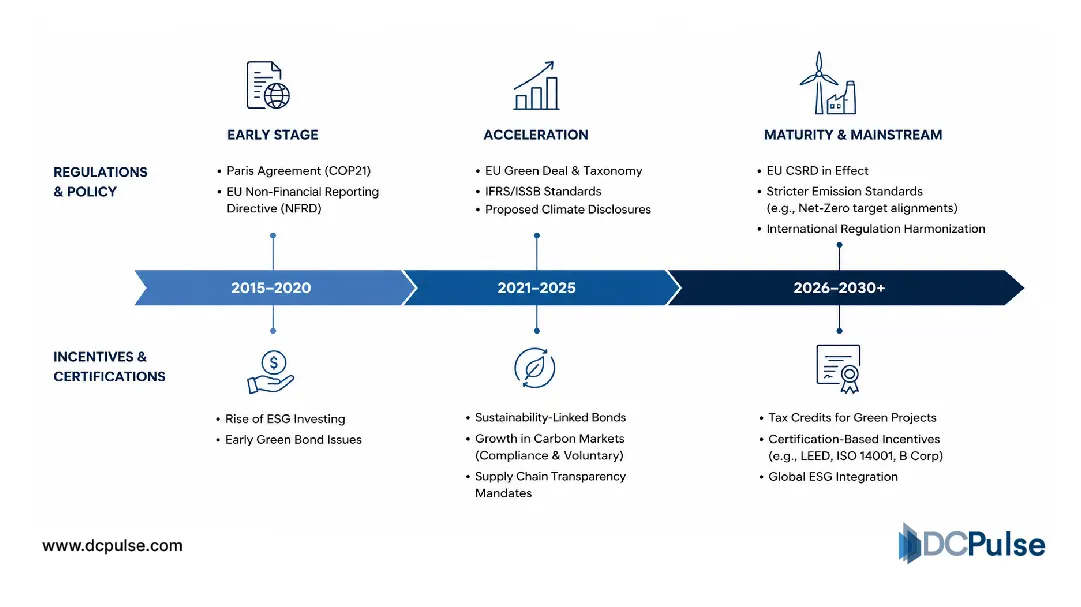
Real-world deployments further highlight this trend. Companies such as Iron Mountain are committing to certifying new data center developments under BREEAM standards, with projects in North America already achieving top-tier ratings.
The landscape is clear; certifications are evolving from optional sustainability signals to formal benchmarks shaping how data centers are financed, designed, and evaluated.
Rethinking Certifications for Data Center Reality
Applying traditional building certifications to data centers has exposed a fundamental mismatch between general sustainability frameworks and highly specialized infrastructure.
Standards like LEED and BREEAM were originally designed for commercial buildings, where occupancy and HVAC efficiency are the primary performance metrics. Data centers, by contrast, operate with continuous high-density compute loads, where most energy consumption is driven by IT equipment rather than building systems.
This has led to the rise of data center–specific metrics. Power Usage Effectiveness (PUE), widely adopted across the industry, is now a primary benchmark for measuring efficiency in data center environments.
At the same time, frameworks are being adapted. The U.S. Green Building Council has introduced data center-specific adaptations within LEED, allowing projects to account for high energy and cooling demands unique to these facilities. As of 2025, more than 1,700 data centers globally are registered or certified under LEED, showing growing adoption.
Growth of LEED-Certified Data Centers (2014-2026)
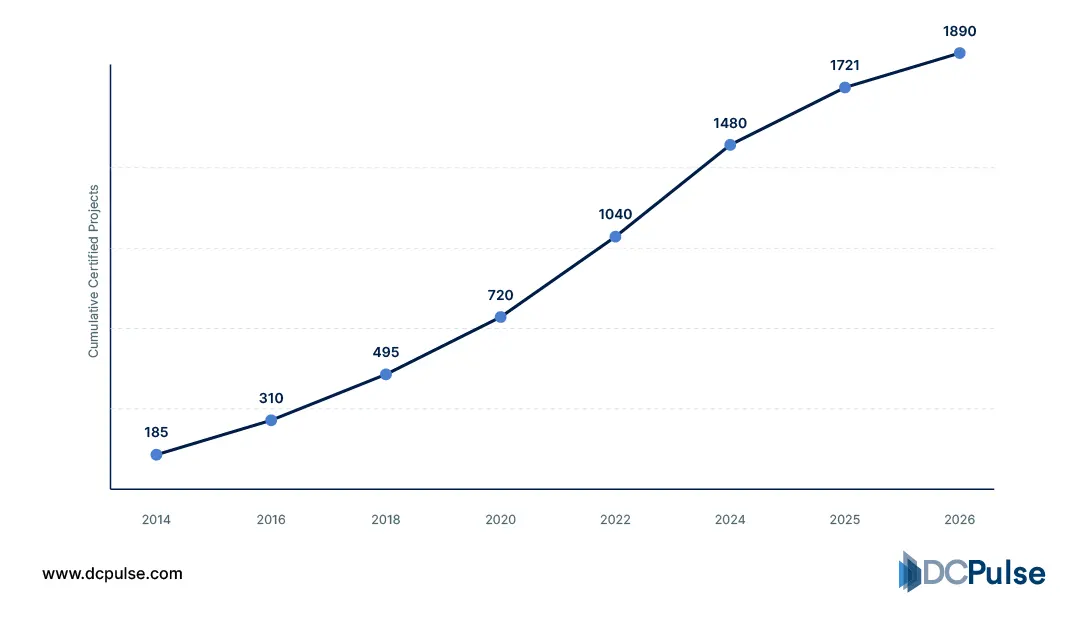
However, gaps remain. Industry analysis highlights that certifications often focus on design and construction criteria, while real sustainability in data centers depends on continuous operational efficiency and workload dynamics.
As a result, the industry is moving toward a hybrid model, combining traditional certifications with real-time operational metrics to better reflect the true environmental impact of modern data centers.
LEED vs BREEAM in Real Deployments
In practice, data center developers and operators are increasingly using green building certifications to demonstrate sustainability leadership, but regional preferences and strategic goals shape which standard they choose.
In North America, the LEED framework has been adapted specifically for data centers by the U.S. Green Building Council (USGBC). According to USGBC’s official guidance, more than 1,700 data centers worldwide are registered or certified under LEED, reflecting significant uptake in the sector. The rating system has been tailored to address data center energy, water, and operational challenges by offering dedicated pathways such as LEED BD+C: Data Centers and LEED O+M for existing facilities.
A notable example of LEED in action is the Wipro Flagship Data Center in North Carolina, which was awarded LEED Gold certification for its energy-efficient design and construction, highlighting early industry adoption of green building standards in IT infrastructure.
Across Europe and increasingly in global markets, the BREEAM framework is often used due to its alignment with regional planning standards and sustainability regulations. Iron Mountain Data Centers’ AZP-2 facility in Phoenix became the first data center in North America to achieve BREEAM certification at the design stage, earning an Excellent rating under BREEAM’s sustainability criteria. Projects in the UK, such as several data center buildings at Cody Park and Spring Park campuses, have also achieved high BREEAM ratings, demonstrating broader adoption of BREEAM in Europe.
Industry analysis shows that certification choice is often influenced by regulatory expectations and investor preferences rather than purely technical differences in environmental performance. In North America, LEED’s strong brand recognition and tailored data center guidance make it a preferred choice, while BREEAM’s comprehensive scoring and integration with European sustainability frameworks drive its use in that region.
LEED vs. BREEAM-Certified Data Center Projects (By Region, 2026 Est.)
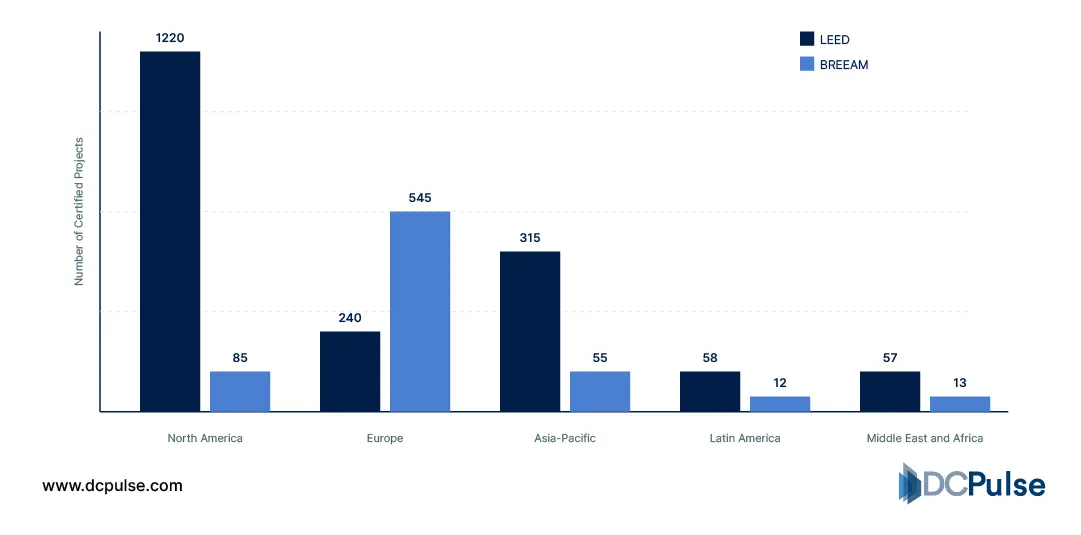
Overall, LEED and BREEAM continue to shape how sustainability is communicated in the data center sector, with real deployments illustrating both frameworks’ strategic value for developers and operators alike.
Is Green Certification Still Enough for Data Centers? Or Just the Starting Point?
Green certifications like LEED and BREEAM remain important, but they no longer define the full picture of data center sustainability.
They still provide structure, guiding design standards, improving energy efficiency, and supporting ESG reporting. In many cases, they are essential for approvals and investor confidence. But their role is increasingly limited to design validation rather than real performance measurement.
The problem is that data centers are no longer static buildings. They are dynamic computing environments driven by AI workloads and constantly shifting energy demands. Traditional certification systems struggle to capture this real-time complexity because they focus on design intent, not operational behavior.
This is why the industry is moving toward live metrics like PUE trends, carbon-aware workload management, and real-time energy optimization. Research from the Uptime Institute shows that operators are prioritizing continuous performance monitoring over one-time certification outcomes.
The direction is clear: certifications will remain the baseline, but real sustainability will be defined by how efficiently data centers operate under real workloads and grid conditions.
In the end, certification is no longer the finish line; it is only the starting point.
.jpg)
.jpg)