Pranav Hotkar
Cooling in data centers has always evolved alongside compute, but AI is forcing that evolution to accelerate.
As workloads shift toward high-density GPU clusters, traditional air cooling is reaching its limits, and even single-phase liquid cooling, once considered the next step forward, is beginning to face constraints. The challenge is no longer just removing heat. It’s doing so efficiently at extreme power densities without driving up energy use or infrastructure complexity.
This is where two-phase liquid cooling is entering the conversation.
Unlike conventional systems that rely on liquid remaining in a single state, two-phase cooling uses phase change, liquid turning into vapor, to absorb and transfer heat far more efficiently. This allows significantly higher heat removal within smaller footprints, making it particularly attractive for next-generation AI infrastructure.
The concept is not entirely new, but its application in data centers is gaining renewed attention as thermal demands intensify.
The promise is clear: higher efficiency, better heat management, and support for ultra-dense compute environments.
The question is whether two-phase cooling is ready to move beyond experimentation and become a practical solution at scale.
Limits of Air and Single-Phase Cooling
The evolution of data center cooling has already moved beyond air, but even current solutions are starting to show their limits under AI workloads.
Air cooling, once the industry standard, is increasingly unable to handle rising thermal density. As AI clusters push power consumption higher, operators have shifted toward liquid cooling, which is far more efficient at removing heat. Industry reporting indicates that liquid cooling can be significantly more effective than air at heat transfer, enabling support for higher-density infrastructure.
Rack Density vs. Cooling Capability (Air vs. Liquid)
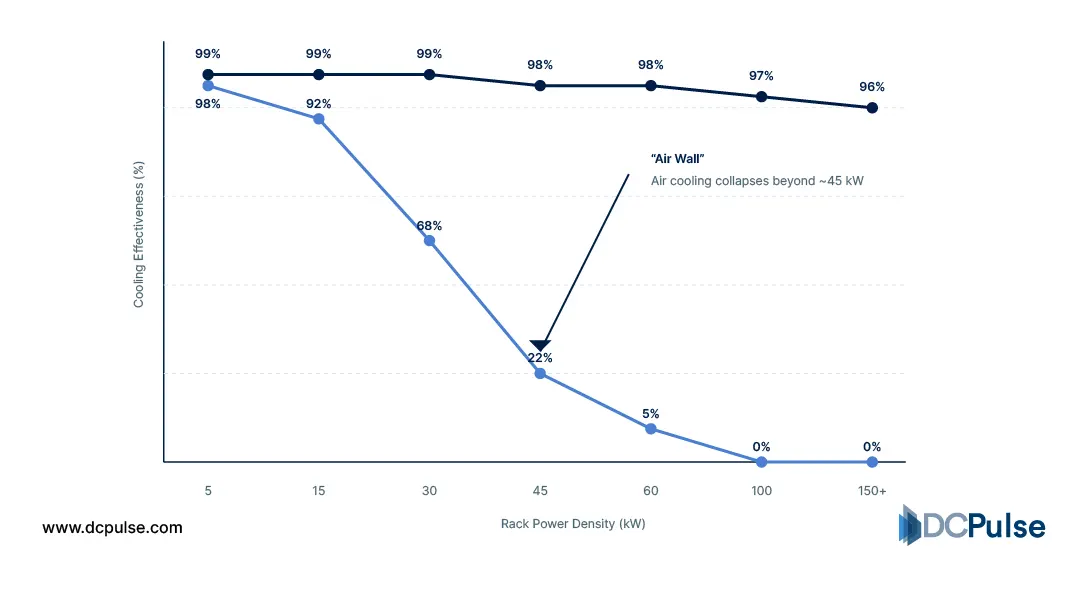
This shift has helped data centers scale, but it has also introduced new challenges. Liquid systems require more complex infrastructure, including pumps, piping, and leak management, increasing operational complexity.
At the same time, cooling demand itself is rising sharply. Some data centers now consume vast amounts of water for cooling, underscoring the growing strain on both infrastructure and resources.
Even with these advancements, single-phase liquid cooling still relies on circulating fluid to carry heat away, which creates efficiency limits as thermal loads continue to climb.
The direction is clear; while liquid cooling has extended the ceiling, it has not removed it. As AI-driven density continues to rise, the industry is now looking beyond single-phase systems toward more efficient approaches like two-phase cooling.
How is Two-Phase Cooling Redefining Heat Removal?
Two-phase liquid cooling represents a fundamental shift in how heat is managed inside data centers.
Unlike single-phase systems, where liquid absorbs heat and is circulated away, two-phase cooling uses phase change to significantly increase heat transfer efficiency. As components heat up, the coolant boils and turns into vapor, absorbing large amounts of energy through latent heat. The vapor is then condensed back into liquid and reused in a closed-loop cycle.
Research shows that two-phase systems can maintain stable chip temperatures even at high power densities, making them well-suited for AI-driven workloads.
Heat Transfer Efficiency - Air vs. Single-phase vs. Two-phase
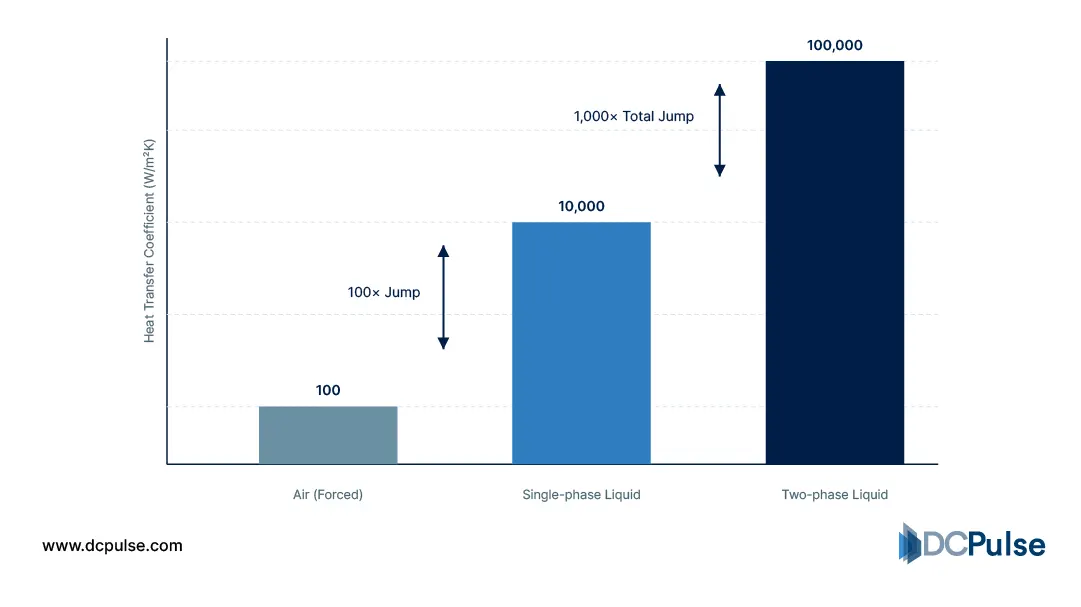
The key advantage lies in latent heat. Unlike single-phase cooling, which depends on temperature rise, two-phase systems absorb energy during boiling, enabling significantly higher heat removal per unit of coolant.
Two main architectures are emerging. In direct-to-chip systems, boiling occurs at the processor surface, enabling targeted heat removal. In immersion systems, servers are submerged in a fluid that evaporates under load, allowing uniform cooling across components.
However, this efficiency comes with complexity. Two-phase systems require precise control of pressure, temperature, and condensation cycles, making them more challenging to operate than conventional designs.
Despite these challenges, two-phase cooling offers a clear advantage: higher efficiency and better thermal stability, positioning it as a strong candidate for next-generation data center infrastructure.
Who’s Betting on Two-Phase?
Two-phase cooling is beginning to move beyond theory, with early pilots, vendor activity, and market growth signals indicating real industry momentum.
Large-scale experimentation is already underway. Reports show that companies like NTT are actively testing two-phase direct-to-chip cooling and running field trials in live data center environments, signaling a transition from lab research to operational validation.
Evolution of Thermal Management Systems
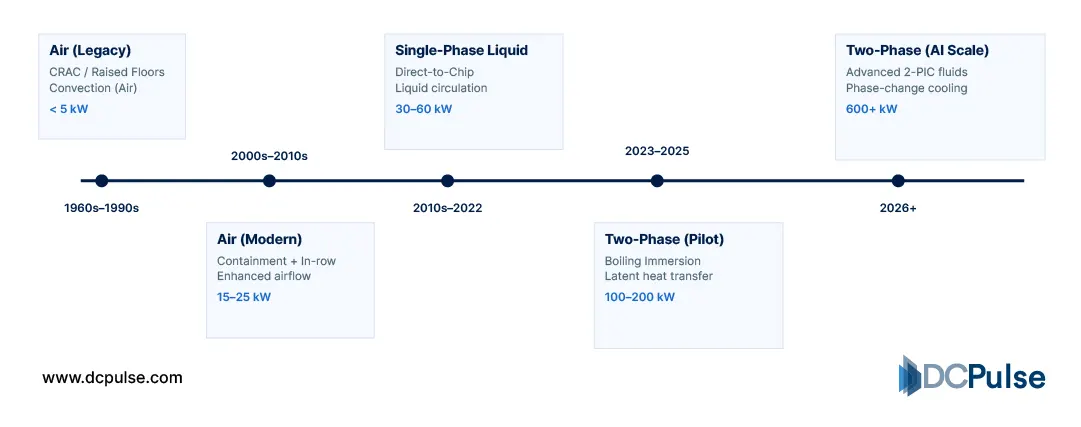
Vendors are also accelerating development. Companies such as Vertiv are working with chip manufacturers to test pumped two-phase direct-to-chip systems, aiming to improve efficiency for AI workloads.
At the same time, hardware and ecosystem players are aligning around the technology. Samsung Electronics has qualified two-phase immersion cooling fluids for enterprise storage systems, indicating growing hardware compatibility with phase-change environments.
Market signals reinforce this trend. The global two-phase immersion cooling market is projected to grow significantly, reaching over USD 1.6 billion by 2034, driven by demand for higher density and energy efficiency.
Two-Phase Cooling Market Growth Trajectory (2024-2032)
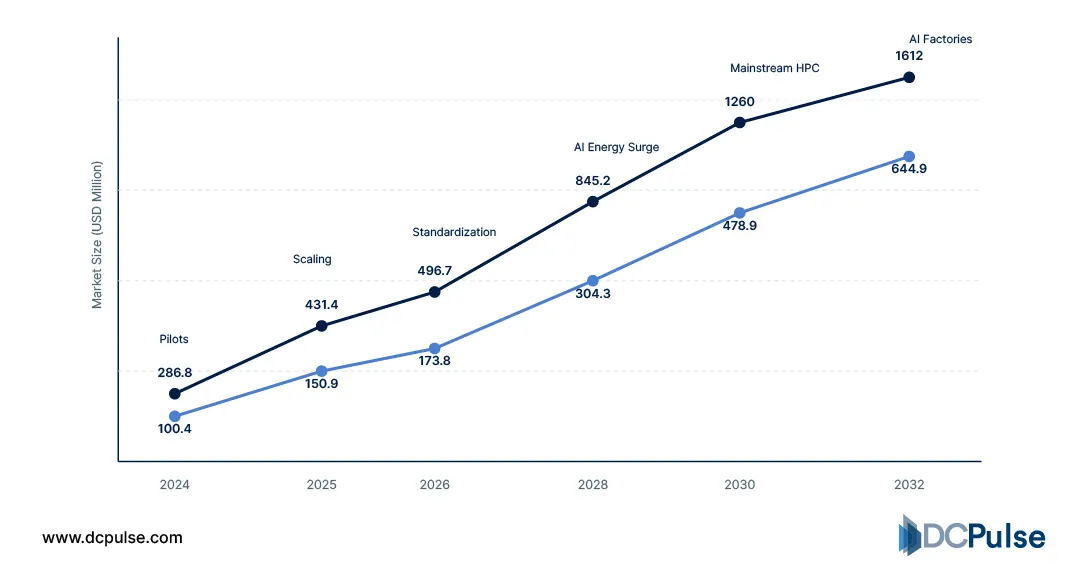
Despite this progress, adoption remains selective. Most deployments are still in pilot or early-stage rollout, as operators evaluate reliability, cost, and integration complexity.
However, the direction is clear: two-phase cooling is shifting from experimental validation toward targeted deployment, particularly in high-density AI and HPC environments where existing cooling methods are reaching their limits.
Is two-phase cooling a breakthrough or niche solution?
Two-phase cooling is not a universal replacement for existing systems, but it is far more than a niche experiment.
The technology clearly delivers superior thermal performance. Its ability to handle extreme heat loads makes it one of the few solutions capable of supporting next-generation AI infrastructure, where power densities are rising beyond the limits of air and even single-phase liquid cooling. In high-density environments, especially those built around advanced GPUs, two-phase systems offer a level of efficiency that traditional methods struggle to match.
However, scalability remains the key constraint. Two-phase cooling introduces operational complexity, from pressure control to vapor management, and requires specialized infrastructure that is not easily retrofitted into existing data centers. Cost, reliability, and standardization are still evolving, which limits widespread adoption in the near term.
The most realistic outcome is targeted deployment.
Two-phase cooling will likely be adopted first in high-performance, high-density environments, AI clusters, hyperscale facilities, and specialized workloads, where its advantages justify the added complexity. For broader data center infrastructure, single-phase liquid cooling will continue to dominate.
Two-phase cooling is not the default future, but it is a critical next step. It will define the upper tier of data center performance, enabling systems that would otherwise be thermally impossible to operate.