Pranav Hotkar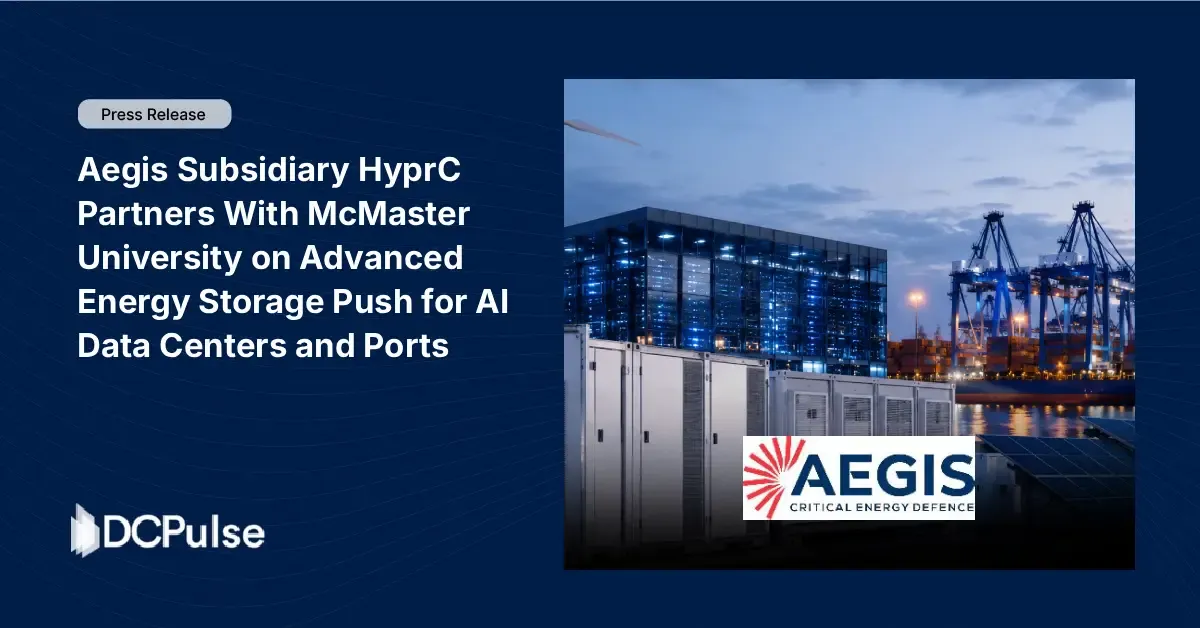
Toronto, Canada – June 15, 2026 - HyprC, a subsidiary of Canadian clean technology company Aegis Brands, has launched a multi-million-dollar research partnership with McMaster University aimed at developing next-generation energy storage systems for AI data centers, ports, and hybrid nuclear-powered infrastructure.
The collaboration includes an initial corporate investment commitment of USD 1 million and will focus on advancing high-density, long-duration energy storage technologies designed for rapidly growing industrial power markets. According to the announcement, the initiative will combine HyprC’s commercialization strategy with McMaster’s engineering and materials science expertise to accelerate deployment-ready systems for energy-intensive environments.
The companies said the research program is targeting sectors facing rising electricity demand and increasing grid instability, particularly AI data centers and electrified industrial operations. AI infrastructure has emerged as one of the fastest-growing electricity consumers globally as hyperscalers expand GPU-heavy computing clusters that require both massive power capacity and continuous uptime.
HyprC said the partnership will prioritize storage technologies capable of supporting hybrid energy architectures, including systems integrated with renewable generation and advanced nuclear power platforms. The company believes future digital infrastructure will increasingly depend on resilient storage layers capable of balancing intermittent power supply, smoothing peak demand, and supporting critical backup operations.
McMaster University researchers will contribute expertise in battery chemistry, advanced materials, and energy systems engineering. The program is also expected to support commercialization pathways for scalable storage technologies that can operate in harsh industrial and mission-critical environments.
The announcement reflects broader shifts underway across the infrastructure and energy sectors as operators search for alternatives to conventional lithium-ion systems. AI data centers, ports, and heavy industrial facilities are placing new pressure on utilities and transmission networks, driving interest in long-duration storage, grid-balancing technologies, and hybrid microgrid systems.
Recent academic research has identified AI data center load volatility as an emerging challenge for power grids, particularly as high-density AI clusters create rapid and unpredictable power fluctuations. Studies have increasingly highlighted hybrid storage systems as a potential solution for stabilizing power demand and improving grid resilience near large-scale compute campuses.
The partnership also points to growing industry interest in pairing advanced nuclear technologies with AI infrastructure. Hybrid nuclear-energy-backed systems are gaining attention among technology and infrastructure firms seeking carbon-free, always-on power sources capable of supporting hyperscale compute growth.
Officials said the HyprC–McMaster initiative is expected to create new research opportunities, support commercialization efforts, and strengthen Canada’s position in advanced energy infrastructure development tied to the global AI economy.