Pranav Hotkar
Colocation providers are no longer competing on space, power, or uptime alone. Increasingly, they are competing on how sustainable their infrastructure is and how convincingly they can prove it. For enterprise customers, the decision is no longer just technical. It is becoming environmental.
Large tenants, from hyperscalers to financial institutions, are under growing pressure to meet their own climate targets. That pressure is cascading down the value chain, forcing colocation providers to demonstrate not just efficiency, but measurable reductions in carbon impact. Metrics like renewable energy usage, carbon intensity, and energy efficiency are moving from supporting details to primary decision factors.
This shift is changing how colocation is positioned and sold. Providers are no longer just offering capacity; they are offering a pathway to lower emissions. But not all “green” claims carry the same weight. Differences in how sustainability is measured, reported, and verified are creating a new layer of competition, one defined as much by transparency as by performance.
In this environment, sustainability is no longer a differentiator. It is becoming a requirement and a benchmark for credibility.
How are colocation providers currently measuring and competing on sustainability?
Colocation providers today compete on sustainability through a growing set of metrics, but the landscape remains fragmented and uneven.
Power Usage Effectiveness (PUE), introduced by The Green Grid, remains the most widely used benchmark. It measures the ratio of total facility energy to IT energy, making it a simple indicator of efficiency, but not of total environmental impact.
PUE vs. Absolute Carbon Emissions
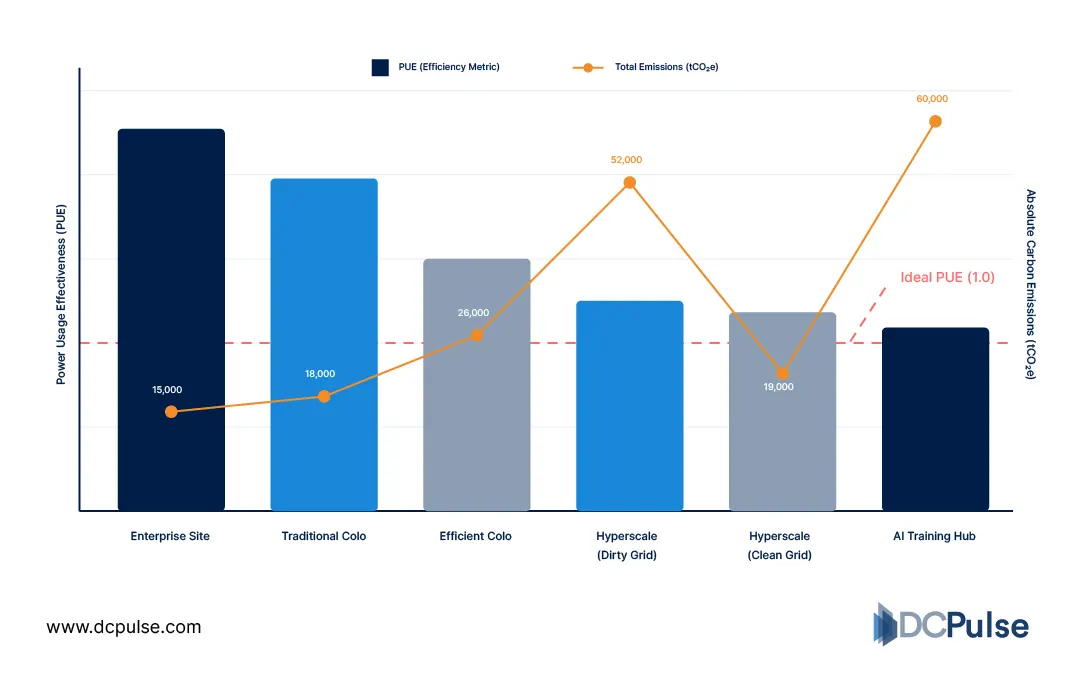
Despite years of optimization, progress has slowed. According to the Uptime Institute, industry average PUE has remained largely flat at around 1.5-1.6 in recent years, highlighting diminishing returns from efficiency gains alone.
To address this gap, providers are expanding into broader sustainability metrics. These include renewable energy sourcing, water usage, and lifecycle considerations such as equipment reuse and circularity. However, adoption is inconsistent. Uptime Institute research shows that while most operators track power metrics, only about one-third track carbon emissions and far fewer track water or lifecycle impacts, reflecting limited standardization.
Data Center Sustainability Metric Tracking (2025–2026)
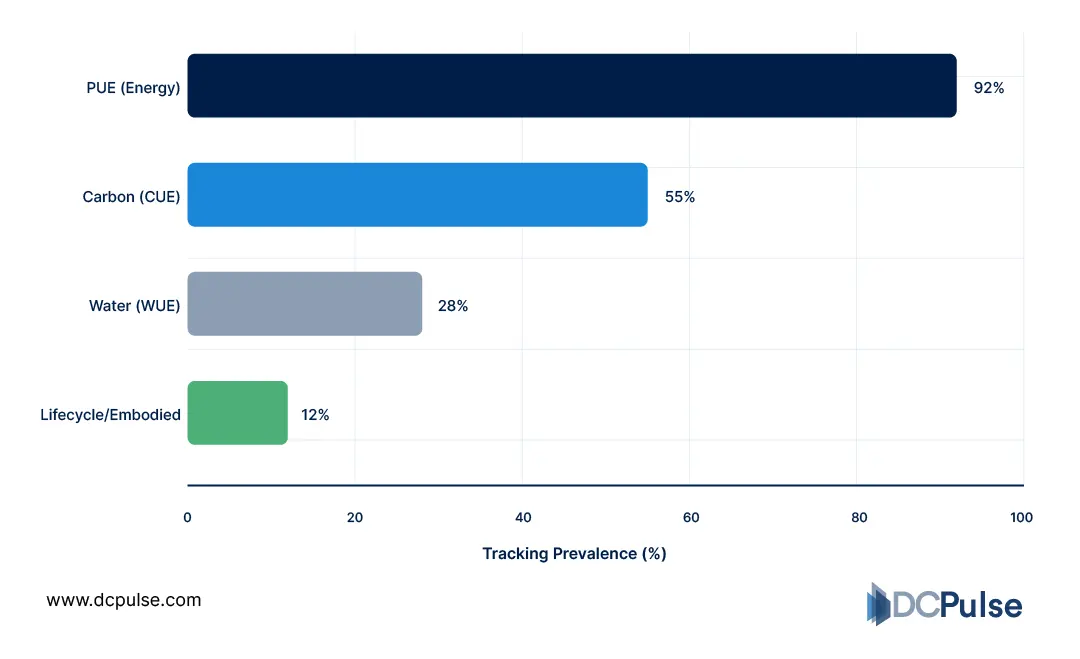
The result is a market where sustainability is measured more than ever, but not yet measured consistently, making direct comparisons between providers difficult.
What innovations are redefining sustainability in colocation?
Colocation providers are moving beyond basic efficiency metrics toward innovations that deliver measurable environmental impact across energy, cooling, and infrastructure lifecycle.
One of the most significant shifts is in cooling. As efficiency gains from traditional air systems plateau, operators are increasingly exploring direct liquid cooling (DLC) as the next step. According to the Uptime Institute, industry-wide efficiency improvements have slowed, with average PUE stabilizing around ~1.6, pushing operators to adopt new cooling approaches for further gains.
Cooling evolution - Air (plateauing efficiency) vs Liquid cooling
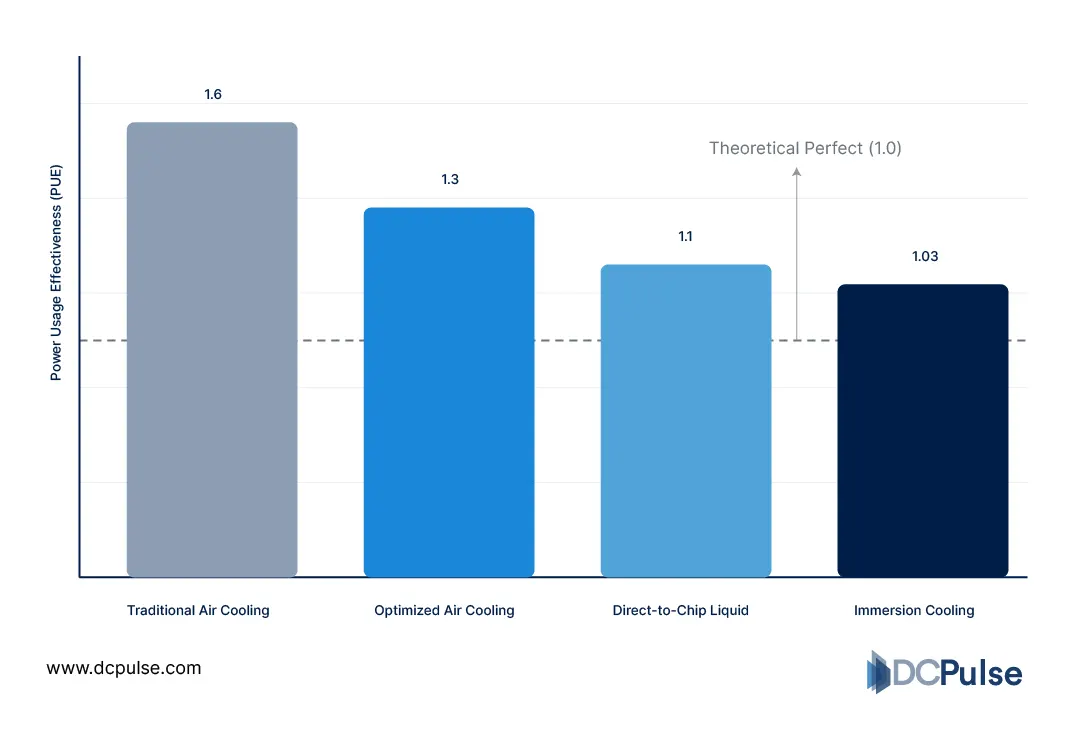
Liquid cooling also enables higher operating temperatures and improved heat capture, making heat reuse increasingly viable. Uptime research highlights that these systems can support waste heat recovery and integration into external uses such as district heating.
Water usage is another area of innovation. Traditional cooling methods can consume significant water, but newer designs are shifting toward water-efficient, hybrid, or even waterless systems. Uptime notes that modern facilities can dramatically reduce or nearly eliminate water use depending on cooling architecture.
Beyond operations, sustainability is extending into life cycle design. However, industry research shows that tracking of lifecycle metrics like carbon and equipment disposal remains limited, indicating that circularity is still an emerging focus area.
Together, these innovations show a clear transition: from optimizing single metrics like PUE to redesigning colocation infrastructure around energy, water, and lifecycle impact as a whole.
Which colocation providers are leading on sustainability, and how?
Sustainability competition in colocation is increasingly defined by what providers can measure, verify, and disclose, not just what they claim.
Equinix provides one of the clearest examples of measurable progress. Its latest disclosures show ~96% renewable energy coverage across its global portfolio, supported by power purchase agreements and energy attribute certificates, alongside a long-term goal of reaching 100%. The company also reports Scope 1, 2, and 3 emissions with independent assurance aligned to ISO standards, reflecting a strong push toward transparency.
Renewable energy coverage vs total portfolio energy use.
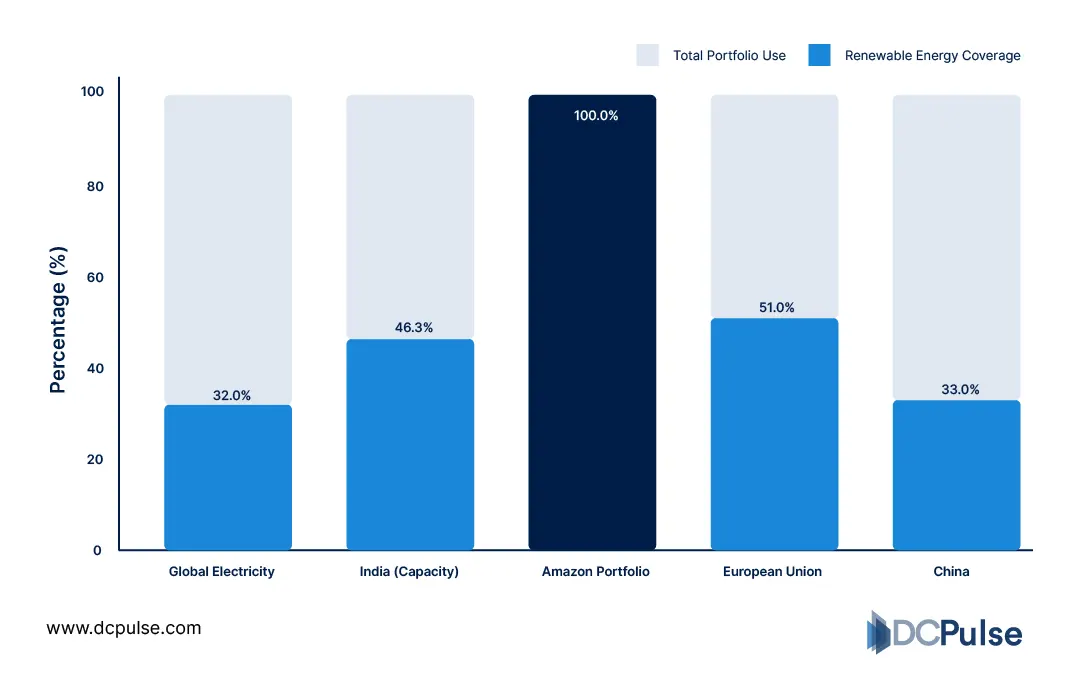
Beyond energy, Equinix is integrating sustainability into infrastructure decisions, evaluating low-embodied carbon materials and supplier impacts as part of new builds, signaling early movement into Scope 3 competition.
This level of disclosure is becoming a competitive baseline. Leading providers are no longer differentiating only through renewable energy procurement but through how deeply sustainability is embedded into operations, reporting frameworks, and customer-facing transparency tools, including site-level emissions data and sustainability dashboards.
The pattern is clear; the leaders in colocation sustainability are those turning sustainability into quantifiable, auditable performance, rather than high-level commitments.
What will define competitive advantage in sustainable colocation going forward?
Sustainability in colocation is moving from a reporting exercise to a core performance metric. What providers measure is no longer enough; what they can verify and demonstrate is becoming the real differentiator.
As customers demand greater transparency, metrics like PUE will continue to matter, but only as part of a broader, more complete picture. The focus is shifting toward auditable data that captures not just energy efficiency, but total environmental impact across operations and infrastructure.
Scope 3 emissions will play a defining role in this transition. As embodied carbon and supply chain impacts come under scrutiny, colocation providers will need to extend their influence beyond facility operations into procurement, construction, and vendor ecosystems.
At the same time, customer expectations are evolving. Enterprises are increasingly looking for site-level visibility into emissions and sustainability performance, making transparency a critical part of the service offering.
The implication is clear; sustainability is no longer a supporting feature; it is becoming part of the core product. Providers that can deliver measurable, verifiable, and lifecycle-based performance will not just meet expectations; they will define the next standard for competition.