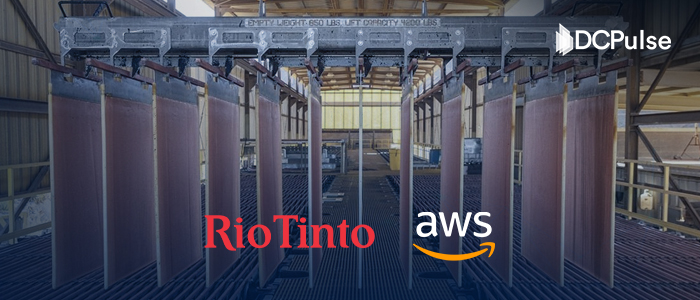
New York, United States - January 12, 2026 - Rio Tinto and Amazon Web Services (AWS) have entered a strategic agreement to supply low-carbon copper for AWS’s expanding portfolio of data centers across the United States, linking the mining giant’s next-generation extraction technology with the cloud provider’s rapidly growing infrastructure footprint.
Under the two-year agreement, AWS will source copper produced using Rio Tinto’s Nuton® bioleaching technology, becoming the first customer to adopt the material for data center infrastructure at scale. The copper will be used in critical components including electrical cabling, transformers, motors, printed circuit boards, and thermal management systems, all of which are essential to high-density, AI-ready data centers.
Nuton technology relies on naturally occurring microorganisms to extract copper from sulfide ores, eliminating the need for traditional concentrators, smelters, and refineries. Rio Tinto says the process significantly reduces energy consumption, water use, and greenhouse gas emissions while delivering 99.99 percent pure copper cathode directly at the mine site. The first industrial-scale deployment is underway at the Johnson Camp mine in Arizona, positioning the project as a domestic source of lower-carbon copper for U.S. infrastructure.
Katie Jackson, chief executive of Rio Tinto Copper, said the collaboration demonstrates how innovation across industries can reshape supply chains. “By combining Nuton technology with AWS’s digital capabilities, we can help deliver copper with a lower carbon footprint while strengthening supply resilience for critical U.S. infrastructure,” she said.
In parallel with the supply agreement, AWS will provide cloud-based analytics and computing services to support optimization of the Nuton process. These tools will be used to model heap-leach performance, improve copper recovery rates, and reduce acid and water consumption, highlighting a two-way collaboration rather than a traditional buyer-supplier relationship.
Amazon’s Chief Sustainability Officer Kara Hurst said the partnership aligns with the company’s long-term climate commitments. “As we continue to expand our data center footprint, sourcing lower-carbon materials is an important lever to reduce emissions across our value chain,” she said, noting Amazon’s goal to reach net-zero carbon by 2040.
The agreement comes as demand for copper accelerates globally, driven by AI workloads, cloud computing growth, electrification, and renewable energy deployment. Data centers, in particular, are increasingly copper-intensive due to rising power densities and advanced cooling requirements. By sourcing material produced closer to where it will be used, the companies say the deal also reduces transportation emissions and improves supply chain transparency.
For the data center sector, the partnership underscores a broader shift toward embedding sustainability into physical infrastructure, not just energy procurement, as operators scale to meet surging digital demand.