Pranav Hotkar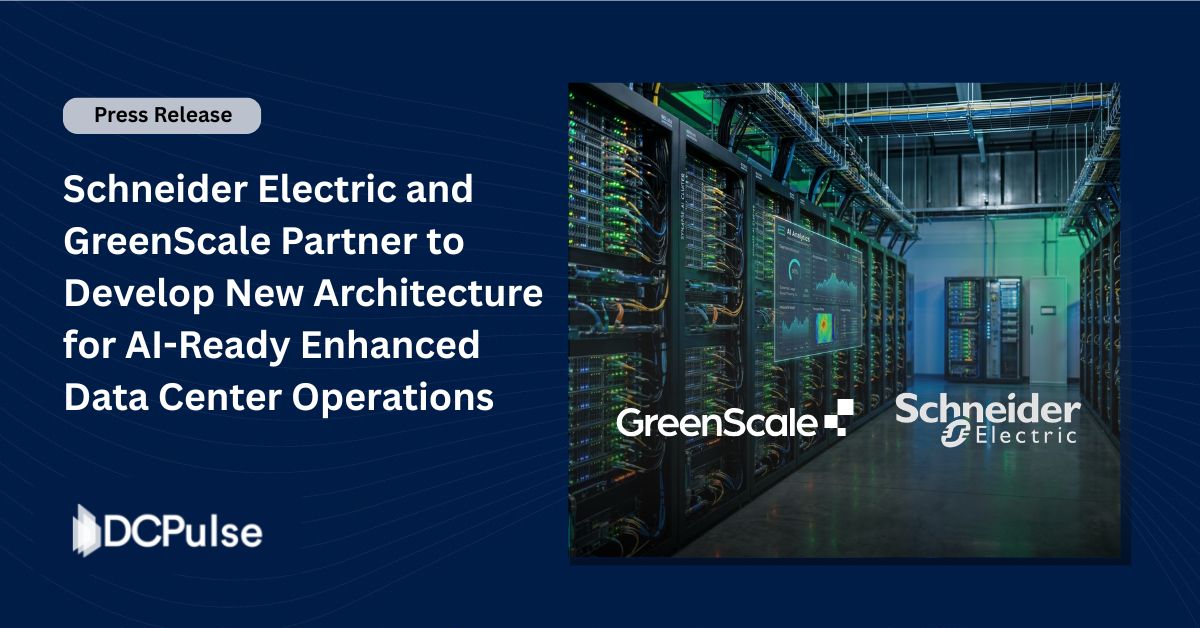
London, United Kingdom - May 5, 2026 - Schneider Electric has announced a strategic partnership with GreenScale to develop a new data center architecture designed specifically for AI-ready operations, as operators face mounting pressure from high-density workloads and rising energy demands.
The collaboration aims to create an integrated framework that combines power, cooling, and digital management into a unified system, an approach increasingly seen as critical for supporting next-generation AI infrastructure. Industry trends show that AI-driven data centers require tightly coordinated systems rather than siloed designs to maintain efficiency and reliability.
At the core of the partnership is a focus on operational intelligence. The companies plan to deploy advanced automation tools, including predictive analytics, condition-based maintenance, and digital twin technologies. These capabilities are expected to improve performance consistency, reduce operational risk, and enable proactive maintenance across distributed data center environments.
The new architecture is also designed to address lifecycle efficiency. By embedding analytics and automation into infrastructure operations, the partners aim to lower total cost of ownership while improving uptime and scalability, two critical metrics as AI workloads push infrastructure to its limits. Early reports indicate the initiative will target enhanced operational visibility and reduced complexity across large-scale deployments.
The announcement comes amid a broader shift in the data center industry, where traditional designs are being re-evaluated to accommodate extreme rack densities and fluctuating AI workloads. Schneider Electric has previously highlighted that supporting these environments requires a more integrated approach to power distribution, cooling systems, and digital controls.
GreenScale’s role in the partnership builds on its focus on sustainable and scalable infrastructure. Previous initiatives between the companies have explored integrating onsite power generation, battery storage, and energy optimization software to improve efficiency and reduce energy consumption over time.
Together, the companies aim to deliver a reference architecture that can be replicated across regions, particularly in Europe, where demand for AI-ready capacity is accelerating. The design is expected to support both hyperscale and emerging edge deployments, reflecting the growing need for flexible infrastructure models.
As AI adoption continues to surge, partnerships like this signal a shift toward standardized, intelligent data center architectures, moving the industry away from bespoke builds and toward repeatable, performance-optimized designs

.jpg)