Pranav Hotkar
Smart cities are being built on a simple expectation: data must move faster than ever, and decisions must happen in real time.
From intelligent traffic systems and connected surveillance to IoT-driven utilities and edge AI applications, urban infrastructure is becoming increasingly dependent on low-latency computing. Traditional centralized data centers, often located far from the point of use, struggle to meet these demands due to latency, bandwidth constraints, and network congestion.
This is where micro data centers are emerging as a critical piece of the puzzle.
Compact, modular, and deployed close to end users, micro data centers bring compute and storage directly to the edge of urban environments. They enable faster processing, reduce data backhaul to core facilities, and support real-time applications that smart cities rely on to function efficiently.
But proximity alone does not guarantee scalability.
Deploying distributed infrastructure across cities introduces challenges, ranging from space constraints and power availability to security and maintenance complexity. As cities become smarter, the question is no longer whether edge infrastructure is needed.
It's a question of whether micro data centers can scale fast enough and efficiently enough to support the cities of the future.
Where Do Micro Data Centers Stand Today?
Micro data centers are emerging as a practical extension of edge computing, bringing compute infrastructure closer to where data is generated. Unlike traditional facilities, these systems are compact, modular, and self-contained, often deployed in telecom sites, industrial environments, retail locations, and urban infrastructure nodes.
According to Schneider Electric, micro data centers are pre-integrated systems that combine power, cooling, security, and IT infrastructure into a single enclosure, enabling rapid deployment at the edge.
This architecture supports a key industry shift: processing data closer to the source. As IBM explains, edge computing reduces latency and bandwidth strain by analyzing data locally rather than sending everything to centralized cloud environments.
Latency Comparison: Data Architecture Tiers
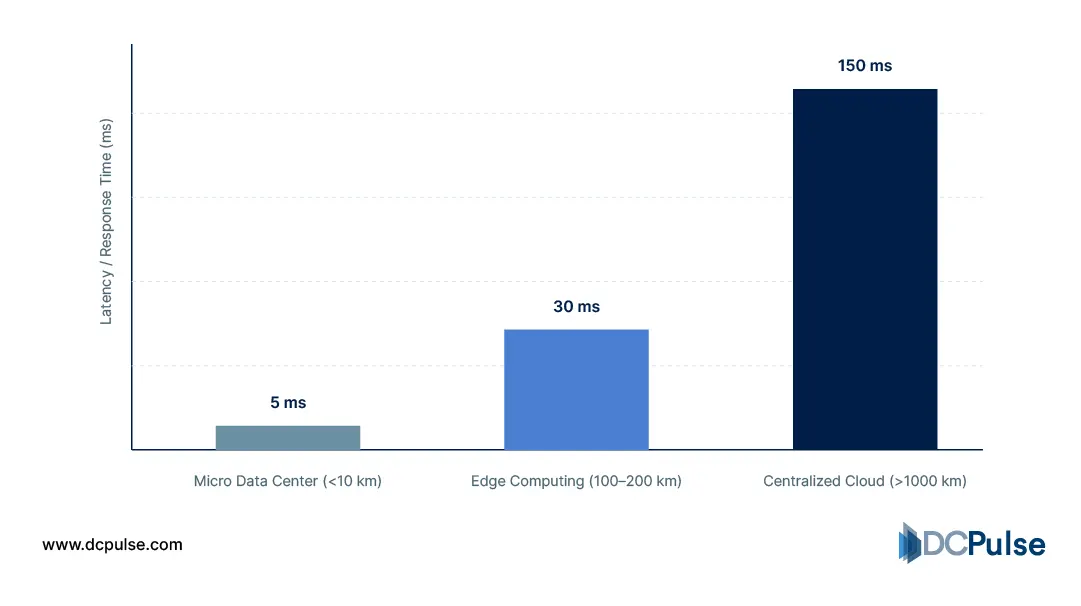
Adoption today is strongest in environments where real-time processing is critical, including industrial IoT, video analytics, and distributed enterprise operations. These deployments are typically targeted and use-case driven rather than city-wide.
Industry coverage also shows that vendors are expanding micro data center offerings specifically for edge and industrial use cases, enabling IT capacity to be deployed quickly in non-traditional locations.
However, large-scale smart city deployments remain limited. Most implementations today are localized and fragmented, reflecting early-stage adoption rather than fully integrated urban infrastructure.
The current landscape, therefore, is transitional; micro data centers are proven in specific scenarios but not yet scaled across entire smart city ecosystems.
Why Micro Data Centers Are Gaining Momentum
The growth of micro data centers is being driven by a convergence of technologies, particularly IoT, edge AI, and 5G, that require real-time localized processing.
One of the biggest drivers is the rapid shift toward edge computing. Industry trends show that a growing share of data is now being processed closer to where it is generated, rather than in centralized cloud environments. This shift is largely fueled by AI workloads and the need for faster decision-making.
Growth of Edge-Processed vs. Centralized Data (ZB)
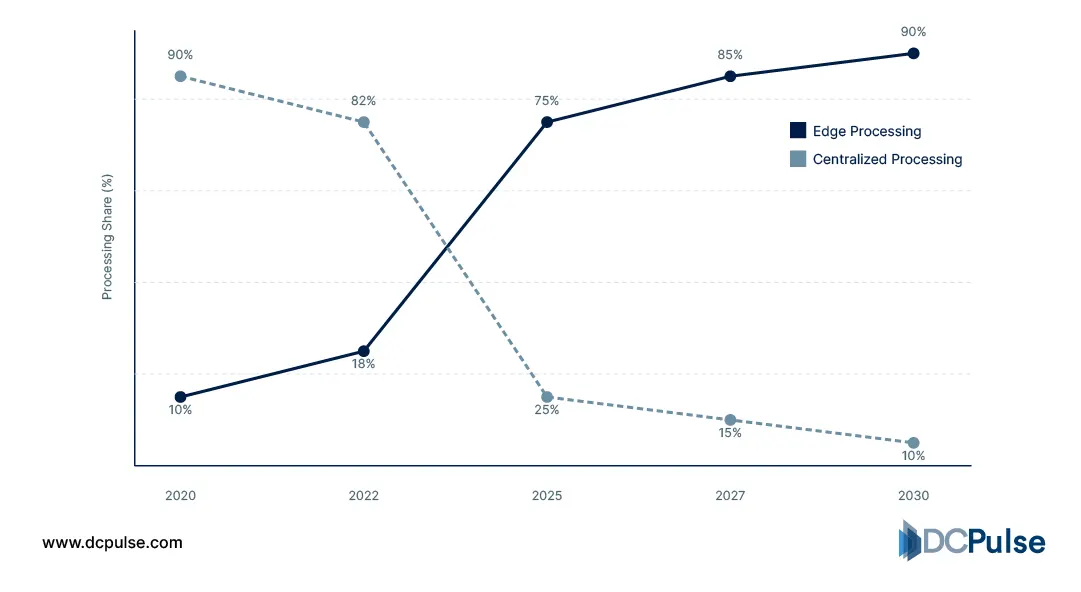
5G is another critical enabler. According to Ericsson, edge computing is essential for supporting low-latency, high-bandwidth 5G use cases, enabling applications that require real-time responsiveness and high data throughput.
These use cases, ranging from smart city systems to industrial automation, cannot function efficiently if data must travel long distances to centralized data centers. Edge deployments reduce latency, improve performance, and enhance reliability by keeping compute closer to users and devices.
Another key factor is deployment flexibility. Micro data centers are modular and prefabricated, allowing infrastructure to be deployed rapidly in distributed environments, something traditional data centers cannot achieve.
The combined effect is clear: micro data centers are not just an optimization; they are becoming a requirement for real-time digital infrastructure.
Who’s Deploying Them? Inside the Industry Push
The deployment of micro data centers is being led by telecom operators and edge infrastructure providers, with early traction also visible in smart city initiatives. However, most implementations today remain targeted and use-case-driven rather than fully scaled urban deployments.
Telecom companies are at the forefront. As 5G networks expand, operators are deploying edge infrastructure closer to users to support low-latency services. According to Ericsson, communications service providers are increasingly integrating edge computing into their networks to enable real-time applications such as video analytics and autonomous systems.
Infrastructure vendors are also accelerating deployments. Companies are offering pre-integrated micro data center solutions designed for rapid installation in distributed environments, including urban locations where space and power are constrained.
Smart city projects are beginning to incorporate these systems, particularly for applications like traffic management, surveillance, and public safety. However, most of these deployments are still in pilot or limited-scale phases rather than city-wide rollouts.
Industry reporting highlights that while edge infrastructure is expanding, scaling remains a challenge due to factors such as site availability, power constraints, and operational complexity.
Urban Infrastructure Adoption Maturity Model
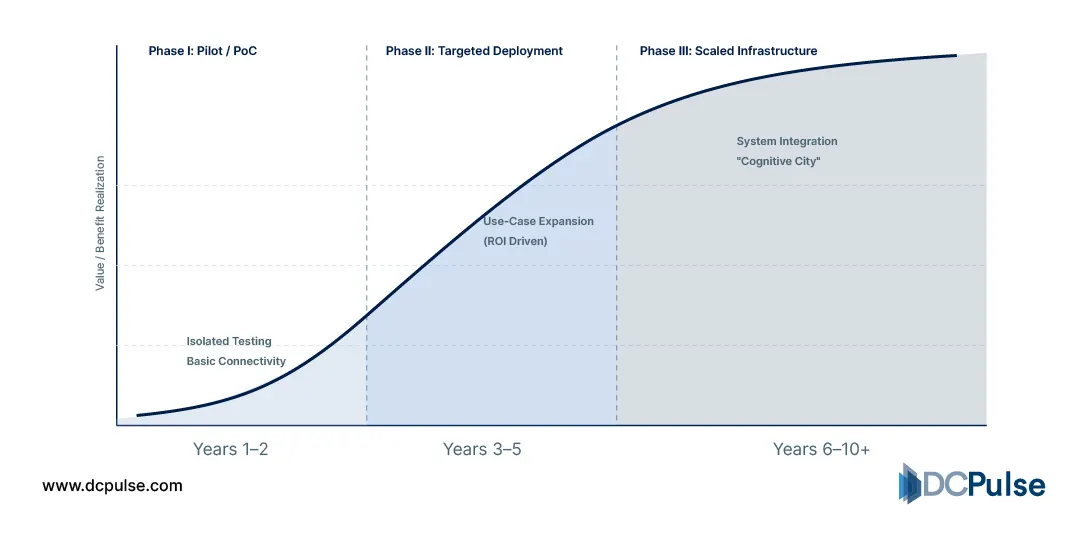
The pattern is clear: deployment is underway, but the transition from isolated edge nodes to fully distributed smart city infrastructure is still in progress.
Are Micro Data Centers the Future of Smart City Infrastructure?
Micro data centers are not a universal replacement for traditional data centers, but they are becoming a critical layer in smart city infrastructure.
They work best in scenarios where latency, bandwidth, and real-time processing are essential. Applications such as traffic management, video analytics, industrial IoT, and public safety systems benefit significantly from localized compute. In these environments, micro data centers enable faster decision-making, reduce network congestion, and improve overall system reliability.
However, they are not suited for every workload. Large-scale data storage, deep learning model training, and non-latency-sensitive applications still depend on centralized or hyperscale data centers, where economies of scale and resource pooling offer clear advantages.
Scalability is another constraint. Deploying and managing hundreds or thousands of distributed micro-sites across a city introduces operational complexity, including challenges around power availability, physical security, and maintenance.
The most realistic future is hybrid. Smart cities will rely on a combination of centralized data centers for heavy compute and micro data centers for edge processing.
In that sense, micro data centers are not the future on their own; they are an essential part of a broader, distributed infrastructure model that will define how smart cities operate.