Pranav Hotkar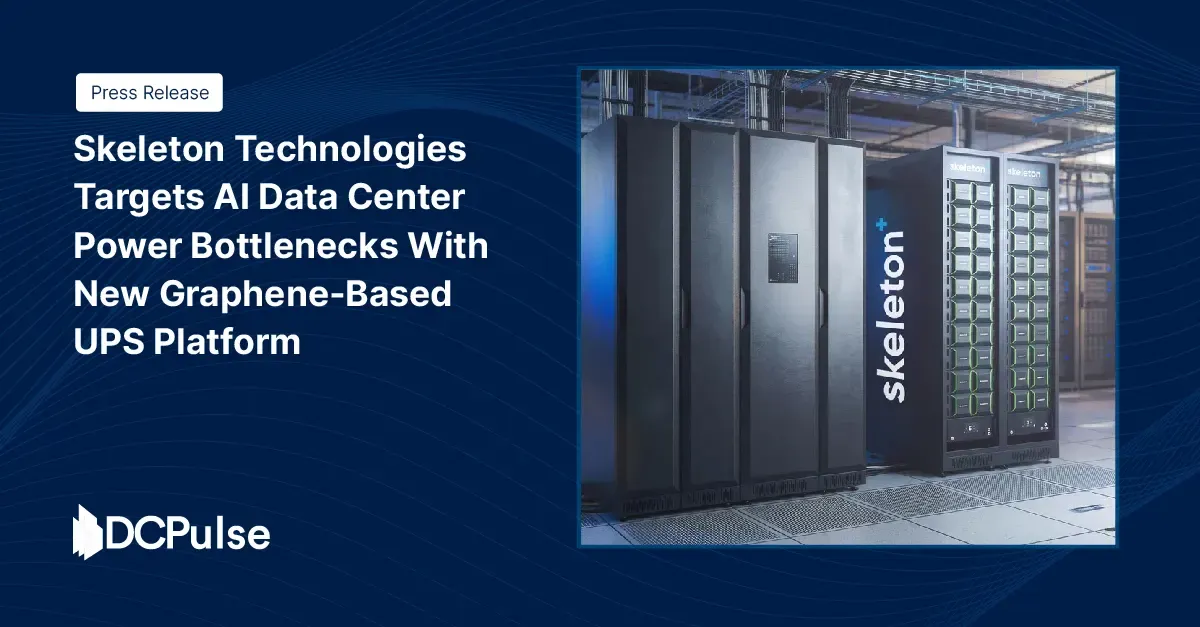
Tallinn, Estonia – June 4, 2026 - Skeleton Technologies has launched GrapheneUPS, a new high-density uninterruptible power supply (UPS) platform designed specifically for AI data center infrastructure, as operators face mounting pressure from rising GPU power demands and grid constraints.
The company said the new system is engineered to address one of the fastest-growing challenges in hyperscale AI infrastructure: delivering stable backup power for increasingly power-intensive GPU clusters while reducing energy losses and infrastructure complexity.
GrapheneUPS is built around Skeleton Technologies’ proprietary Curved Graphene-based supercapacitor technology rather than conventional lithium-ion battery systems. According to the company, the platform is designed to deliver higher power density, faster response times, and longer operational life cycles for AI-focused data center environments.
Skeleton said the system can support highly dynamic AI workloads characterized by rapid power fluctuations and dense compute clusters. Such environments have become increasingly difficult to manage using traditional power architectures as AI training and inference deployments continue scaling globally.
The company argues that conventional UPS systems are becoming less effective for next-generation AI facilities because of increasing rack densities and the highly variable electricity demand patterns associated with GPU infrastructure.
“AI data centers are creating unprecedented stress on electrical infrastructure,” Skeleton Technologies said, positioning GrapheneUPS as part of a broader effort to improve energy efficiency and reduce pressure on utility grids.
The launch comes as power availability has emerged as one of the largest bottlenecks for AI infrastructure expansion worldwide. Hyperscale operators are increasingly competing for grid access and exploring alternative energy storage and power management technologies capable of supporting gigawatt-scale AI campuses.
Skeleton Technologies has been expanding aggressively into AI infrastructure markets in both Europe and North America. Earlier this year, the company announced plans to expand operations in the United States, including a Houston engineering facility focused on AI data center and energy infrastructure projects.
The company says its graphene-based systems can help smooth AI-related electricity demand spikes, reduce strain on local grids, and improve overall infrastructure efficiency. Skeleton previously introduced GrapheneGPU, another AI-focused energy platform aimed at reducing AI data center energy consumption and improving compute efficiency.
Industry analysts increasingly view advanced power management and energy storage technologies as critical components of future AI infrastructure design. As AI clusters grow denser and electricity consumption rises sharply, operators are seeking alternatives to conventional battery-backed UPS systems to improve scalability, resilience, and energy efficiency.
Skeleton Technologies said GrapheneUPS is intended to support hyperscale AI facilities, cloud operators, and high-performance computing deployments as the industry transitions toward larger and more power-intensive AI infrastructure environments.