Pranav Hotkar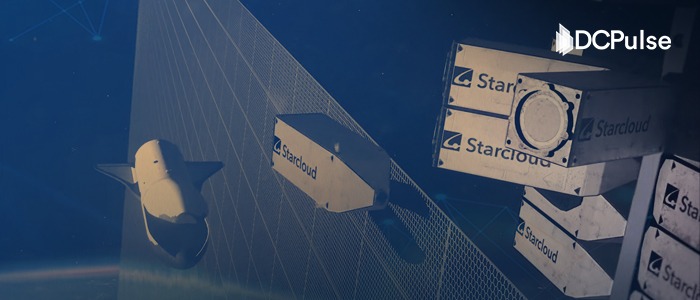
Redmond, United States - March 30, 2026 - U.S.-based space infrastructure startup Starcloud has raised USD 170 million in fresh funding, reaching a USD 1.1 billion valuation as it advances plans to develop large-scale data centers in orbit to support artificial intelligence (AI) workloads.
The funding round was led by Benchmark and EQT Ventures, underscoring growing investor interest in alternative computing infrastructure as terrestrial data centers face increasing pressure from energy constraints and land limitations.
Starcloud said the new capital will be used to accelerate the development of next-generation satellites, expand manufacturing capabilities, and secure future launch contracts as it moves toward commercial deployment of orbital computing systems.
The company is developing a network of space-based data centers designed to operate in low Earth orbit, with long-term plans for a constellation of up to 88,000 satellites capable of delivering massive AI compute capacity. These systems aim to harness near-continuous solar energy in space, reducing reliance on terrestrial power grids while eliminating many of the cooling challenges associated with ground-based facilities.
Starcloud has already demonstrated early progress by launching a satellite equipped with an NVIDIA H100 chip, enabling AI training and inference in orbit, an industry-first milestone. The company is also working with major technology partners, including NVIDIA and cloud providers such as Amazon and Google, to scale its infrastructure ecosystem.
Chief Executive Philip Johnston said the company is exploring agreements with hyperscalers and other customers, as demand for compute infrastructure continues to surge alongside rapid AI adoption.
The initiative comes amid intensifying global competition to develop space-based computing platforms. Companies such as SpaceX and Blue Origin are pursuing similar concepts, aiming to deploy solar-powered satellite networks capable of supporting large-scale AI processing beyond Earth.
While orbital data centers offer potential advantages in energy availability and thermal efficiency, challenges remain, particularly around high launch costs and long-term operational economics. Starcloud expects these costs to decline significantly by the end of the decade, which could make space-based infrastructure competitive with terrestrial data centers.
With total funding now reaching approximately USD 200 million, Starcloud is positioning itself at the forefront of a new frontier in AI infrastructure, where computing capacity may increasingly extend beyond traditional, Earth-bound data centers.