DCPulse
The economics of AI infrastructure are increasingly tied to the economics of networking. As data centers move toward larger GPU clusters and distributed AI workloads, the network connecting servers, clusters, facilities, and regions has become a central component of infrastructure design.
Data center interconnect (DCI) and scale-across networking are consequently taking on a more strategic role. The objective is not simply to add bandwidth. Network architectures must support large volumes of east-west traffic, maintain predictable performance, and provide flexibility without creating an infrastructure cost structure that undermines the economics of AI computing.
For operators and enterprises, the challenge is finding the point where network capacity, performance, resilience, and cost remain balanced.
AI workloads are changing network requirements.
Traditional enterprise applications often generate traffic patterns that are relatively distributed across applications, users, and systems. AI training and some high-performance computing workloads can behave differently.
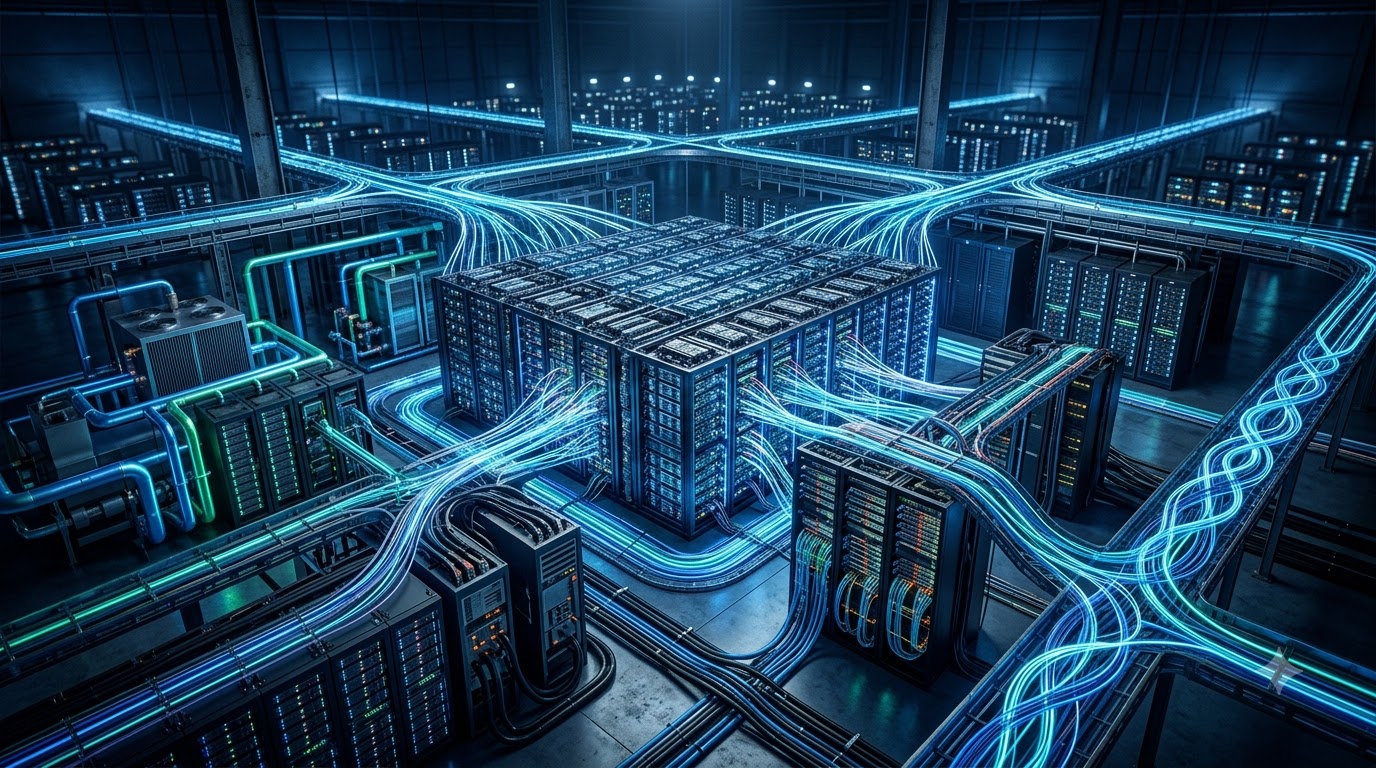
Large clusters may require frequent communication between accelerators, storage systems, and other compute resources. Model training can therefore place substantial demands on interconnects within a facility and between infrastructure domains.
The network becomes part of the computing system rather than simply a connectivity layer.
This shift has implications for data center design. Compute capacity can no longer be evaluated independently from the network fabric supporting it. Bottlenecks between GPUs, storage, and compute nodes can reduce the effective utilization of expensive infrastructure.
A network that is technically capable but poorly aligned with workload requirements can therefore create unnecessary costs.
DCI becomes a scaling tool.

Data center interconnect provides a way to connect geographically separated facilities and infrastructure environments.
For AI operators, DCI can support several approaches to capacity planning. Workloads may be distributed between facilities, additional compute can be introduced at another site, and infrastructure resources can be connected without requiring every capability to exist inside a single campus.
The approach can also provide greater flexibility when local constraints affect expansion.
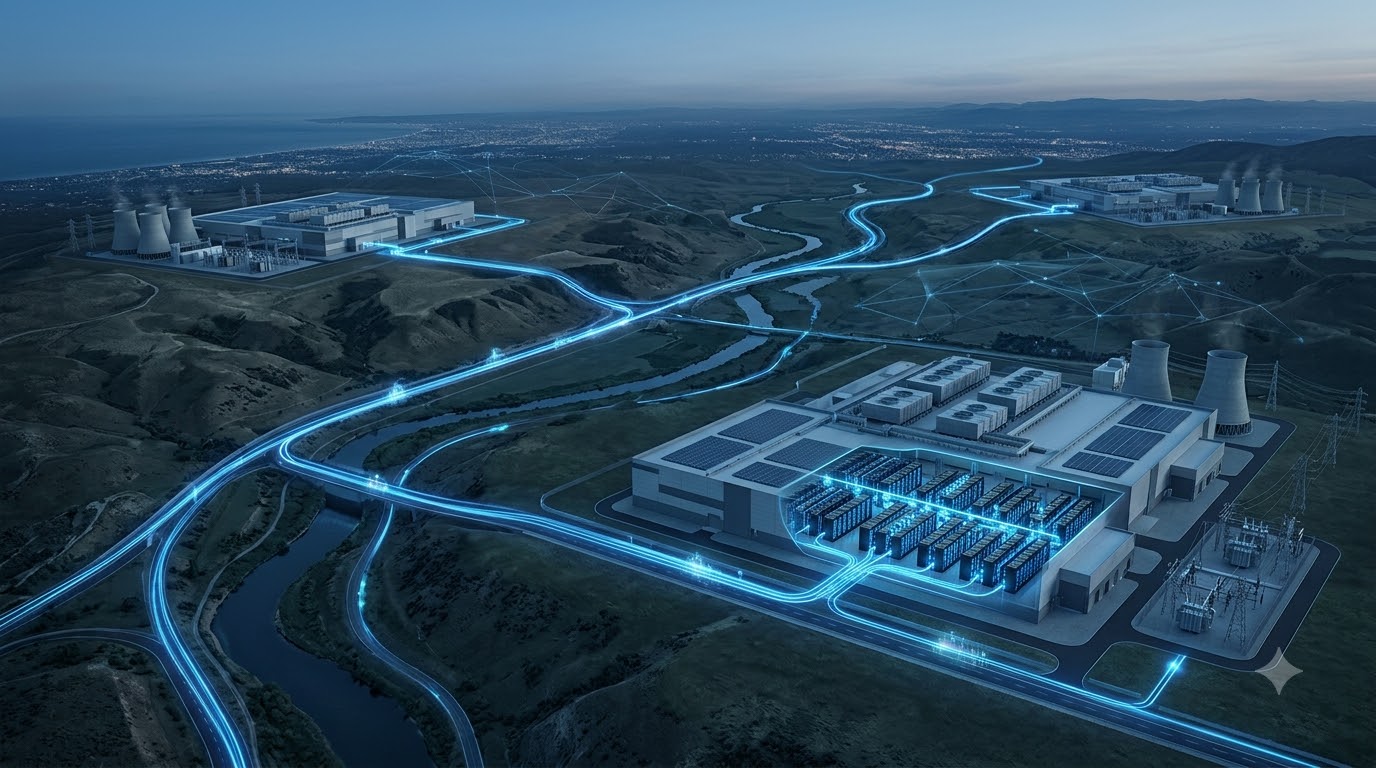
Land availability, electricity access, construction schedules, and cooling requirements can all influence where new AI capacity is developed. Interconnecting multiple facilities gives operators another option: scale across locations instead of continuously increasing the size of one site.
That model requires careful network engineering. Latency, bandwidth, route diversity, and failure domains become important considerations when workloads depend on resources distributed across multiple facilities.
Scale-across networking changes the architecture.
Scale-up and scale-out are familiar concepts in computing. Scale across extends the discussion beyond individual systems or clusters toward multiple infrastructure locations.
The approach can connect separate data centers, availability zones, campuses, or regional compute resources into a broader infrastructure environment.
Such architectures can help operators use available capacity more dynamically. A facility with constrained expansion options may still participate in a wider compute environment if sufficient connectivity exists to another site.
The economics, however, depend on workload characteristics.
Not every AI workload needs the same network performance. Some applications can tolerate geographic separation and additional latency, while tightly coupled training workloads may require highly optimized local interconnects.
Network architecture therefore needs to reflect the application rather than assuming that every workload should be distributed.
Cost efficiency requires more than cheaper hardware.
Network cost is influenced by more than switches, routers, and optical equipment.
Fiber infrastructure, connectivity services, transceivers, power consumption, network operations, and redundancy requirements all contribute to the total cost of ownership.
A cost-effective AI network consequently requires decisions across the entire infrastructure stack.
Open networking approaches can provide additional flexibility in some deployments by separating hardware and software functions. Ethernet-based architectures are also receiving increased attention as AI infrastructure expands and operators evaluate alternatives for large-scale accelerator environments.
The appropriate architecture will depend on workload requirements, interoperability, operational capabilities, and the existing technology environment.
Lower acquisition cost alone does not necessarily translate into a lower long-term infrastructure cost.
Fiber and optical infrastructure move closer to the center.
Optical networking has become increasingly important as data volumes and connection speeds rise.
Inside large data centers, optical links can support connections between network equipment and compute infrastructure. Between facilities, fiber provides the physical foundation for DCI.
The availability and diversity of fiber routes can therefore influence the feasibility of multi-site AI infrastructure.
A facility may have substantial compute capacity but limited connectivity to other relevant infrastructure locations. In such cases, network expansion can become a prerequisite for realizing the value of additional compute.
Operators planning AI campuses may consequently need to consider fiber availability alongside electricity, land, and cooling during site selection.
Resilience must remain part of the design.
AI infrastructure creates strong incentives to maximize utilization, but high utilization cannot come at the expense of resilience.
A network failure affecting a large cluster can interrupt workloads and leave expensive compute resources underused. Inter-site architectures introduce additional considerations because failures can occur across facilities, carrier routes, optical systems, or network equipment.
Route diversity can reduce dependence on a single physical path. Redundant network equipment and carefully designed failure domains can provide additional protection.
The correct level of redundancy remains workload-dependent. An architecture designed for mission-critical inference may have different requirements from one supporting batch-oriented workloads.
Cost-effective networking, therefore, does not mean minimizing redundancy. It means matching resilience investments to the operational consequences of failure.
Interconnection can improve capacity utilization.
Distributed infrastructure can create opportunities to use compute capacity more efficiently.
A network connecting multiple facilities may allow workloads to move toward available resources rather than requiring every site to maintain identical capacity profiles.
Such flexibility can become valuable as AI demand changes over time. Demand may vary by customer, workload type, geography, and time of day.
The ability to connect different pools of infrastructure can provide operators with additional options for managing those variations.
The same principle applies to storage and data movement. AI systems often depend on large datasets, model repositories, and shared storage environments. Efficient movement of information between these resources and compute clusters can influence overall application performance.
Data centers may evolve into interconnected AI infrastructure zones.
The future AI infrastructure landscape may not consist exclusively of isolated hyperscale campuses.
A broader ecosystem could emerge in which multiple data centers, edge locations, cloud environments, and specialized AI facilities are connected through high-capacity networks.
Such an environment would place greater emphasis on network orchestration and visibility.
Operators would need to understand not only what compute capacity exists but also where it is located, how it is connected, and what network conditions apply between infrastructure domains.
Software-defined networking, automation, and telemetry can become important components of that operating model. Visibility across interconnected facilities can help infrastructure teams identify congestion, capacity constraints, and potential failure points.
Site selection increasingly includes network economics.
Data center site selection has traditionally focused heavily on electricity, land, taxation, permitting, and access to customers.
AI workloads add another dimension.
Connectivity to other data centers, cloud platforms, network exchanges, and major fiber routes can influence the practical value of a site. A location with attractive physical infrastructure may be less useful for distributed AI if interconnection options are limited or expensive.
The relationship between energy and networking is also becoming more significant. New AI facilities may be built where electricity can be secured, while their customers and supporting infrastructure remain concentrated elsewhere.
DCI can help bridge that geographic separation, but the network itself becomes part of the infrastructure investment required to make the model work.
The network becomes part of AI infrastructure economics
AI infrastructure expansion is creating a broader definition of data center capacity.
Compute, electricity, cooling, storage, and networking increasingly operate as interdependent components. Additional GPUs do not automatically translate into additional usable capacity if the network cannot support the required communication patterns.
DCI and scale-across networking provide operators with tools for extending that capacity beyond individual facilities. Their value, however, depends on thoughtful architecture rather than simply adding more bandwidth.
The most cost-effective networks for the AI era are likely to be those designed around actual workload behavior, geographic constraints, resilience requirements, and long-term operating costs.
For data center operators, that means networking can no longer be treated as an afterthought to compute expansion. It is becoming one of the infrastructure layers that determines how efficiently AI capacity can be deployed, connected, and ultimately used.