DCPulse
Cloud autoscaling has long been a central component of modern infrastructure management. By adjusting computing capacity in response to demand, autoscaling systems help cloud operators maintain application performance while controlling infrastructure costs. However, the growing adoption of artificial intelligence is exposing limitations in how traditional scaling mechanisms interpret workload behavior.
Conventional cloud applications often exhibit relatively predictable resource consumption patterns. Web traffic increases during peak hours, database queries fluctuate with user activity, and application servers can scale according to metrics such as CPU utilization, memory consumption, and request volume. AI workloads introduce a different set of demands, particularly when infrastructure supports large language models, generative AI applications, recommendation engines, and high-performance model training.
The challenge is not necessarily that autoscaling systems are inaccurate. Rather, their measurements may not fully represent the resources an AI workload needs to deliver consistent performance. A cluster can appear adequately provisioned according to standard utilization metrics while accelerator queues, memory constraints, networking bottlenecks, or storage delays undermine actual application performance.
For datacenter operators and cloud infrastructure providers, this distinction is becoming increasingly important. Scaling decisions influence hardware utilization, power consumption, cooling requirements, network performance, and the economics of operating AI infrastructure.
Why AI Workloads Behave Differently
AI infrastructure supports several distinct workload patterns, each with different resource requirements. Model training involves sustained computation, frequent movement of model parameters and intermediate data, and coordination among multiple accelerators. Inference workloads, by comparison, respond to user requests and can experience abrupt changes in demand, depending on application usage and the complexity of incoming prompts.
Large language model inference presents an additional complication. Processing an incoming prompt and generating a response are computationally different stages. Prompt processing, commonly called prefill, can demand substantial parallel computation, while token generation, or decoding, can be more sensitive to memory bandwidth and sequential processing constraints.
Consequently, a single utilization metric may not adequately describe the condition of an inference cluster. GPU utilization, for example, can provide useful information but does not independently establish whether users are receiving responses within acceptable latency limits. A workload may experience delays because requests are waiting for available accelerators, model weights are competing for memory capacity, or communication between components is becoming inefficient.
The result is a mismatch between the signals used to trigger scaling and the performance outcomes infrastructure teams actually need to protect.
GPU Capacity Is Not Interchangeable With General Compute
Traditional cloud environments can often accommodate additional demand by scheduling more application instances across available CPU resources. AI workloads complicate this approach because suitable accelerators, high-bandwidth memory, specialized interconnects, and compatible software configurations may be necessary for a particular model.
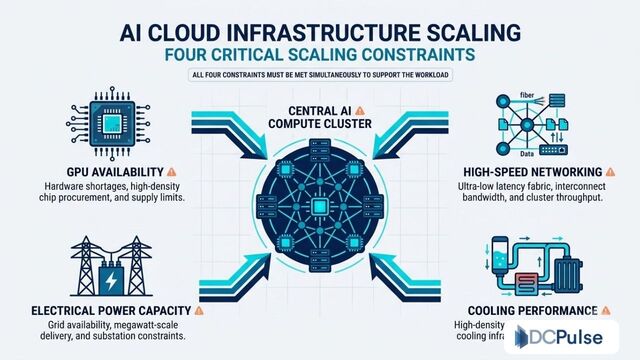
An autoscaler can request additional instances without guaranteeing that the required GPU capacity is immediately available. Physical accelerator inventory, cloud quota limits, placement constraints, model compatibility, and cluster scheduling policies can all affect whether additional capacity becomes usable.
Datacenter topology adds another layer of complexity. Distributed AI workloads may depend on low-latency communication between accelerators and high-throughput networking across servers. A collection of available GPUs is not necessarily equivalent to a well-connected cluster capable of executing a distributed workload efficiently.
These constraints have direct implications for infrastructure planning. Capacity management must account for the availability of complete, usable configurations rather than relying exclusively on aggregate counts of available compute resources.
For cloud providers, this means that scaling policies must be coordinated with accelerator inventory, cluster scheduling, network topology, and the time required to make new capacity operational.
The Hidden Cost of Scaling Delays
Autoscaling decisions are only as effective as the time required to translate them into working capacity. In conventional environments, launching additional application instances may be relatively straightforward when suitable resources are available. AI-serving environments can involve additional preparation, including accelerator allocation, container initialization, model loading, memory allocation, and the establishment of communication paths.
Large model artifacts can also introduce storage and data-transfer demands during deployment. When new instances must load substantial model weights, the delay between requesting capacity and serving traffic can become a significant operational consideration.
This creates a timing problem. By the time an autoscaler identifies rising demand and additional instances become ready, an application may already be experiencing increased latency or a growing request queue. Scaling too early can leave expensive accelerators underused, while scaling too late can degrade the user experience.
The appropriate response depends on the workload. Interactive AI assistants may prioritize response latency and predictable service levels, while batch inference systems may place greater emphasis on throughput, completion time, and cost per processed item.
Infrastructure teams therefore need to evaluate scaling performance against workload-specific service objectives rather than assuming that additional instances automatically translate into better performance.
Power and Cooling Complicate Capacity Planning
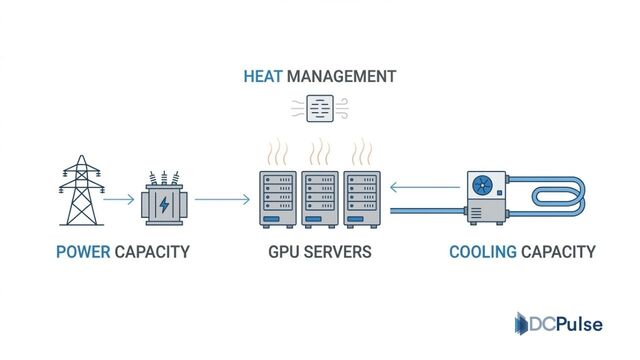
The physical consequences of AI scaling extend beyond virtual machines and orchestration software. Accelerator-intensive workloads place substantial electrical and thermal demands on datacenter infrastructure, making available power and cooling capacity essential considerations in deployment decisions.
An increase in requested compute capacity does not guarantee that the corresponding rack, row, or facility can accommodate the additional equipment. Electrical distribution, rack power limits, cooling-system capabilities, and hardware deployment constraints can restrict where new accelerators can be installed or operated. These limitations make power density optimization in hyperscale data centers an important consideration when aligning AI computing demand with physical facility capacity.
Dynamic workload behavior also affects how operators interpret facility utilization. A cluster that appears lightly loaded at one moment may experience a substantial increase in accelerator activity when demand changes. Power management systems must account for the electrical characteristics of the installed hardware and the operational limits of the facility, rather than treating software scaling as an isolated event.
Cooling requirements vary with equipment configuration, workload intensity, and the design of the cooling system. High-density AI deployments may require liquid-cooling solutions or other approaches designed to manage concentrated thermal loads. However, the suitability of any particular cooling configuration depends on the facility, equipment, and operating conditions.
The broader implication is that software-level elasticity has physical boundaries. Cloud platforms can distribute workloads across existing capacity, but they cannot automatically eliminate constraints imposed by electrical infrastructure, thermal management, or the availability of suitable hardware.
Better Metrics for AI Infrastructure
A more effective approach to AI autoscaling begins with a broader view of workload performance. CPU utilization and memory consumption remain useful measurements, but they are insufficient as the only indicators for many accelerator-based applications.
Infrastructure teams can combine several signals to understand demand more accurately. Relevant measurements include GPU utilization, accelerator memory pressure, pending request queues, request arrival rates, token-generation throughput, time to first token, overall response latency, and the duration required to initialize new instances.
The selection of metrics should reflect the architecture and service requirements of the workload. A training cluster, for example, may benefit from visibility into accelerator synchronization, communication overhead, and data-loading performance. An inference service may need closer monitoring of queue depth, request latency, batching behavior, and the availability of model-serving capacity.
Predictive scaling can also help where workload patterns are sufficiently understood. Historical demand, scheduled processing jobs, and known traffic patterns may provide useful indicators of future resource requirements. Such approaches still require safeguards because unexpected demand, model changes, and infrastructure failures can undermine predictions.
The objective is not simply to collect more telemetry. It is to connect operational measurements with decisions about when to scale, which resources to add, and whether the resulting capacity can meet application requirements.
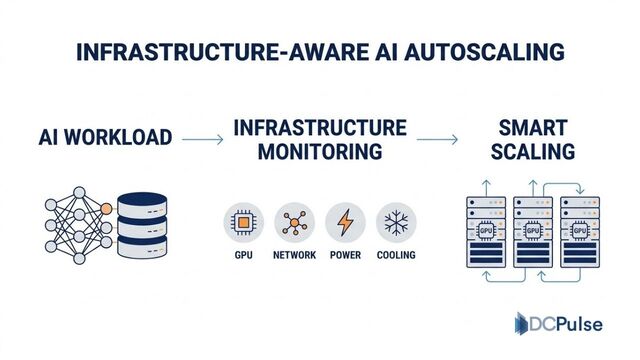
The next stage of AI infrastructure management will require closer coordination between application orchestration and the underlying datacenter environment. Autoscaling policies need visibility into the availability of accelerators, the constraints of cluster topology, the readiness of model-serving instances, and the physical resources supporting deployment.
This approach also creates opportunities for more deliberate workload placement. Flexible inference jobs may be scheduled around available capacity, while latency-sensitive services receive resources that better match their performance requirements. Model sharing, batching, workload consolidation, and capacity reservations can further influence the balance between utilization and responsiveness.
Cost management remains a critical part of this equation. Additional accelerators can improve throughput or reduce queueing delays, but their value depends on how effectively they are used and whether the resulting performance improvement justifies the expense. Conversely, aggressive consolidation may reduce infrastructure costs while introducing contention that affects service quality.
For datacenter operators, the priority is a more complete understanding of the relationship between software demand and physical capacity. Power availability, cooling performance, network bandwidth, accelerator inventory, and workload scheduling increasingly need to inform the same operational decisions.
The Outlook for AI-Ready Cloud Infrastructure
AI adoption is changing the meaning of elasticity in cloud computing. The ability to add instances remains important, but it is no longer a sufficient measure of whether an infrastructure platform can respond effectively to demand.
Reliable AI scaling depends on the availability of the right accelerators, adequate memory and network performance, timely model initialization, and sufficient physical infrastructure to support the workload. Monitoring systems must also distinguish between resources that appear available and resources that can deliver the required application performance.
For cloud providers and enterprise infrastructure teams, the practical lesson is straightforward: autoscaling should be evaluated by the outcomes it produces, not merely by the number of instances it launches.
As AI workloads become more varied and accelerator-intensive, infrastructure strategies will need to connect orchestration, performance monitoring, power management, cooling, and capacity planning. The organizations that develop this integrated view will be better positioned to balance service quality, resource efficiency, and the physical realities of operating AI infrastructure at scale.