Pranav Hotkar
The financial sector is entering a new era where AI-powered risk engines are becoming central to decision-making, operational efficiency, and compliance. From credit scoring to fraud detection and market risk assessment, these engines are transforming how banks and financial institutions manage uncertainty. The stakes are high: with real-time data streams and increasingly complex financial products, traditional risk frameworks struggle to keep pace, creating pressure on both IT infrastructure and data center capacity.
Leading banks such as J.P. Morgan and Goldman Sachs are investing heavily in AI-driven platforms capable of processing millions of transactions per second, highlighting the intersection of cutting-edge machine learning models and high-performance computing environments. These investments are not limited to software; they require infrastructure that can support low-latency decisioning, compliance reporting, and secure data storage at scale.
As AI risk engines evolve, they are reshaping the backbone of BFSI infrastructure, signaling a shift where technology and finance are inextricably linked to manage risk effectively in real-time.
The Current Landscape of AI Risk Engines in BFSI
AI-powered risk engines are rapidly moving from experimental projects to core components of banking, financial services, and insurance (BFSI) infrastructure. These systems blend machine learning, predictive analytics, and large-scale data processing to deliver real-time insights for credit scoring, fraud detection, operational risk, and compliance.
One high-profile example of BFSI incorporating AI broadly across internal systems is Goldman Sachs. The firm has rolled out its GS AI Assistant internally to thousands of employees, and senior leaders have publicly discussed expanding AI usage across risk, compliance, and client-facing functions.
Another report notes that Goldman is taking a measured, phased approach to AI deployment, with roughly half of its workforce given access to AI tools in early 2025, indicative of a broader trend where legacy financial institutions are carefully scaling AI platforms across their risk and operational infrastructure.
These developments are mirrored across the industry. AI risk engines place significant demands on computation and data infrastructure because they rely on streaming data, high-frequency scoring, and integration with compliance reporting systems. Institutions are responding by adopting hybrid architectures that combine on-premises data centers with cloud burst capacity to ensure both performance and regulatory control.
AI Adoption in BFSI Risk Management (Verified 2026)
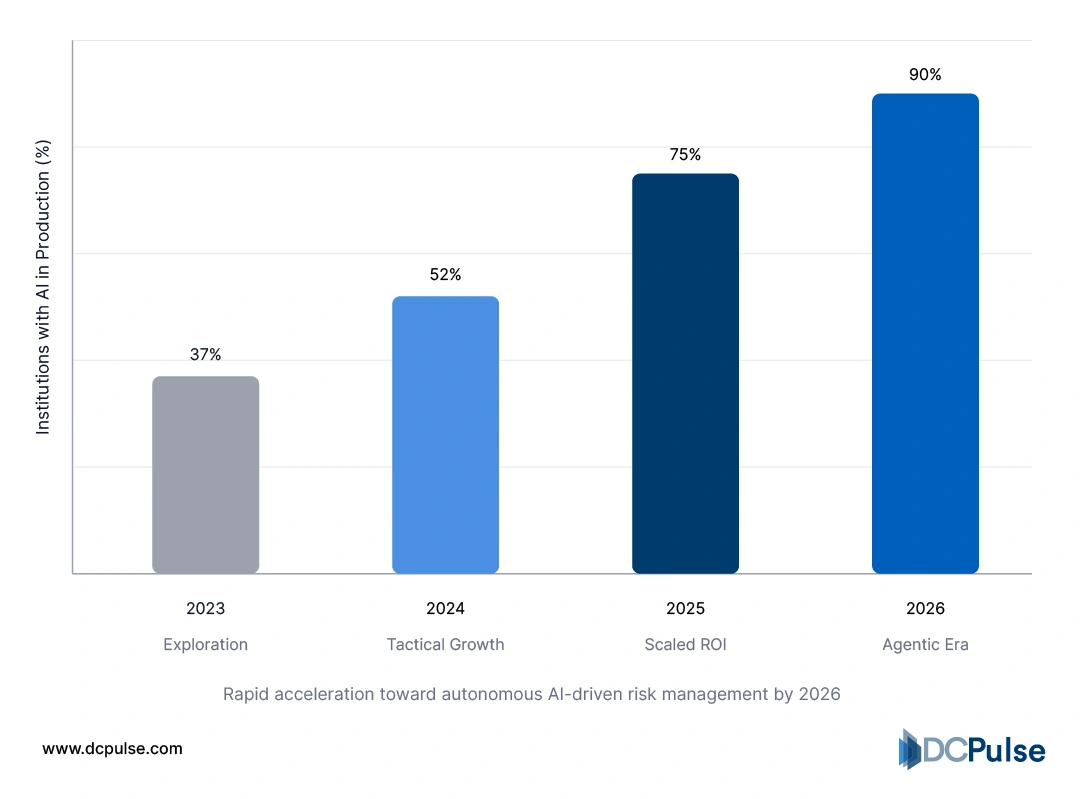
In this landscape, success in risk management depends as much on infrastructure readiness, compute, networking, and storage as it does on model sophistication.
How Are AI Risk Engines Driving Innovation in BFSI Infrastructure?
AI risk engines in the BFSI sector are evolving rapidly as financial institutions adopt advanced technologies to improve real-time decisioning, fraud detection, and risk assessment. These innovations are reshaping not just the models themselves but the underlying infrastructure needed to support them.
One major area of innovation is real-time predictive analytics and machine learning, which enables banks to analyze vast quantities of transaction data instantly and identify irregular patterns before they result in losses. For example, AI-based systems can detect suspicious activities and reduce false positives far more effectively than traditional rule-based systems. These capabilities are being increasingly used in fraud detection and risk monitoring across the industry.
Another innovation comes from entity resolution and contextual decisioning platforms developed by companies like Quantexa, whose tools help financial institutions map relationships across accounts and transactions to uncover complex risk scenarios and hidden fraud networks.
In addition, advanced fraud management systems deployed by banks such as HSBC and DBS Bank use AI to monitor millions of transactions per hour, improving detection accuracy while reducing false alerts and enabling faster investigations.
Together, these innovations are pushing AI risk engines beyond traditional computation. They rely on low-latency, scalable infrastructure architectures, often combining on-premises compute for sensitive workloads with elastic cloud resources for high-volume processing, to meet the dual demands of performance and regulatory compliance.
How AI Risk Engines Are Being Deployed Across BFSI
The deployment of AI risk engines across the BFSI sector is being shaped by distinct, real-world initiatives across banks, vendors, and infrastructure providers, each contributing to the broader transformation of risk management systems.
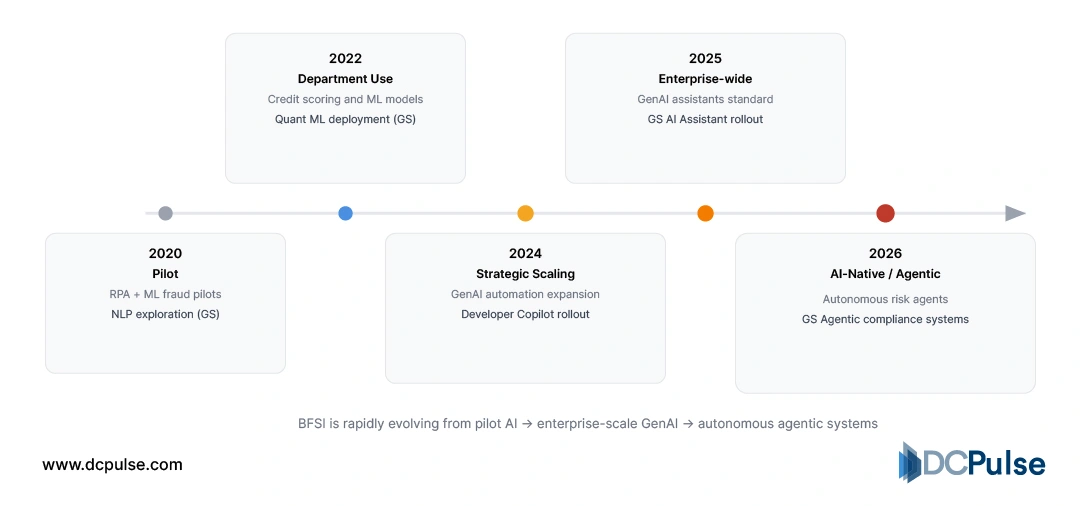
At the institutional level, Goldman Sachs has expanded the use of AI through its internal AI assistant rollout, which is being integrated into workflows spanning compliance, monitoring, and decision support. This reflects a broader shift where AI is embedded directly into operational and risk-related processes rather than functioning as a standalone tool.
Enterprise AI Adoption Stages in BFSI (2020-2026+)
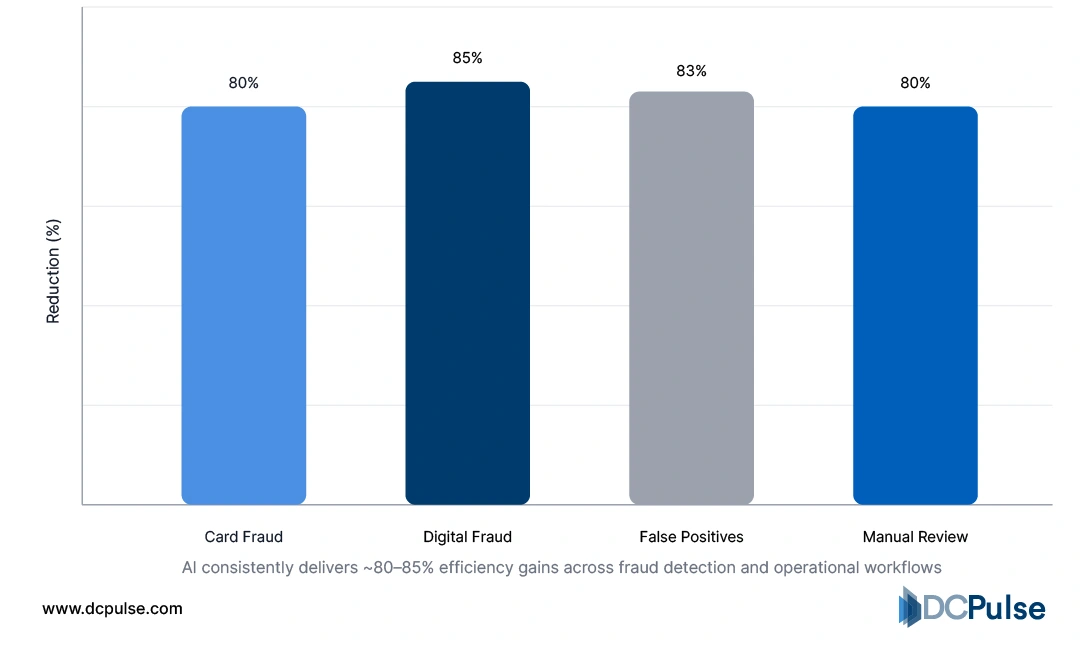
On the vendor side, platforms like FICO are enabling banks to deploy real-time AI risk engines at scale. In one deployment, FICO’s fraud platform helped Bank Mandiri reduce card fraud losses by 80% and digital fraud by 85%, while other implementations process billions of transactions monthly for real-time decisioning.
Impact of AI Risk Engines on Fraud Reduction (2026)
Meanwhile, cloud and infrastructure providers such as Microsoft Azure are enabling scalable AI environments tailored for financial services. These platforms allow institutions to run complex risk models while ensuring compliance with data residency and security requirements, accelerating deployment without compromising governance.
Together, these moves illustrate a clear pattern: AI risk engines are being operationalized through a layered ecosystem, where financial institutions, technology vendors, and cloud providers collectively define how risk infrastructure is built, deployed, and scaled.
Will AI Risk Engines Become the Backbone of BFSI Infrastructure?
AI risk engines are rapidly moving toward becoming a foundational layer of BFSI infrastructure, driven by the need for real-time decisioning, regulatory compliance, and scalable risk management. As financial institutions continue to process growing volumes of transactions and increasingly complex risk scenarios, traditional systems are no longer sufficient to meet performance and accuracy requirements.
However, widespread adoption comes with challenges. Regulatory scrutiny around data privacy, model transparency, and explainability remains a significant barrier, particularly in highly regulated markets. At the same time, integrating AI risk engines into legacy systems requires substantial investment in compute infrastructure, data pipelines, and governance frameworks, increasing both cost and operational complexity.
Despite these constraints, the long-term trajectory is clear. Advances in cloud computing, hybrid architectures, and automated model management are enabling institutions to deploy AI risk engines more efficiently and at scale. Over time, these systems are expected to evolve into autonomous risk platforms, capable of continuously learning and adapting to new threats.
In this context, AI risk engines are not just an enhancement; they are becoming the core infrastructure layer that will define how financial institutions manage risk in the future.