Pranav Hotkar
Cloud’s first decade was defined by scale. Regions multiplied. Availability zones expanded. Hyperscalers raced to deploy compute capacity across continents. The metric that mattered most was footprint: how many locations, how much capacity, how fast.
But scale is no longer the true differentiator.
As multi-cloud architectures mature, AI workloads intensify, and regulatory boundaries tighten, a deeper layer of competition is emerging. It is not about where workloads run. It is about how they connect.
Interconnection, once treated as background plumbing, is becoming the strategic center of gravity. Private cross-connects, direct cloud on-ramps, carrier-neutral exchanges, and software-defined fabrics are shaping latency, cost efficiency, resiliency, and compliance outcomes. Increasingly, the density of connections inside a data center matters more than the size of the facility itself.
Cloud interconnect ecosystems are evolving into the control plane of digital infrastructure, programmable fabrics linking hyperscalers, enterprises, AI clusters, SaaS platforms, and sovereign networks into tightly woven digital economies.
To understand why this shift is accelerating now, we must first examine how today’s interconnect landscape was built.
From Peering to Global Interconnect Ecosystems
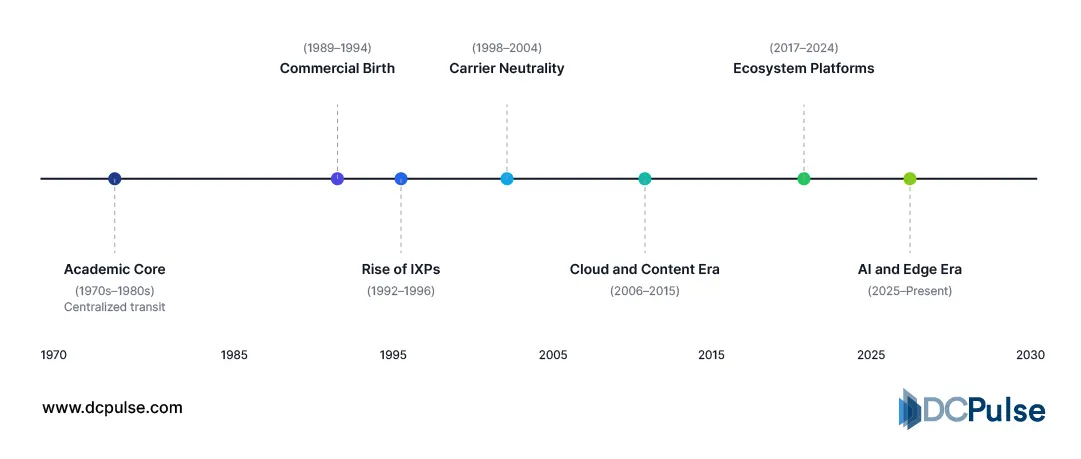
The shift from basic internet peering to private cloud interconnection has defined the modern infrastructure landscape. Historically, enterprises exchanged traffic through local internet exchange points (IXPs), but the rise of data center and carrier-neutral platforms accelerated private connectivity adoption. For example, an independent study noted that 80% of US IXs are now data center and carrier-neutral to support cloud, AI, and latency-critical workloads.
Evolution of Internet Interconnection
Carrier-neutral operators such as Equinix built platforms that aggregate networks, cloud onramps, and enterprise endpoints into a unified ecosystem. The Equinix Global Interconnection Index finds that organizations with direct interconnection links to partners and cloud providers expanded their interconnect usage significantly faster than peers, with global interconnect bandwidth projected to exceed 27,000+ Tbps by 2025.
Hyperscalers and cloud providers themselves have embraced private connectivity. For instance, expanded Azure ExpressRoute access into multiple metros via interconnection platforms demonstrates how enterprises increasingly bypass the public internet for predictable performance and security.
Public Internet vs. Private Interconnect Comparison (2026)
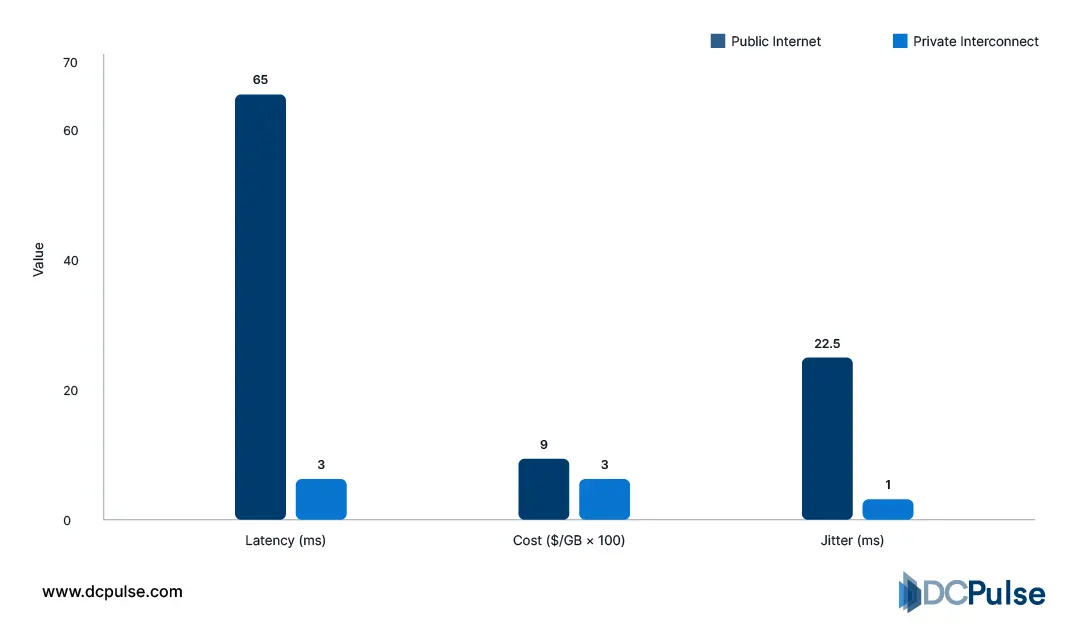
Today’s landscape is defined less by isolated cloud regions and more by the density and reach of interconnected ecosystems that bind compute, networks, and enterprises into a unified fabric.
How Are Cloud Interconnect Ecosystems Becoming Programmable and Intelligence-Driven?
Cloud interconnect ecosystems have evolved beyond static physical links. Modern interconnection is software-defined, dynamic, and increasingly responsive to workload demands. Platforms like Equinix Fabric® allow enterprises to provision secure, private connections between distributed infrastructure, clouds, and partners on demand, reducing dependency on manual cross-connects and accelerating hybrid and multicloud rollout timelines.
Interconnect innovation also tightens the integration between cloud and edge. For example, Equinix announced enhancements that offer faster virtual connections with bandwidth up to 50 Gbps to major cloud platforms, enabling data-intensive AI workloads to move more efficiently between environments without traditional routing bottlenecks.
Ecosystems are also responding to performance and sovereignty needs. Equinix’s global footprint, spanning more than 270 data centers across 77 markets, provides the dense interconnect fabric enterprises use to build globally distributed yet locally compliant digital infrastructure. This extensive mesh layer enhances performance while allowing organizations to meet regional latency and regulatory requirements.
Visual: Map — Global Interconnect & Sovereign Node Density (2026)
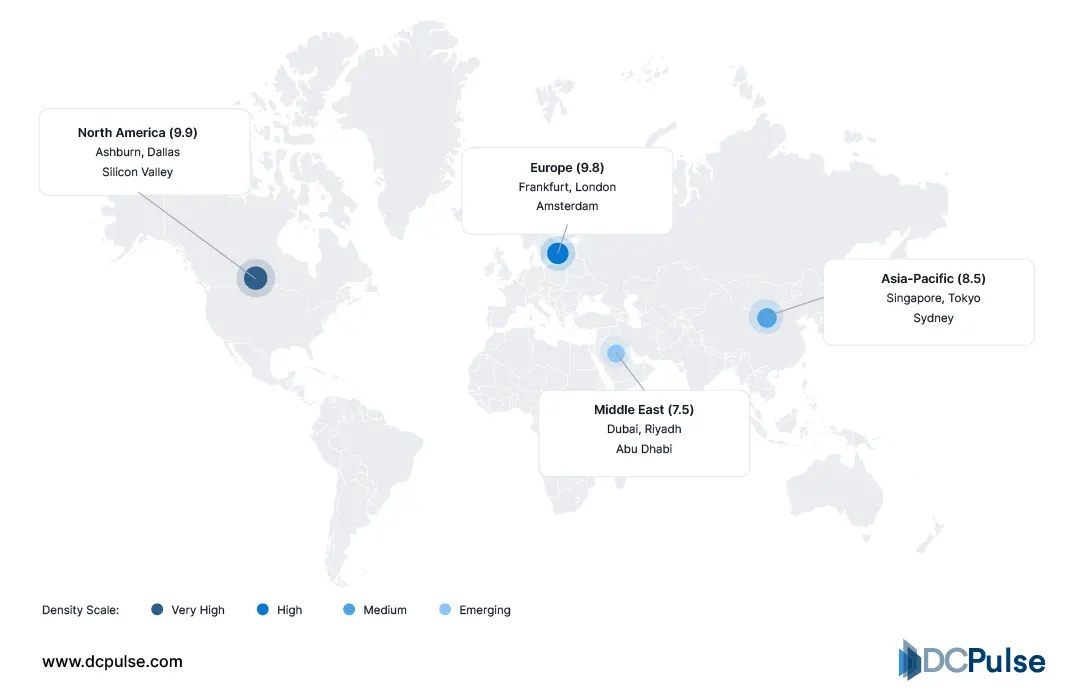
Highlights physical and logical interconnect density in key global markets.
Interconnect Density as a Strategic Advantage
Interconnect density has quietly become one of the most decisive competitive variables in digital infrastructure. It is no longer just about physical data center capacity; it is about how many networks, clouds, enterprises, and service providers coexist within a single ecosystem and how efficiently they can exchange traffic.
According to the Global Interconnection Index (GXI) 2023 published by Equinix, global interconnection bandwidth is projected to reach nearly 28,000 Tbps by 2026, growing significantly faster than traditional internet traffic.
Private Interconnection Bandwidth vs. Traditional/Public IP Traffic Growth (2022–2026)
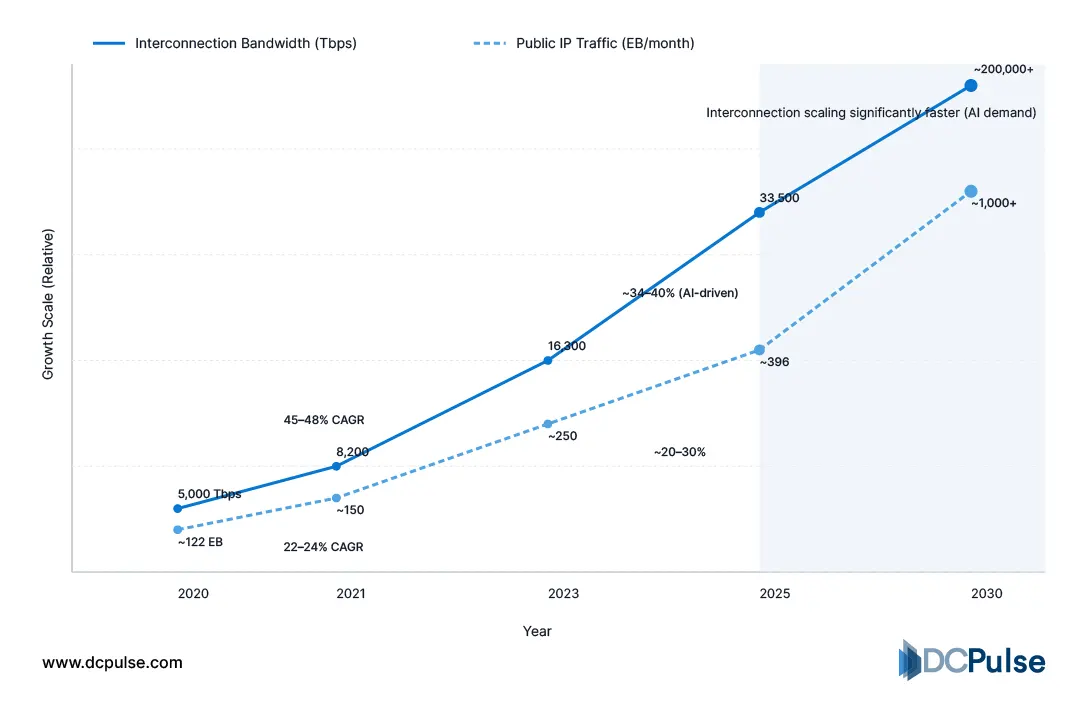
For enterprises executing multi-cloud strategies, dense ecosystems reduce latency and eliminate unnecessary transit costs. Direct connections to hyperscalers such as Amazon Web Services and Microsoft Azure enable predictable performance for AI inference, financial trading, SaaS delivery, and edge applications.
Strategically, operators with greater interconnect density create gravitational pull. The more participants within an ecosystem, the stronger the network effect, attracting additional clouds, partners, and enterprises. This flywheel dynamic transforms interconnection from a support layer into a core strategic moat, shaping how digital infrastructure markets evolve.
Interconnection Becomes the New Infrastructure Core
The evolution of cloud interconnect ecosystems signals a broader shift in how digital infrastructure is designed and deployed. As enterprises move deeper into multi-cloud architectures, the role of interconnection is expanding from a networking convenience to a foundational layer of the digital economy. Direct, private connectivity between clouds, partners, and enterprises is increasingly necessary to support AI workloads, distributed applications, and real-time services.
For infrastructure operators, this shift means that success will depend less on raw capacity and more on ecosystem depth. Facilities that host dense communities of networks, cloud providers, and digital service platforms create natural exchange points where data moves more efficiently and securely. The resulting network effects attract additional participants, reinforcing the value of the ecosystem.
Enterprises are also recalibrating their architecture strategies around this reality. Rather than routing traffic through the public internet, organizations are building architectures that prioritize private interconnection to ensure predictable latency, stronger security controls, and more consistent performance for data-intensive workloads.
Looking ahead, cloud interconnect ecosystems will likely become one of the defining pillars of next-generation digital infrastructure. As AI, edge computing, and distributed applications scale globally, the ability to move data efficiently between ecosystems will determine how effectively organizations compete in an increasingly connected world.