Pranav Hotkar
Inside many modern enterprise campuses, a quiet shift is underway. Data centers that once depended almost entirely on wired networking and traditional Wi-Fi are beginning to integrate a new layer of connectivity: private 5G. Designed to deliver ultra-reliable, low-latency wireless communication, these dedicated cellular networks are increasingly being deployed alongside enterprise infrastructure to support data-intensive and mission-critical applications.
Vendors such as Nokia and Ericsson have been actively developing private 5G platforms tailored for industrial and enterprise environments, while cloud providers, including Amazon Web Services and Microsoft, are integrating private cellular connectivity into edge computing architectures. As enterprises adopt AI-driven analytics, automation, and massive IoT deployments, the limitations of conventional wireless networks are becoming more apparent.
Private 5G is emerging as a potential solution, offering enterprises the ability to build secure, localized networks that connect thousands of devices while maintaining predictable performance. In this evolving landscape, the enterprise data center is becoming a central hub where computing infrastructure and next-generation connectivity converge.
Enterprise Networks Enter the Private 5G Era
Enterprise networking is entering a transitional phase as organizations seek wireless infrastructure capable of supporting highly automated and data-intensive operations. Traditional Wi-Fi networks remain essential for general connectivity, but their performance limitations in large industrial environments, particularly around device density, mobility, and predictable latency, have prompted enterprises to evaluate dedicated cellular networks. Private 5G has emerged as one of the most promising alternatives.
Evolution of Enterprise Wireless Connectivity (2020-2028)
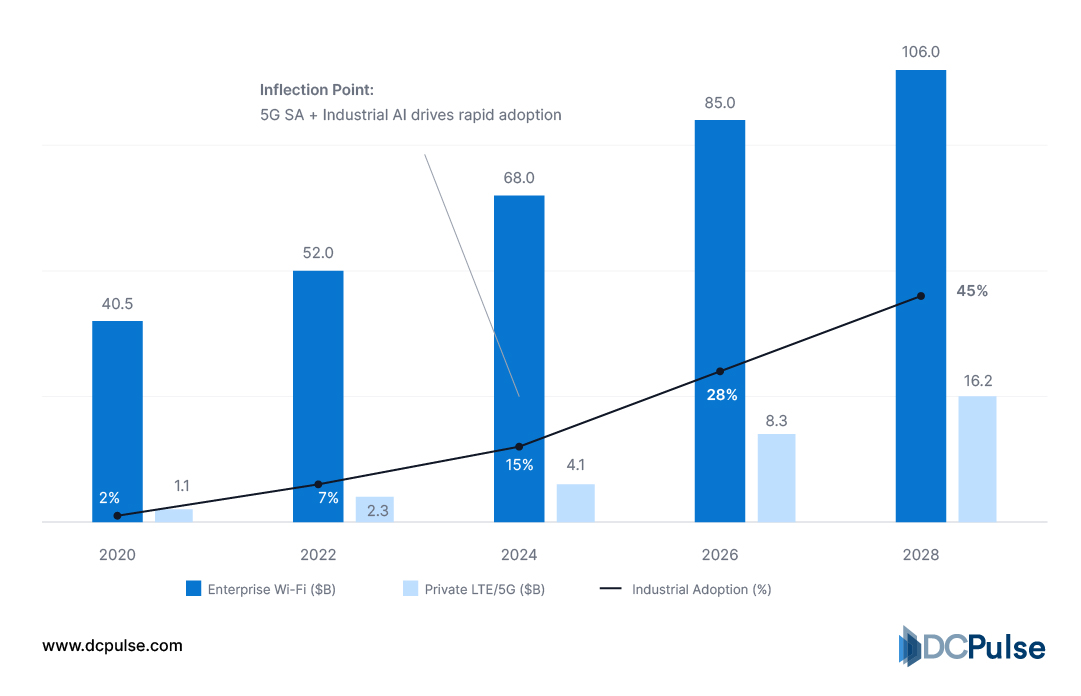
Unlike public cellular services, private 5G networks operate on dedicated spectrum and are deployed specifically for a single organization’s infrastructure. This allows enterprises to maintain full control over network performance, security policies, and data flows. Vendors such as Nokia and Ericsson have introduced enterprise-focused private wireless platforms designed to integrate with industrial environments and IT systems.
Technical Comparison (Wi-Fi 7 vs. Public 5G vs. Private 5G)
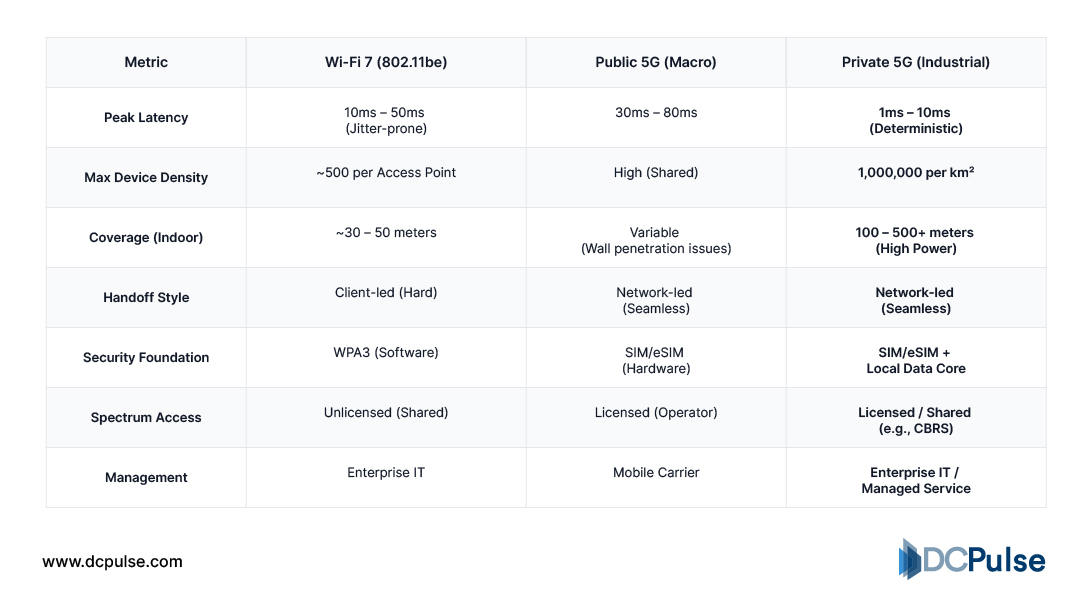
In many deployments, private 5G networks are closely linked to enterprise data centers or edge compute facilities where critical applications are hosted. These localized data centers process operational data generated by sensors, machines, and connected devices while the private cellular network provides secure wireless connectivity across the campus environment.
Industry bodies such as GSMA note that private mobile networks are increasingly being deployed across sectors including manufacturing, logistics, energy, and transportation, where reliable wireless connectivity is required for large-scale industrial automation.
Where Is Private 5G Technology Heading Next?
Private 5G deployments are evolving beyond simple wireless connectivity to become tightly integrated with enterprise edge computing environments. Many organizations are now pairing private cellular networks with localized compute infrastructure so that data generated by connected devices can be processed closer to where it is created. This architecture reduces latency and enables real-time applications such as industrial automation, robotics coordination, and predictive maintenance across large facilities.
Another emerging innovation is network slicing, which allows a single private 5G network to allocate dedicated virtual segments for different operational workloads. For example, mission-critical machine control systems can run on a highly reliable slice, while less sensitive applications such as asset tracking or environmental monitoring operate on separate network segments. Vendors, including Ericsson and Nokia, have incorporated these capabilities into enterprise private wireless platforms.
Cloud providers are also introducing simplified deployment models for private cellular infrastructure. For instance, Amazon Web Services offers AWS Private 5G, which allows enterprises to deploy and manage private cellular networks using a cloud-managed service model.
Strategic Deployments Accelerating Private 5G Adoption
Private 5G is moving from pilot projects to large-scale enterprise deployments as organizations look for reliable wireless connectivity across industrial campuses and data-intensive facilities. Manufacturing plants, logistics hubs, and energy sites are increasingly adopting private cellular networks to connect machines, sensors, and mobile equipment while maintaining control over network performance and security.
One of the major drivers behind this shift is the expansion of enterprise-focused wireless platforms developed by telecom equipment vendors. Companies such as Nokia and Ericsson have introduced private 5G solutions designed specifically for industrial and enterprise environments, enabling organizations to deploy dedicated cellular networks within factories, ports, and large operational campuses.
Growth of Enterprise Private 5G (2020-2026)
Cloud providers are also entering the ecosystem by simplifying the deployment and management of private cellular networks. For example, Amazon Web Services offers AWS Private 5G, which allows enterprises to set up and operate private cellular infrastructure through a cloud-managed service model integrated with AWS compute and storage services.
Industry organizations such as GSMA note that private mobile networks are being deployed across sectors including manufacturing, transportation, utilities, and mining, where reliable wireless connectivity is essential for automation and real-time data processing.
Will Private 5G Become Core Infrastructure for Enterprise Data Centers?
Private 5G is increasingly being viewed not just as an alternative wireless technology but as a strategic connectivity layer for modern enterprise infrastructure. As organizations expand automation, edge computing, and large-scale IoT deployments, traditional networking models are being stretched by the need for reliable mobility, predictable latency, and support for thousands of connected devices across large operational environments.
In this context, private cellular networks are beginning to complement enterprise data centers by providing a secure and controlled wireless layer that connects machines, sensors, and mobile assets directly to localized compute resources. These environments often rely on nearby edge data centers or on-premises infrastructure where operational data can be processed in real time before being integrated with broader enterprise IT systems.
Industry bodies such as GSMA highlight is that private mobile networks are gaining traction across sectors, including manufacturing, transportation, and energy, as enterprises seek reliable connectivity for digital transformation initiatives. Analysts from IDC also note that enterprise adoption of private LTE and 5G networks is expected to expand as organizations modernize operational infrastructure and integrate advanced analytics, automation, and AI-driven systems.
Together, these trends suggest that private 5G could become an increasingly important component of enterprise data center ecosystems, supporting a new generation of connected industrial and digital operations.