DCPulse
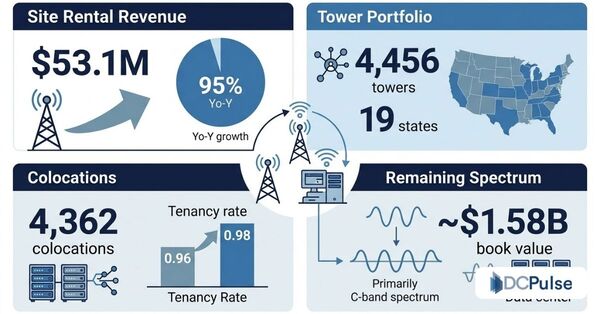
Array Digital Infrastructure is seeing a sharp rise in site rental revenue as it continues its transition toward a tower-focused digital infrastructure business while retaining a measured approach to the remaining wireless spectrum in its portfolio. The company reported second-quarter site rental revenue of approximately $53.1 million, representing a 95% year-over-year increase. Total operating revenue reached $54.1 million for the quarter, compared with $28.5 million a year earlier.
The results highlight the growing importance of communications infrastructure assets as operators expand wireless networks and require additional locations for network equipment. Although Array is primarily a telecommunications tower owner rather than a conventional data center operator, its infrastructure sits within the broader digital infrastructure ecosystem that supports mobile connectivity, edge applications, and distributed network capacity.
Tower Infrastructure Drives Revenue Growth

Array's second-quarter performance reflects the impact of its expanded relationship with T-Mobile. The company owns 4,456 towers across 19 states, while its reported number of colocations reached 4,362 at the end of June. The tower tenancy rate increased sequentially from 0.96 in the first quarter to 0.98 in the second quarter.
The company's tower portfolio provides physical locations for wireless communications equipment. Higher utilization of those sites can increase the economic value of existing infrastructure without requiring the construction of entirely new sites for every network expansion.
The improvement is particularly relevant as digital infrastructure becomes increasingly distributed. Mobile networks, edge computing environments, and other latency-sensitive services depend on connectivity closer to users. Tower infrastructure can therefore form part of the wider network architecture connecting users, wireless access points, fiber networks, and centralized computing facilities.
T-Mobile Agreement Remains a Major Factor
A key element of Array's revenue expansion is its Master Lease Agreement with T-Mobile. The agreement includes a minimum commitment covering 2,015 additional array-owned tower sites, while also extending lease terms on approximately 600 existing sites.
The arrangement provides a larger contracted base for the tower business and supports the company's strategy of increasing colocations. Array has also reported revenue associated with interim T-Mobile leases, although those arrangements are temporary and subject to their contractual terms.
The distinction between committed and interim leases remains important when assessing the sustainability of revenue growth. Array has indicated that T-Mobile has until January 2028 to finalize its selection of committed sites. The company has also been evaluating the implications of towers that may ultimately remain without tenants, including continued leasing efforts and potential portfolio rationalization.
For digital infrastructure investors, the situation illustrates the importance of separating near-term revenue gains from longer-term recurring tenancy. Contract duration, tenant concentration, and the ability to attract additional colocations can materially influence the economics of tower portfolios.
Spectrum Monetization Continues
Array's transformation is not limited to its tower operations. The company has been selling wireless spectrum following the divestiture of its wireless operations, using transactions with major carriers to monetize portions of its former spectrum portfolio.
During the second quarter, Array reported completed transactions involving 700 MHz licenses, 600 MHz licenses, and other cellular and wireless spectrum. The company also reported a special dividend of $11 per common share following those transactions.
The remaining portfolio is increasingly concentrated in the C-band spectrum. Array's June 30 financial filing reported that the book value of spectrum not subject to pending sale agreements was approximately $1.58 billion, with the holdings consisting primarily of C-band spectrum.
Rather than pursuing an immediate sale of those remaining assets, Array continues to evaluate opportunities to monetize them. Company management has indicated that the remaining C-band holdings can be approached opportunistically, giving the business flexibility over the timing of any transaction.
Why C-Band Matters to Digital Infrastructure

C-band spectrum occupies an important position in modern wireless networks because it can provide a balance between coverage and capacity. Its continued availability for future network deployment makes the spectrum relevant to operators planning additional wireless capacity.
For the wider digital infrastructure market, the significance extends beyond mobile services. Wireless networks increasingly operate alongside fiber, cloud infrastructure, edge facilities, and data centers. Additional wireless capacity can support connectivity requirements for distributed applications, while tower sites provide the physical layer needed to deploy network equipment.
Array's decision to retain C-band assets therefore gives it exposure to future wireless infrastructure demand without requiring the company to operate a conventional mobile network itself. The strategy also allows the company to evaluate potential transactions against market conditions rather than treating spectrum disposal as an immediate requirement.
Implications for Infrastructure Investors
Array's latest results demonstrate how existing infrastructure portfolios can generate additional value through higher utilization and long-term leasing arrangements. The 95% increase in quarterly site rental revenue is significant, but the underlying composition of that growth remains important.
The company's financial disclosures show that revenue growth is being influenced by the T-Mobile relationship, new leases, and interim arrangements. At the same time, Array has stopped recognizing revenue associated with DISH Wireless after determining that collection was unlikely, adding another variable to the tower portfolio's revenue outlook.
Tenant concentration is another consideration. A tower business can benefit from long-term leases, but changes in the network strategies or financial position of major wireless carriers can affect site economics. The array itself identifies reliance on a relatively small number of tenants and changes in demand as risks to its business.
For data center and edge infrastructure markets, the broader lesson is the increasing interdependence between physical connectivity assets and computing infrastructure. Data centers depend on networks to distribute workloads and connect customers, while wireless infrastructure extends connectivity beyond fixed fiber endpoints.
A More Infrastructure-Focused Array
Array's second-quarter results reinforce its repositioning as a digital infrastructure company centered on towers and spectrum assets. The company has raised its 2026 revenue guidance to between $205 million and $215 million and increased its adjusted EBITDA guidance to between $220 million and $235 million, while maintaining its capital expenditure range at $25 million to $35 million.
The immediate priority remains improving tower operations and increasing tenancy. Spectrum monetization represents a separate source of potential value, with C-band holdings providing Array with an asset that can be retained while market conditions develop.
The combination creates a business model built around physical network infrastructure and strategically held wireless assets. For the broader digital infrastructure sector, Array's progress illustrates how tower portfolios, spectrum, and connectivity infrastructure can increasingly be managed as interconnected components of the digital ecosystem rather than as isolated telecommunications assets.