DCPulse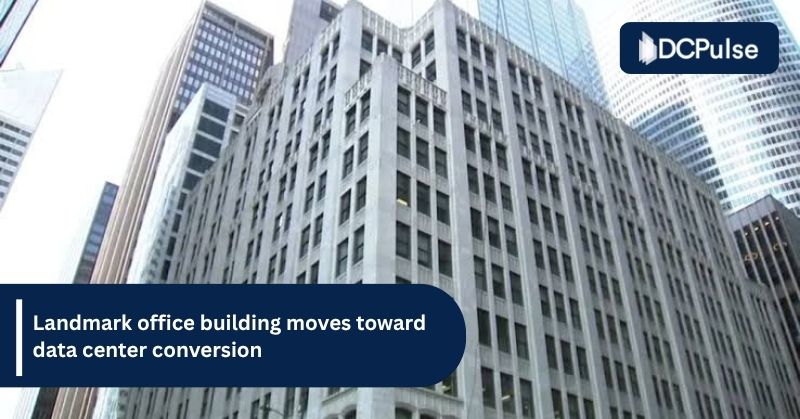
Landmark office building moves toward data center conversion
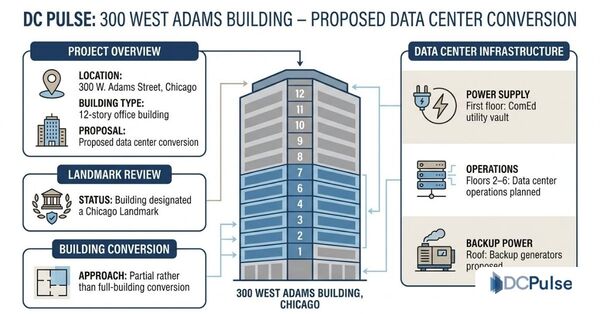
A 12-story office building in Chicago’s Loop is being considered for partial conversion into a data center, adding another example of existing commercial real estate being evaluated for digital infrastructure use. The proposal concerns the 300 West Adams Building at 300 W. Adams Street, where the lower portion of the property could be adapted for data center operations. The Permit Review Committee of the Commission on Chicago Landmarks has given the proposal an initial approval, while the full commission still needs to review the plans.
The project is being led by local developer Igor Gabal, with Adams RE MGMT LLC identified as the building owner in application filings. The proposed conversion would not transform the entire building into a data center. Current plans focus on floors two through six, with additional electrical infrastructure on the first floor and backup generation equipment on the roof.
For Chicago’s digital infrastructure market, the proposal is notable because it places data center development within an existing high-rise office structure rather than relying on a purpose-built campus. The approach could provide an alternative path for bringing computing infrastructure into established urban locations where land is limited and connectivity is already developed.
Existing building provides an adaptive reuse opportunity
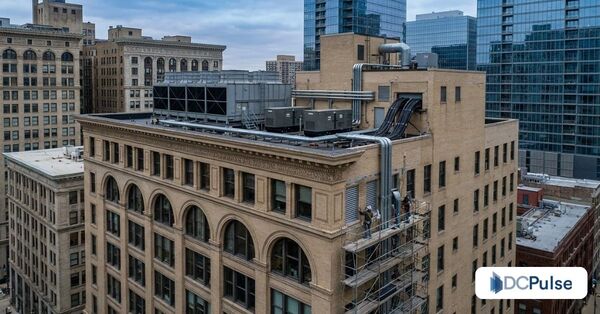
The 300 West Adams Building was constructed around 1972 and contains approximately 240,000 square feet across 12 stories. The property was designated a Chicago Landmark in 2009, adding an important preservation consideration to any major redevelopment plan.
The building's landmark status makes the proposed conversion different from a conventional office-to-data-center redevelopment. Changes to electrical systems, mechanical equipment, rooftop infrastructure, and building interiors must be considered alongside the architectural characteristics that contributed to its designation.
From a data center perspective, adaptive reuse can offer an opportunity to repurpose an existing structure rather than construct an entirely new building. That does not automatically make a conversion simpler, however. Data centers have demanding requirements for electrical distribution, cooling, backup power, physical security, fire protection, and equipment loading.
The suitability of an existing office building therefore depends heavily on its structural characteristics and the ability to introduce the infrastructure required for reliable computing operations.
Electrical infrastructure is central to the proposal
The current plans call for a new ComEd utility vault on the first floor. Data center equipment and supporting infrastructure would occupy floors two through six, while backup generators are proposed for the roof.
Those elements show how an office-to-data-center conversion can require significant changes to a building's underlying infrastructure. A conventional office property is designed around human occupancy, lighting, elevators, heating and cooling, telecommunications, and other commercial loads. A data center instead places computing equipment and associated mechanical systems at the center of the building's electrical and operational requirements.
The proposed ComEd vault would form part of that electrical strategy. Rooftop backup generation would provide another layer of infrastructure intended to support continuity of data center operations.
No publicly disclosed project capacity figure was identified in the available filings and reporting reviewed for this article. As a result, the eventual IT load, power capacity, and density of the proposed facility remain important details for future project stages.
Location could support digital infrastructure connectivity
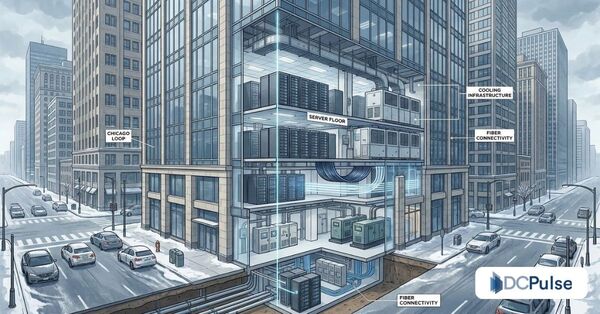
The Chicago Loop has an established telecommunications and data center ecosystem, making location an important part of the redevelopment concept. Chicago is already a significant U.S. data center market, with established facilities and network infrastructure supporting financial services, cloud platforms, enterprises, and other digital workloads.
An urban facility can provide proximity to existing network infrastructure and customers. For certain workloads, that connectivity can be valuable because the physical distance between computing infrastructure and users or network interconnection points can influence network performance.
The broader Chicago market has also seen purpose-built and adaptive-reuse data center concepts. The 300 West Adams proposal therefore forms part of a wider pattern in which developers are examining unconventional urban properties as potential digital infrastructure locations.
The opportunity is particularly relevant in a market where suitable land, electrical infrastructure, and connectivity can be difficult to secure in central business districts.
Landmark status adds a preservation dimension
The building's designation as a Chicago Landmark introduces a second layer of review beyond the technical requirements of a data center.
The Permit Review Committee's initial approval moves the proposal forward, but the full Commission on Chicago Landmarks still has to review the project. ABC Chicago reported that the initial approval came despite opposition from a preservation group.
For digital infrastructure developers, the situation illustrates one of the challenges associated with converting architecturally significant commercial buildings. Data center infrastructure can require substantial electrical, mechanical, and backup-power installations, while landmark properties may face restrictions or additional scrutiny over physical modifications.
The balance between preserving an existing building and adapting it for a new economic use could become increasingly relevant as more older office properties face changing demand.
Office-to-data-center conversions remain technically challenging
The 300 West Adams project also highlights a broader distinction between repurposing an office building and simply placing servers inside unused commercial space.
Data center operations require reliable power distribution, cooling, backup systems, fire protection, security, and network connectivity. Structural requirements can also differ significantly from those of conventional offices because computing equipment and supporting systems can impose different floor-loading and equipment-access requirements.
The proposed concentration of data center equipment on floors two through six suggests that the project is being designed around a defined portion of the existing structure rather than attempting to convert the entire tower.
That approach could help separate data center infrastructure from the remaining portions of the building. At the same time, the final design will need to demonstrate that the existing structure can support the required equipment and building systems.
Chicago's data center policy environment is evolving
The proposal is moving forward at a time when Chicago is reassessing how data centers are regulated.
Mayor Brandon Johnson called for a temporary moratorium on new data center construction in August and directed city officials to develop updated rules addressing issues including backup generators, cooling-system noise and potential environmental burdens on neighborhoods. The executive order also called for more extensive review of proposed facilities.
That policy discussion could influence how future data center projects are evaluated across Chicago. For the 300 West Adams conversion, the immediate regulatory process remains focused on the landmark review, but the wider policy environment could become increasingly relevant to urban digital infrastructure projects.
The distinction between new construction and adaptive reuse may also become important as policymakers consider how existing buildings can contribute to digital infrastructure without creating the same land-use footprint as a new campus.
Conversion could offer a model for urban digital infrastructure
The 300 West Adams proposal is still subject to further review, meaning the final scope and implementation of the data center conversion could change.
Its significance extends beyond the individual property, however. The project demonstrates how the continued growth of digital infrastructure is intersecting with Chicago's office real estate market and historic-building policies.
For data center developers, existing office properties can offer access to established locations that may already have strong transportation, telecommunications, and utility connections. The technical condition of each building remains critical, particularly when electrical capacity, cooling, backup power, and structural requirements must be integrated into an older structure.
For Chicago, the project could become another test of whether established commercial buildings can be adapted to support modern computing infrastructure while retaining their architectural identity.
As demand for cloud services, AI workloads, and other digital applications continues to influence infrastructure investment, projects such as 300 West Adams point toward a more varied development model. Purpose-built campuses will remain important, but selected urban buildings may also become candidates for conversion where power, connectivity, structure, and regulatory requirements can be aligned.