DCPulse

Foresight has received a Platinum award in the 2026 Pinnacle Technology Awards for its Predictive Project Delivery platform, which uses artificial intelligence (AI) to help infrastructure owners and operators identify schedule risks earlier. Announced on July 2, 2026, the recognition highlights the company's approach to improving delivery visibility across complex capital projects, including data centers, energy infrastructure, and other large-scale developments.
The award comes as the data center industry works to expand capacity for cloud computing, AI, and other digital services. Investment alone does not guarantee that new facilities will become operational on schedule. Construction, equipment procurement, utility connections, and commissioning all influence when infrastructure can begin supporting customer workloads.
Foresight's platform focuses on using project data to identify emerging risks and support earlier decisions. For data center developers, this approach reflects a broader effort to make project schedules more visible to leadership teams and manage delivery risks before they disrupt critical milestones.
Predictive AI Targets Infrastructure Delivery Risks
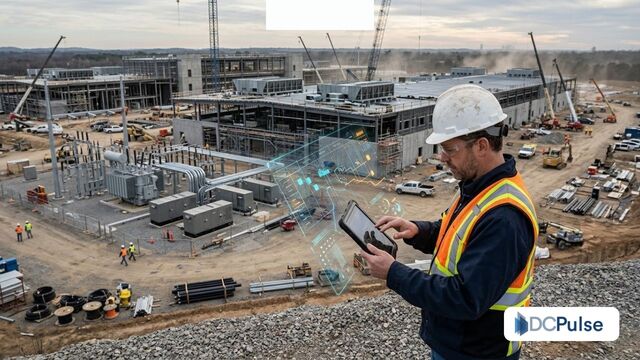
Large infrastructure projects involve interconnected workstreams, including engineering, construction, procurement, permits, contractor coordination, and equipment installation. A delay in one area can affect other activities, creating consequences that may not be immediately apparent through separate project reports.
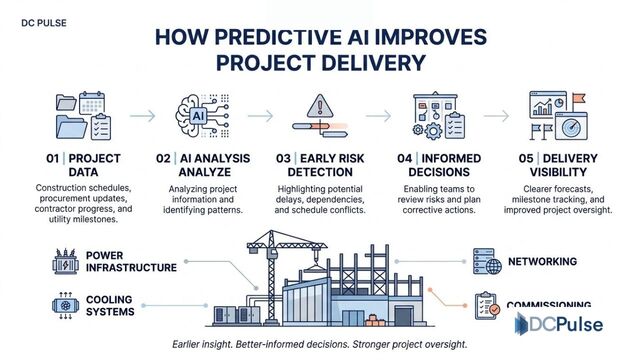
Traditional project controls provide information about progress, costs, and completed milestones. Predictive project delivery tools seek to build on that information by analyzing schedules and project data to identify patterns that could signal emerging delays. The objective is to give teams more time to investigate risks, assess possible impacts, and consider corrective action.
Foresight describes its platform as a project delivery system that analyzes project information, identifies emerging risks, forecasts completion dates, and provides insights for decision-makers. The company says its approach is intended to move beyond retrospective reporting toward earlier intervention and more consistent schedule oversight. Its capabilities are described on the
The usefulness of predictive analytics depends on the quality and completeness of the underlying data, as well as the ability of project teams to respond to identified risks. A forecast does not eliminate construction complexity or guarantee on-time completion. Its value lies in providing decision-makers with information that may help them act before a problem becomes more difficult to address.
Why Schedule Certainty Matters for Data Centers
Data center construction requires coordination between the building itself and the technical systems that make it operational. Electrical infrastructure, cooling equipment, network connectivity, backup power, security systems, and IT equipment must be installed, integrated, tested, and commissioned in a coordinated sequence.
Facilities designed for high-density AI workloads can add further complexity. Their requirements may include substantial electrical capacity, specialized cooling arrangements, and careful integration of computing systems. A completed building does not necessarily mean that the facility is ready to support customer workloads.
Delays can therefore affect more than a construction completion date. They may postpone service launches, disrupt customer deployment plans, and extend the period before an investment begins generating revenue. For operators developing several facilities simultaneously, a delay at one site can also complicate equipment allocation, workforce planning, and portfolio-wide schedules.
Schedule visibility can help project teams identify dependencies that require attention, including utility connections, long-lead equipment, design changes, and commissioning activities. Practical responses may include adjusting construction sequences, coordinating with suppliers, reallocating resources, or escalating unresolved decisions.
Bringing Time Into Project Governance
Infrastructure organizations commonly use established processes to manage budgets, contracts, procurement, and capital allocation. Schedule performance can be harder to oversee when information is fragmented across contractors, planning systems, spreadsheets, and separate reporting processes.
Foresight positions project time as a business asset that deserves systematic oversight. Its platform is designed to give project leaders and executives a clearer view of delivery risks, milestone performance, and potential schedule impacts. This approach connects project execution with broader decisions about investment, customer commitments, and operational readiness.
For data center owners and developers, a delay affecting a grid connection or critical cooling equipment can have implications for commissioning plans and anticipated revenue. Earlier visibility may help management evaluate those consequences while there is still time to consider alternatives.
Effective implementation nevertheless requires organizational discipline. Project teams need consistent progress definitions, reliable reporting practices, clear responsibilities, and established procedures for responding to warnings. Predictive insights are less useful when data is outdated or decision-making authority is unclear.
The technology should therefore complement, rather than replace, experienced project directors, planners, engineers, contractors, and site teams. Human judgment remains essential when interpreting risk signals, validating assumptions, and deciding which interventions are practical.
Reported Results Across a Data Center Portfolio
Foresight reported that, across a global portfolio of 15 concurrent data center projects, its platform reduced reporting overhead by 90% and helped prevent more than $100 million in projected lost revenue through earlier identification of schedule risks. These are company-reported case-study outcomes and should not be interpreted as independently verified results or a guarantee of similar performance elsewhere. The figures appear in the company's
The reported outcomes illustrate the potential business case for improving project visibility. Less time spent assembling reports could allow teams to focus more attention on investigating risks, coordinating stakeholders, and evaluating corrective action. However, the wider value depends on whether reporting improvements lead to better decisions and measurable changes in delivery performance.
Organizations assessing predictive project delivery tools can examine indicators such as forecast accuracy, the time available to respond to identified risks, milestone performance, and the outcomes of corrective actions. Comparisons against established project baselines can help determine whether a platform is producing operational benefits.
Project complexity, procurement arrangements, supplier conditions, and the maturity of existing controls vary between developments. Results from one portfolio may not translate directly to another, making transparent evaluation important when companies consider adopting new systems.
Implications for AI Infrastructure Expansion
The growth of AI infrastructure is increasing the importance of coordinating computing capacity with the physical systems that support it. Data center development depends on land, power availability, network connections, equipment supply chains, construction capability, and commissioning readiness.
Predictive project intelligence may help organizations bring these dependencies into a more unified view. Earlier identification of schedule risks could allow teams to reassess delivery assumptions, prioritize constrained resources, and communicate potential changes to customers and investors with greater clarity.
The same principle applies to supporting infrastructure. Grid upgrades, substations, transmission connections, and energy projects can influence when a data center becomes operational. Better visibility across connected programs may help developers understand how delays outside the facility itself could affect the overall delivery timeline.
Predictive AI cannot independently resolve unavailable grid capacity, equipment shortages, permitting delays, or labor constraints. Its role is to help teams identify and manage risks, not eliminate the underlying physical limitations. Effective project delivery still depends on coordination among developers, utilities, contractors, equipment suppliers, and local authorities.
The Role of Data Quality and Human Oversight
Predictive systems depend on the information used to train, configure, and operate them. Inconsistent schedules, incomplete progress reporting, changing assumptions, and disconnected data sources can weaken the reliability of risk assessments. Organizations adopting these tools need to understand how information is collected, validated, updated, and interpreted.
Human oversight is equally important. A flagged risk may require an engineering review, supplier discussion, construction-sequence change, or executive decision about competing priorities. Project leaders must assess the context and feasibility of each response rather than treating a model's output as a definitive forecast.
Information governance also deserves attention when project schedules, supplier details, commercial information, and operational plans are processed through digital platforms. Appropriate access controls and data-handling practices are important considerations for infrastructure organizations introducing new project intelligence systems.
A Broader Shift Toward Delivery Intelligence
Foresight's Pinnacle Technology Award highlights growing interest in applying predictive AI to infrastructure project delivery. For the data center sector, the wider question is how developers can translate investment and expansion plans into functioning facilities with more predictable timelines.
The answer is unlikely to rest on a single software platform. Reliable delivery requires sound engineering, realistic schedules, experienced teams, coordinated procurement, utility planning, and effective governance. Predictive analytics can complement these foundations by helping organizations identify emerging risks and direct attention toward decisions that matter.
As cloud and AI infrastructure projects become increasingly interconnected, earlier insight into schedule risk may become a valuable part of project management. The practical test will be whether these systems consistently improve forecasts, enable timely intervention, and deliver measurable benefits across different projects.
Foresight's award puts that approach in the spotlight. For developers, operators, and investors, the central challenge remains execution: ensuring that infrastructure is not only planned and funded, but also delivered, commissioned, and made available when it is needed.