Pranav Hotkar
A colocation data center used to have a predictable rhythm.
Customers arrived with equipment, signed in at the desk, rolled racks across the floor, and scheduled maintenance visits weeks in advance. Presence was part of the service.
Today, some tenants operate entire deployments without entering the facility once.
Servers are provisioned remotely. Power cycles happen through software. Diagnostics run before anyone considers opening a cabinet. The building is still full, but the human traffic is fading. Activity hasn’t decreased; it has been displaced.
What changed are not just the tools but the expectations.
Customers no longer treat colocation as a place they go. They treat it as infrastructure, they call it.
Remote management didn’t begin as a convenience feature. It emerged as an operational necessity as distributed teams, automation workflows, and high-frequency deployments made physical coordination impractical. Once deployments could be executed from anywhere, visiting the data center became the exception instead of the routine.
The facility still exists.
But interaction with it is becoming indirect.
Colocation is starting to behave less like leased space and more like a remotely operated platform, a physical environment accessed through software rather than doors.
The Facility Without the Visit
For most of its history, colocation depended on coordination. Routine actions, such as installing hardware, checking indicators, and swapping components, required someone to enter the white space. Remote monitoring existed, but the workflow still ended at the cabinet door.
That model is changing.
Distributed IT teams now operate across regions and time zones, and infrastructure is modified continuously rather than during scheduled maintenance windows. The slowest step is no longer network access but physical access. Modern operational guidance, therefore, prioritizes remote administration to reduce on-site intervention.
Operators have expanded what can be done remotely. Out-of-band management standards allow full server control independent of the operating system. Switched rack PDUs enable remote power monitoring and cycling. Environmental telemetry lets teams verify operating conditions without entering the room.
Workflow - Remote vs. On-Site
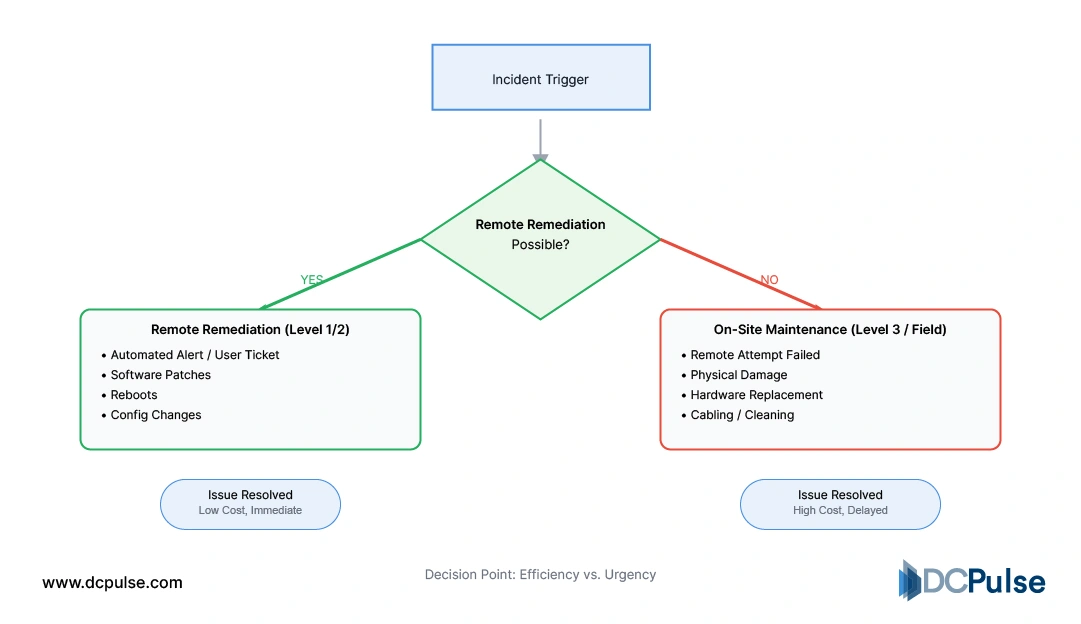
Because of this, customer interaction changes. Tenants operate systems through remote sessions while on-site staff execute predefined actions. Industry operational practices now treat remote hands as an extension of automated workflows rather than ad hoc support.
Remote Control Plane vs. Facility Floor
The result is a shift in how colocation is experienced. Access is no longer defined by entering the building but by interacting with systems programmatically. The facility remains physical, yet its day-to-day operation becomes remote.
When the Data Center Becomes Software-Operated
Remote management in colocation is moving beyond visibility into control.
The facility is gradually exposing operational actions as programmable functions rather than manual procedures.
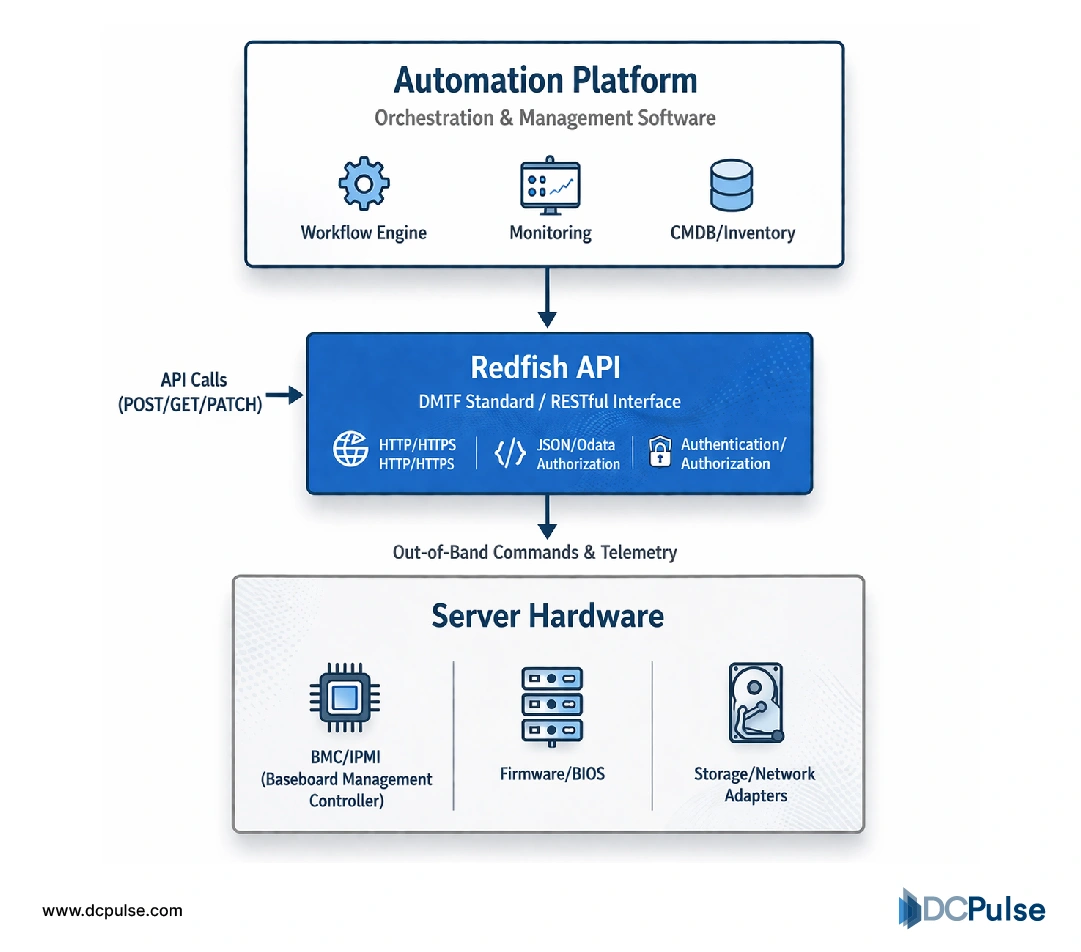
Modern servers include a dedicated management controller that operates independently from the operating system. The DMTF Redfish specification defines this as a RESTful interface capable of remote boot, firmware update, and hardware control without physical access.
Redfish-Enabled Out-of-Band Management Architecture
Power infrastructure is evolving similarly. Networked PDUs expose structured telemetry and remote switching so systems can recover automatically after faults. This remote power control capability is formally described in SNMP-managed power distribution devices used in data centers.
Environmental operation is also becoming sensor-driven. Data center thermal operation guidance recommends continuous monitoring and automated response to environmental measurements rather than manual inspection.
Together these capabilities shift human roles. Instead of diagnosing faults onsite, staff execute predefined procedures triggered by monitoring systems. Industry operational research notes increasing use of automation to reduce routine human intervention in data center operations.
Operational Efficiency Evolution
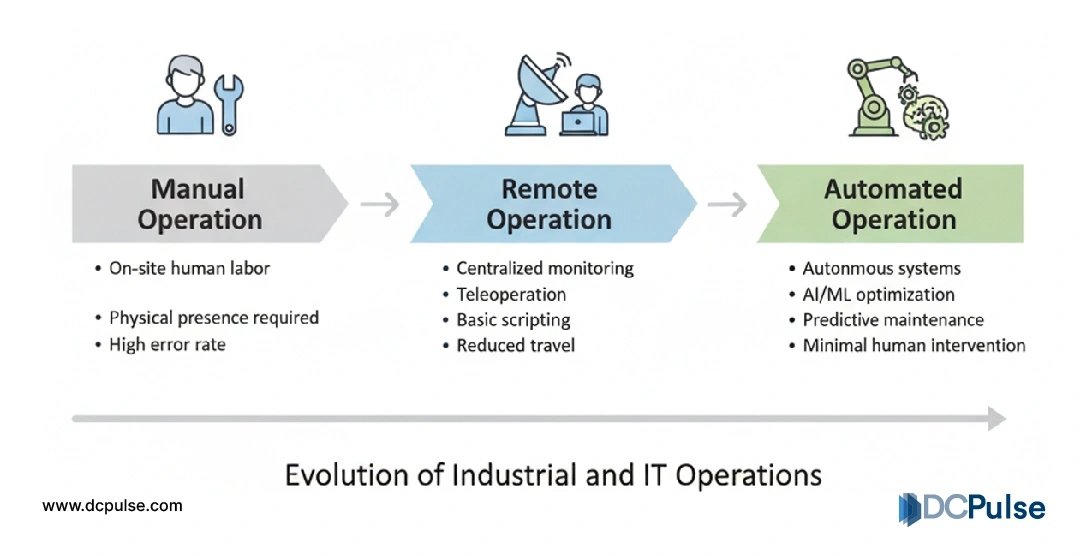
c, therefore, begins to operate like software infrastructure.
The hardware remains physical, but the primary interface becomes an API rather than a visit.
Colocation Becomes a Remote Service Model
Remote operation is no longer just a technical capability; providers are reshaping their service offerings around it.
Many colocation operators now design onboarding procedures assuming customers may never enter the facility. Equipment arrives pre-configured, installation follows documented steps, and verification is performed through remote sessions rather than visual inspection. This aligns with zero-touch provisioning workflows, where devices become operational automatically after network connection.
Service contracts are changing as well. Instead of ad hoc remote-hands requests, providers increasingly define standardized operational actions executed while customers observe remotely. Operational reliability guidance emphasizes documented, repeatable maintenance procedures to reduce human error.
The economic model follows the operational one. When customers interact primarily through remote workflows, the facility behaves less like leased real estate and more like managed infrastructure. Automated infrastructure coordination and intent-based operations are described in network automation practices supporting remote service delivery.
Colocation does not become cloud; hardware ownership remains separate, but operationally, the experience begins to resemble it. The customer relationship shifts from access to space toward access to controlled outcomes.
From Place to Interface
Remote management is quietly redefining what colocation actually is.
For decades, the value of a facility was tied to controlled physical access, secure space, power availability, and the ability for customers to interact directly with their equipment. As operational control shifts into software, those elements remain necessary but no longer define the experience. The primary interaction moves from entering the building to invoking an action.
This changes how infrastructure is evaluated. Proximity matters less than responsiveness. Access windows matter less than operational predictability. The differentiator becomes how reliably a provider can execute tasks without requiring customer presence.
Over time, the expectation follows the capability. Teams begin designing deployment processes assuming they will never touch the hardware. Maintenance procedures are written for observation rather than participation. The data center stops being a destination and becomes an endpoint in an operational workflow.
Colocation does not turn into cloud infrastructure, but it adopts the same interaction model: physical resources accessed through a logical interface. What customers are really buying is no longer space inside a building; it is the ability to operate hardware at a distance with certainty.
Remote management therefore does more than improve efficiency.
It changes the definition of the service itself.