Pranav Hotkar
ESG reporting is no longer a compliance exercise for data center operators; it is becoming a key determinant of capital access.
As investors intensify their focus on sustainability, data centers are facing increasing scrutiny over energy consumption, carbon emissions, and water usage. The rise of AI and high-density workloads has only intensified this pressure, pushing infrastructure operators into the spotlight as major energy consumers. For investors, the question is no longer whether companies have ESG strategies, but whether those strategies are measurable, transparent, and aligned with long-term risk management.
At the same time, expectations are evolving rapidly. Investors are looking beyond high-level commitments and net-zero pledges, demanding granular, comparable, and auditable data. Metrics such as Power Usage Effectiveness (PUE), Water Usage Effectiveness (WUE), and Scope 1, 2, and 3 emissions are becoming central to evaluating performance.
This creates a gap.
While ESG disclosures are increasing, they are often inconsistent, making it difficult for investors to assess true sustainability performance.
The result is a shift.
ESG reporting is moving from narrative-driven disclosure to data-driven accountability.
What Do Investors Expect from ESG Reporting in Data Centers Today?
Investor expectations around ESG reporting in data centers have shifted from broad commitments to quantifiable, comparable performance metrics.
At the core of this expectation are standardized efficiency indicators. Metrics such as Power Usage Effectiveness (PUE), Water Usage Effectiveness (WUE), and Carbon Usage Effectiveness (CUE) have become foundational in evaluating operational sustainability. PUE, for example, remains the most widely used benchmark for energy efficiency, measuring the amount of energy consumed beyond core IT workloads.
Core ESG Metrics for Data Center Evaluation (2026 Benchmarks)
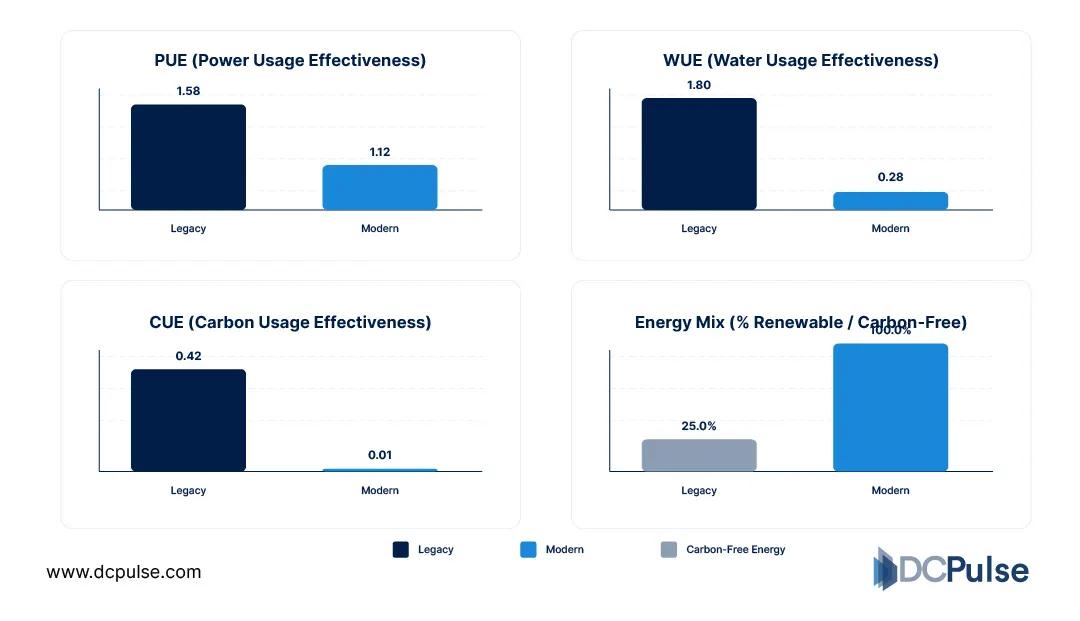
However, investors are increasingly aware that these metrics are not directly comparable across operators. Variations in measurement boundaries, methodologies, and reporting frequency can significantly distort results. Even widely used metrics like PUE can fluctuate based on how and when they are measured, making cross-company comparisons difficult.
ESG Performance and Reporting Metrics Across Major Operators (2025-2026)
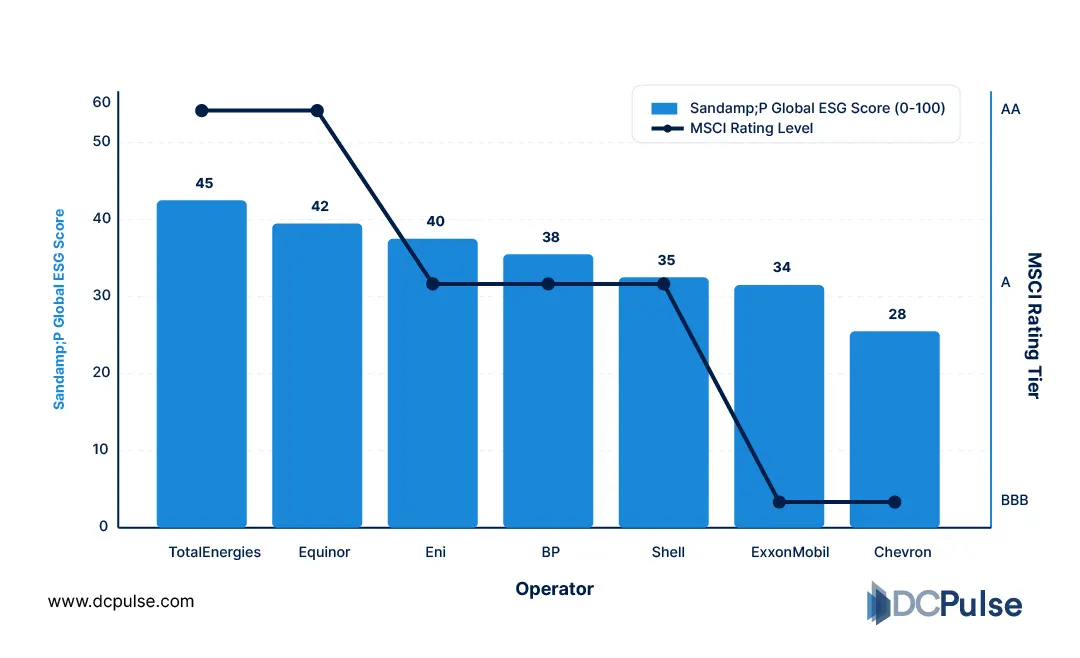
Another key expectation is multi-dimensional transparency. Investors now look beyond single metrics to assess trade-offs between energy, water, and carbon. For instance, improving energy efficiency may increase water consumption depending on cooling methods, highlighting the need for integrated reporting frameworks.
Finally, there is growing focus on data completeness and granularity. While hyperscalers are leading in ESG disclosures, research shows that reporting quality and detail still vary significantly across the industry, limiting investor ability to assess true performance.
The shift is clear;
Investors are no longer evaluating ESG based on isolated metrics; they require consistent, comparable, and multi-dimensional data to assess real sustainability performance and risk.
How Is ESG Reporting Evolving Beyond Traditional Metrics?
ESG reporting in data centers is evolving from periodic disclosure to a continuous, data-driven system built on completeness, accuracy, and auditability.
A major shift is the integration of Scope 1, 2, and 3 emissions into reporting frameworks. These categories provide a full view of emissions across operations, energy use, and the entire value chain, critical because Scope 3 often represents the largest share of total emissions.
Scope 1 vs Scope 2 vs Scope 3 Emissions Contribution
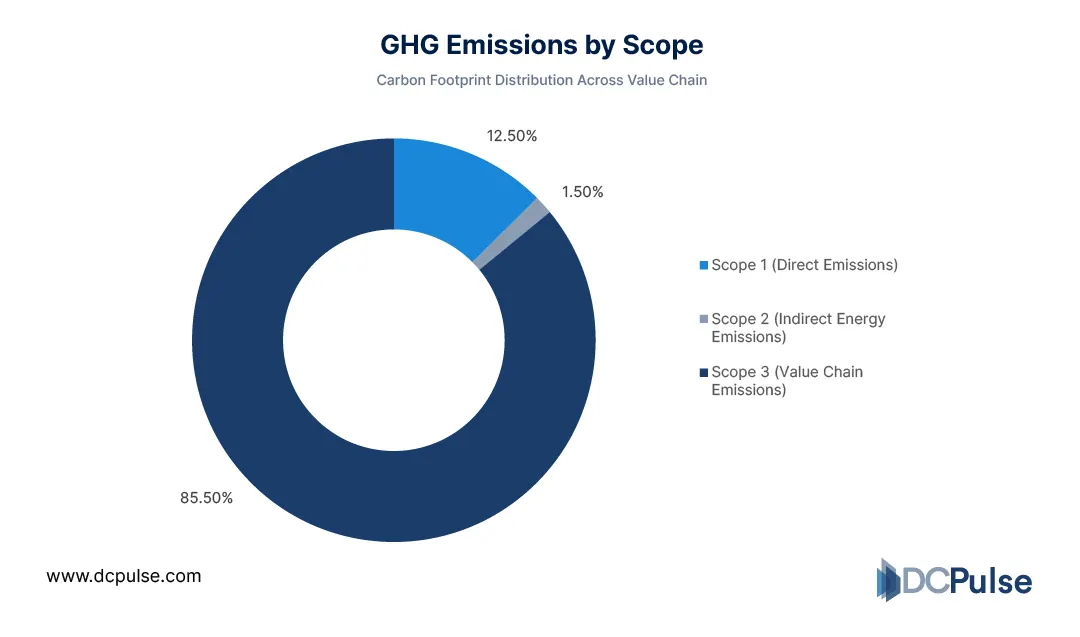
However, capturing this data is complex. Scope 3 emissions, covering suppliers, logistics, and downstream activities, are particularly difficult to measure and require extensive data collection across fragmented ecosystems.
To address this, ESG reporting is moving toward real-time tracking and automation. New platforms integrate operational and financial data streams to continuously monitor emissions, improving accuracy and enabling audit-ready disclosures.
ESG Performance & Reporting Variability (2025-2026)
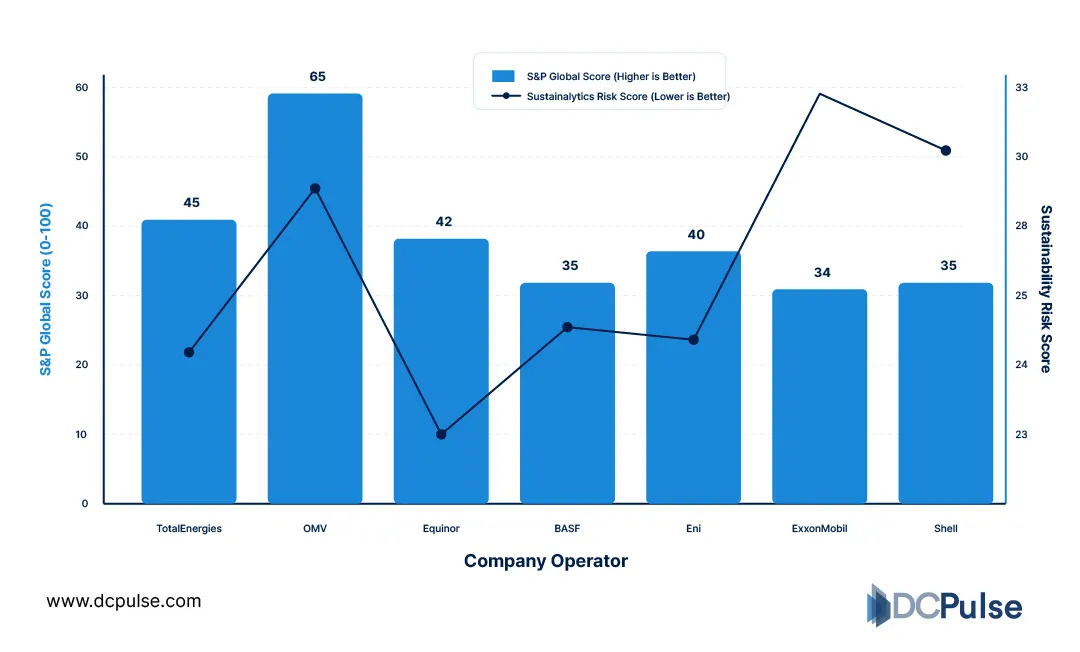
Another key innovation is the shift from manual reporting to auditable, system-driven ESG data infrastructure. Traditional spreadsheet-based methods often lead to inconsistent and unverifiable results, whereas modern platforms provide traceability, standardized calculations, and real-time dashboards.
The transformation is clear;
ESG reporting is no longer a static, backward-looking exercise; it is becoming a continuous, technology-driven system that delivers granular, verifiable, and investor-grade data.
Who Is Setting the Benchmark for ESG Transparency, and How?
ESG transparency in data centers is increasingly defined not by promises, but by how deeply and consistently operators disclose measurable performance data.
Across the industry, leading operators are differentiating themselves through detailed, multi-metric reporting. According to recent ESG analysis of global data center providers, key disclosures now include energy consumption, carbon emissions, water usage, and efficiency metrics such as PUE, forming the core dataset investors rely on.
ESG Key Performance Indicators (KPIs)
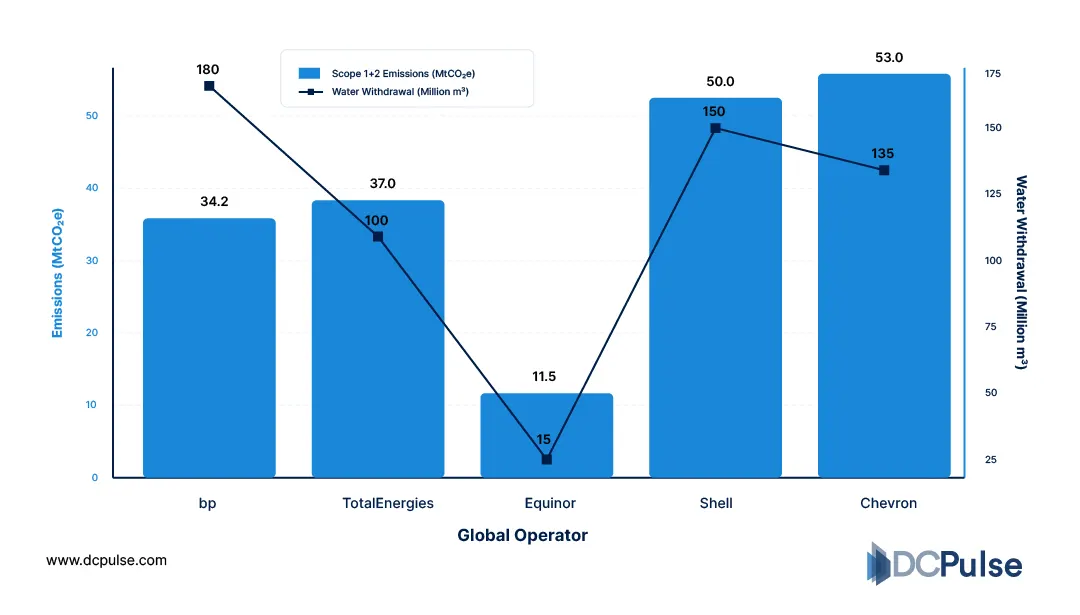
Benchmarking studies show that hyperscalers are leading in both efficiency and transparency. Average PUE has improved to around 1.22 for hyperscalers versus ~1.38 for broader operators, reflecting not only operational efficiency but also more consistent reporting practices.
At the operator level, ESG reporting is becoming more granular. For example, companies like Chindata Group disclose facility-level efficiency metrics (e.g., PUE ~1.21) and supply chain emissions, expanding beyond basic operational data.
However, a critical issue remains: lack of standardization. Even among leading hyperscalers, reporting boundaries differ; some disclose total energy use, while others limit reporting scope or use different accounting methods, making direct comparison difficult.
The defining shift is this:
Benchmark leaders are not just reporting more; they are providing granular, multi-dimensional, and increasingly auditable ESG data, setting a new standard that the rest of the industry is being forced to follow.
Will ESG Reporting Become a Gatekeeper for Data Center Investment?
ESG reporting is rapidly moving beyond disclosure; it is becoming a determinant of investment eligibility in the data center sector.
As capital providers place greater emphasis on sustainability, ESG performance is increasingly influencing how assets are valued, financed, and selected. Investors are no longer relying on high-level commitments; they are prioritizing verifiable data, consistent reporting, and measurable progress. In this environment, incomplete or inconsistent ESG disclosures can directly impact access to funding.
At the same time, reporting expectations are becoming more structured. Operators are under pressure to align with evolving standards, improve data granularity, and demonstrate how sustainability performance connects to long-term risk and operational resilience.
However, the transition is uneven. While leading operators are advancing toward detailed, data-driven reporting, others are still adapting to growing disclosure requirements, creating a widening gap in transparency across the industry.
The direction is clear:
ESG reporting is no longer a supporting function; it is becoming a gatekeeping mechanism, where the ability to provide credible, comparable data will increasingly determine who attracts capital and who does not.