DCPulse
Firebird.ai has launched an AI factory in Hrazdan, Armenia, marking the company’s move from development into operational AI infrastructure in the Caucasus region. The facility is built around NVIDIA-accelerated computing, Dell Technologies infrastructure, and NVIDIA’s DSX AI Factory reference architecture.
The project is planned for a substantial expansion. Firebird says it intends to scale the Armenian platform beyond 70,000 NVIDIA Rubin and Blackwell GPUs and reach 300 megawatts of AI infrastructure capacity by the end of 2027. The 300MW figure therefore represents the company’s expansion roadmap rather than capacity that is already fully operational.
The development gives Armenia a new position in the emerging market for regional AI computing infrastructure. It also highlights how AI data center projects are increasingly being developed outside the traditional concentration of hyperscale computing capacity in North America and Western Europe.
Hrazdan Facility Moves Into Operation
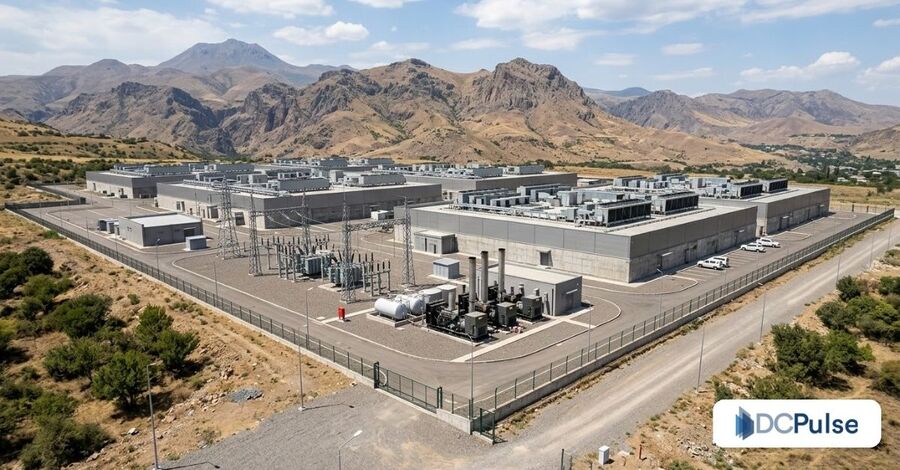
Firebird’s AI factory is located in Hrazdan, around 45 kilometers northeast of Yerevan. The company describes the facility as the largest AI factory in the CIS region following its launch in August 2026.
The project has progressed rapidly. NVIDIA said the facility was delivered in just over six months, although the scale of infrastructure expected at full buildout will require additional expansion. The initial operating configuration should therefore be distinguished from the much larger capacity outlined in Firebird’s longer-term roadmap.
That distinction is important for the wider data center industry. Large AI facilities are increasingly being announced according to their eventual power and GPU capacity, but those figures can represent multi-phase deployments rather than immediately energized infrastructure.
Firebird’s Armenian project illustrates this development model, with the operational facility serving as the foundation for additional GPU, electrical, and cooling infrastructure.
NVIDIA Architecture Shapes the Facility

The Hrazdan facility uses NVIDIA’s DSX AI Factory reference architecture, which integrates computing, networking, power, and cooling considerations into a coordinated infrastructure design. NVIDIA says the architecture is intended to improve the utilization of physical space and available electrical capacity for AI workloads.
NVIDIA accelerated computing forms the core of the platform, with Firebird planning to deploy more than 70,000 Rubin and Blackwell GPUs in Armenia by the end of 2027. The company is also using NVIDIA Spectrum-X Ethernet networking for the AI factory.
The approach reflects a broader shift in data center engineering. Traditional facilities were often designed around relatively predictable enterprise workloads, whereas large AI clusters place substantially greater demands on compute density, networking, electrical distribution, and thermal management.
The infrastructure surrounding the GPUs consequently becomes as important as the processors themselves. High-performance networking is required to connect large numbers of accelerators, while electrical and cooling systems must be designed around the sustained demands of AI computing.
Power and Cooling Become Central Design Issues

Schneider Electric is providing the electrical infrastructure for Firebird’s Armenian AI factory. NVIDIA said the equipment includes medium- and low-voltage switchgear, three-phase uninterruptible power supply systems, and rack enclosures.
Vertiv is supplying the cooling architecture, including chilled-water technology, advanced controls, and TrimCooler technology. Its iCOM CWM Chilled Water Manager is designed to coordinate cooling resources as workload requirements change.
The supplier mix illustrates the infrastructure requirements associated with high-density AI deployments. Compute capacity cannot be expanded independently of electrical distribution and thermal management. Each additional phase of GPU deployment requires corresponding infrastructure capable of supporting the resulting load.
For data center developers, the project demonstrates the importance of treating compute, power, and cooling as an integrated system. The approach is becoming increasingly relevant as AI clusters move toward higher rack densities and greater concentrations of accelerated computing resources.
Armenia Emerges as a Regional AI Location
The Firebird project also represents a significant development for Armenia’s digital infrastructure ecosystem. The country has historically had a relatively small data center market compared with major European and Middle Eastern hubs, making a large AI-focused deployment a notable change in the local infrastructure landscape.
Firebird has positioned the facility as infrastructure that can serve Armenia’s domestic AI ecosystem while also making a substantial portion of its compute available to international customers. The company's website says its Armenian platform is intended to serve domestic demand and provide access for U.S. companies operating in the region.
The model could provide a pathway for regional enterprises, researchers, and AI developers to access accelerated computing without necessarily relying on infrastructure located in established hyperscale markets.
The availability of local AI capacity can also become an important consideration for organizations dealing with latency, data governance, regional connectivity, and access to high-performance computing resources.
GPU Supply and Expansion Remain Key Variables
Firebird’s planned expansion depends on the availability and deployment of large numbers of advanced GPUs. Earlier in 2026, the company announced that it had secured U.S. export licensing and regulatory approvals related to an additional 41,000 NVIDIA GB300 GPUs for Armenia.
The company’s latest roadmap has shifted toward a broader deployment involving more than 70,000 Rubin and Blackwell GPUs by the end of 2027. That target represents a major expansion from the initial operational stage and will require additional infrastructure deployment over time.
The distinction between planned and installed capacity remains important. Electricity availability, equipment delivery, financing, construction schedules, and customer demand can all affect the pace at which announced AI infrastructure becomes operational. Armenian technology publication TECHi has specifically noted that the 300 MW and more-than-70,000-GPU figures remain roadmap targets rather than current commissioned capacity.
For the broader market, Firebird’s project provides another example of how AI infrastructure announcements are increasingly structured around phased expansion rather than single-stage construction.
Connectivity Extends Beyond the Data Center
The facility’s significance extends beyond its physical buildings. AI infrastructure depends on high-bandwidth networks connecting compute clusters to customers, cloud platforms, and other digital infrastructure.
Firebird’s use of NVIDIA Spectrum-X networking reflects this requirement. The networking architecture is intended to support communication between large-scale GPU resources, making network performance a critical component of overall AI cluster performance.
Regional connectivity could also influence Armenia’s ability to develop as an AI infrastructure location. Firebird’s broader strategy is built around connecting emerging-market computing infrastructure to global AI demand rather than treating each facility as an isolated data center.
The company's website identifies Armenia as the starting point for a wider expansion strategy across frontier markets. Firebird has also announced 125MW of AI infrastructure capacity in Kazakhstan, indicating that the Armenian project is part of a broader regional development strategy.
A New Model for Frontier-Market AI Infrastructure
Firebird’s Armenian AI factory reflects a broader change in the data center industry: advanced AI infrastructure is beginning to expand into markets that have not historically hosted large-scale accelerator clusters.
The Hrazdan project combines NVIDIA-accelerated computing, high-performance networking, specialized electrical infrastructure, and advanced cooling into a purpose-built AI platform. Its planned 300 MW scale would make the Armenian development significant if the expansion roadmap is fully delivered.
The immediate infrastructure milestone is the launch of the operational AI factory. The larger industry question will be how quickly Firebird can translate its planned GPU and capacity roadmap into energized, commercially utilized infrastructure.
For Armenia, successful expansion could strengthen the country’s role in regional AI computing. For the wider data center sector, the project demonstrates the growing importance of power availability, thermal management, networking, and GPU supply in determining where the next generation of AI infrastructure can be deployed.