DCPulse
Cloud computing remains a major component of enterprise IT infrastructure, but many organizations now operate across multiple environments rather than relying on a single infrastructure model. Public cloud platforms, private data centers, colocation facilities, and specialized infrastructure can coexist within the same technology architecture.
This shift is making hybrid data center and multi-cloud strategies increasingly relevant to infrastructure planning. Workloads can have different requirements for performance, latency, security, connectivity, data location, and operational control, making a single deployment model unsuitable for every application.
For data center operators, the change creates a need for facilities that can support multiple infrastructure environments and maintain reliable connections between them. The physical data center becomes part of a broader architecture in which computing resources can be distributed across cloud regions, enterprise facilities, colocation sites, and edge locations.
Hybrid Data Centers Connect Private and Public Infrastructure
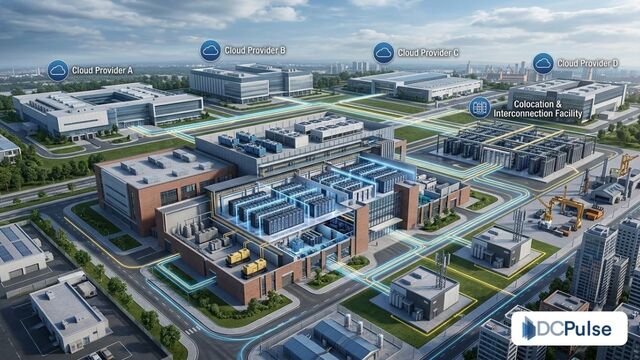
A hybrid data center strategy combines infrastructure operated within private environments with resources delivered through public cloud platforms. The model allows organizations to retain certain workloads in dedicated facilities while using cloud resources where additional flexibility or specific services are required.
The infrastructure relationship depends heavily on connectivity. Reliable private connections, network diversity, and appropriate security controls allow applications and data to move between environments without treating each infrastructure location as an isolated system.
For colocation providers, hybrid architectures create opportunities to serve as an intermediary layer between enterprise infrastructure and cloud platforms. Facilities with strong interconnection capabilities can support connections to multiple cloud providers, network operators, and enterprise environments.
Data center design therefore increasingly needs to account for the network architecture surrounding the facility. Power and physical capacity remain essential, but connectivity becomes equally important to the usefulness of the site within a hybrid environment.
Multi-Cloud Changes Workload Placement
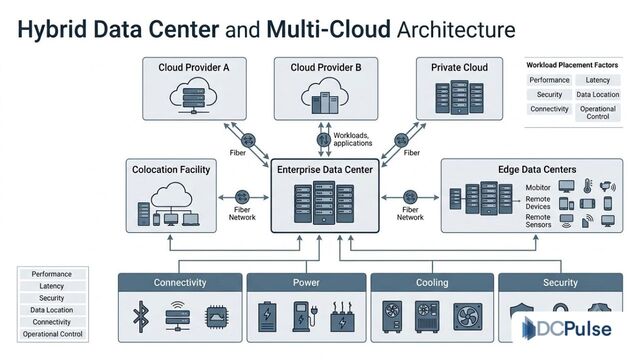
Multi-cloud strategies involve the use of services or infrastructure from more than one cloud provider. Organizations can distribute workloads across different platforms according to technical, operational, or business requirements.
The approach can create a more complex infrastructure environment. Each cloud platform can have different networking architectures, service configurations, management tools, security models, and operational processes.
For data center operators, multi-cloud environments increase the importance of interconnection. Customers may need access to several cloud platforms from the same physical facility, particularly when applications depend on data exchange between cloud environments and enterprise systems.
Cloud on-ramps and private connectivity can consequently become important components of the colocation value proposition. The data center can function as a neutral meeting point where enterprises connect to multiple digital infrastructure providers.
Connectivity Becomes the Foundation of Hybrid Architecture
Connectivity represents one of the most important physical layers supporting hybrid and multi-cloud strategies. Workloads distributed across different environments require reliable communication between applications, databases, users, cloud services, and infrastructure platforms.
Carrier diversity can provide organizations with additional network options, while direct interconnection can reduce dependence on public internet paths for certain enterprise workloads. Network architecture also needs to accommodate redundancy and operational continuity requirements.
The role of data centers consequently extends beyond housing servers. A well-connected facility can provide access to cloud providers, telecommunications networks, internet exchanges, content platforms, and other digital infrastructure ecosystems.
For operators, network capacity and interconnection options can influence how effectively a facility supports customers with distributed infrastructure strategies.
Power and Cooling Requirements Remain Critical
Hybrid and multi-cloud strategies do not eliminate the physical requirements of computing infrastructure. Servers, networking equipment, storage systems, and specialized computing hardware still require reliable power and effective thermal management.
AI and high-performance computing introduce additional considerations for facilities supporting dense deployments. Rack power requirements, electrical distribution, redundancy, and cooling architecture need to align with the hardware being deployed.
A hybrid strategy can also create a more diverse equipment environment. Different workloads may operate on different hardware platforms, with varying density and cooling requirements across the same facility.
For data center developers, flexibility can therefore become an important design consideration. Electrical capacity, cooling systems, floor layouts, and network infrastructure need to accommodate changing customer requirements rather than being optimized for a single workload profile.
Data Sovereignty Influences Infrastructure Decisions
Data location can play an important role in determining where workloads are deployed. Organizations operating across different jurisdictions may face requirements related to data residency, regulatory controls, security, and governance.
Private infrastructure and regional data centers can provide organizations with greater control over where specific data and applications are physically hosted. Public cloud services can then complement those environments where the relevant operational and regulatory requirements permit their use.
For data center operators, these requirements make location a strategic infrastructure consideration. Facilities in markets with strong connectivity and appropriate regulatory environments can support organizations seeking to maintain workloads within particular geographic boundaries.
The combination of private infrastructure, colocation, and cloud services can therefore provide organizations with greater flexibility when designing geographically distributed architectures.
Data Center Operators Face a More Complex Customer Environment
Customer requirements are becoming less uniform as enterprises adopt different combinations of infrastructure. One customer may require dedicated private infrastructure, while another may need connections to multiple cloud platforms or specialized computing resources.
This diversity affects data center operations. Facilities may need to support different rack densities, network architectures, security requirements, deployment schedules, and service models within the same environment.
Operational visibility also becomes important. Infrastructure teams need appropriate tools and processes to understand how physical resources connect with external cloud and network environments.
For operators, the ability to support complex infrastructure relationships can become as important as the physical availability of data center space.
Edge Infrastructure Adds Another Layer
Edge computing can further expand hybrid infrastructure architectures by placing selected workloads closer to users, devices, or data sources. The edge does not necessarily operate independently from centralized cloud infrastructure.
Instead, applications can use a combination of centralized processing and localized computing. Data may be generated or processed at an edge location while additional workloads, storage, analytics, or management functions remain within centralized facilities or cloud platforms.
This architecture creates additional requirements for connectivity between core data centers and smaller distributed sites. Network reliability, local power availability, physical security, and remote operational capabilities become important considerations.
For data center developers, edge infrastructure can consequently extend the geographical footprint of a hybrid architecture beyond traditional enterprise and hyperscale facilities.
Infrastructure Management Becomes More Important
A multi-cloud environment can introduce operational complexity because infrastructure is distributed across multiple providers and locations. Consistent monitoring, security controls, network management, and workload visibility become important for maintaining an effective operating model.
The data center remains a physical anchor within this environment, but infrastructure teams need visibility beyond individual facilities. Cloud resources, private infrastructure, colocation environments, and edge sites may all contribute to the delivery of the same application.
Standardized processes can help organizations manage these environments more consistently. Network architecture, infrastructure monitoring, security policies, and capacity planning need to account for the complete infrastructure chain rather than individual facilities alone.
Flexible Data Center Design Supports Changing Workloads
Data center development is increasingly influenced by uncertainty around future workload requirements. A facility designed around a narrow infrastructure profile may face limitations as customer requirements change.
Flexible power allocation, adaptable cooling systems, scalable network capacity, and modular deployment approaches can provide operators with greater ability to accommodate different infrastructure configurations.
The requirement is particularly relevant for facilities serving enterprises with hybrid and multi-cloud architectures. Customers may change cloud providers, expand private infrastructure, introduce AI workloads, or redistribute applications across locations over time.
A flexible facility can therefore serve as a longer-term infrastructure platform rather than simply providing fixed physical capacity.
Hybrid and Multi-Cloud Strategies Reshape Data Center Planning
The adoption of hybrid data center and multi-cloud strategies is changing the role of physical infrastructure within enterprise technology architectures. Cloud platforms remain important, but organizations can combine them with private facilities, colocation environments, specialized infrastructure, and edge locations.
For data centers, the implications extend across connectivity, power, cooling, network architecture, security, location, and operational management. The facility increasingly operates as one component of a connected infrastructure ecosystem rather than as an isolated computing site.
The way forward is consequently centered on interoperability and flexibility. Data centers capable of supporting diverse workloads and connecting customers with multiple infrastructure environments can remain relevant as enterprise architectures continue to evolve.
Future infrastructure planning will depend on workload characteristics, cloud adoption patterns, AI deployment, network availability, power conditions, regulatory requirements, and application design. Hybrid and multi-cloud strategies place the data center at the intersection of these requirements, making physical infrastructure an important part of how distributed digital services are delivered.