DCPulse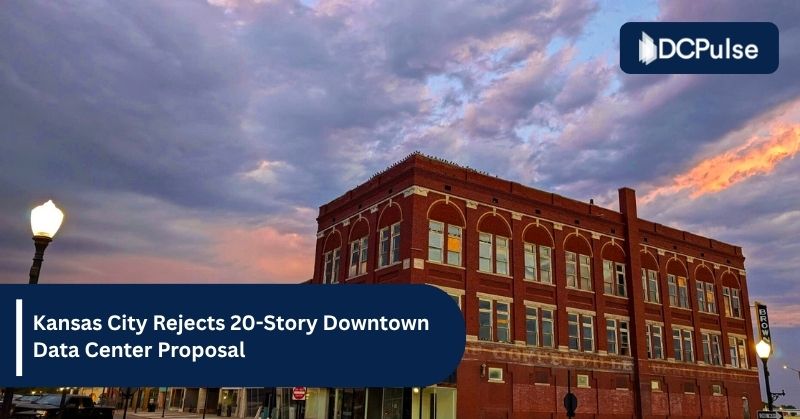
The Kansas City Plan Commission has rejected a proposal for a 20-story data center in downtown Kansas City, Missouri, ending the latest development push for a high-density computing facility at a prominent urban site. The decision highlights the growing tension between demand for new digital infrastructure and local concerns over land use, utility requirements, community value, and historic preservation.
Planning commission rejects downtown data center.
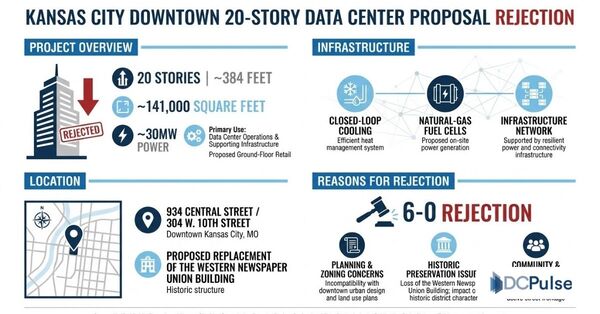
The Kansas City City Plan Commission voted 6-0 on August 5 to deny an application from Miami-based developer Revitalization Unlimited for the proposed facility. The project was planned for 934 Central Street, also identified as 304 W. 10th Street in the Quality Hill area of downtown.
The proposed tower was designed to reach approximately 384 feet across 20 stories. Development documents described a building of roughly 141,000 square feet, with the majority of the space intended for data center operations and supporting infrastructure. Ground-floor retail, including a proposed coffee shop, was also part of the plans.
The project would have replaced the existing Western Newspaper Union Building, a historic structure constructed in 1900 and expanded in 1906. The building has been listed on the National Register of Historic Places since 2007 because of its association with communications and newspaper publishing.
The commission's rejection followed a public hearing that attracted substantial opposition. According to KCUR, commissioners said they received 475 letters opposing the development and none supporting it. More than 50 people also spoke at the meeting.
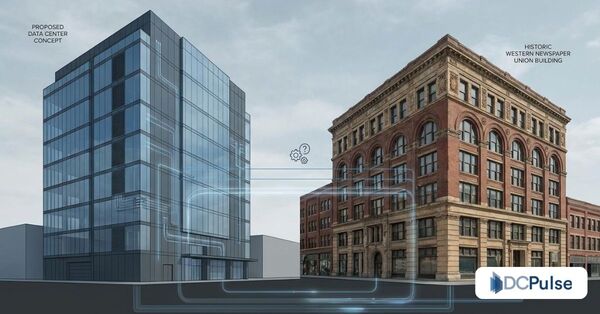
The proposed facility represented an unusual model for data center development because of its downtown high-rise format. Most large data centers are developed on expansive sites where operators can accommodate electrical infrastructure, cooling systems, generators, security zones, and other technical equipment horizontally.
A vertical data center can use land differently, but it also creates a more concentrated infrastructure footprint within an established urban environment. The Kansas City proposal therefore raised questions about how a computing facility should fit within a dense downtown district rather than a dedicated technology or industrial campus.
Earlier project descriptions indicated that the facility was expected to use approximately 30MW of power. Plans also referenced natural-gas fuel cells and a closed-loop cooling approach, while utility-related filings indicated planned support from local infrastructure providers.
For digital infrastructure developers, those characteristics are significant. A downtown facility can potentially place computing infrastructure closer to existing telecommunications networks, businesses, and customers. Project architect Geoff Bird of Skidmore, Owings & Merrill previously argued that an urban location could support low-latency data processing by keeping infrastructure closer to users and network demand.
The concept therefore reflected an emerging question within the data center industry: whether some forms of AI, cloud and distributed computing infrastructure can be deployed effectively inside established urban areas instead of being concentrated exclusively in large peripheral campuses.
Historic preservation became a central issue
The proposed demolition of the Western Newspaper Union Building became one of the most significant objections to the project.
Historic Kansas City argued that the building represented an important part of Kansas City's communications and publishing history and that downtown redevelopment could accommodate new digital infrastructure without removing a National Register-listed structure. City planning staff also recommended denial, citing concerns about compatibility with downtown planning policies and the surrounding area's scale and character.
The preservation issue gives the decision broader relevance for data center developers. As demand for computing capacity expands, operators are increasingly competing for locations that already have access to power, fiber networks, customers, and transportation infrastructure. Urban sites can provide some of those advantages, but they may also involve more complex planning constraints than greenfield developments.
Kansas City's decision demonstrates how those competing priorities can affect the feasibility of an individual project even before construction begins.
Community concerns extended beyond the building
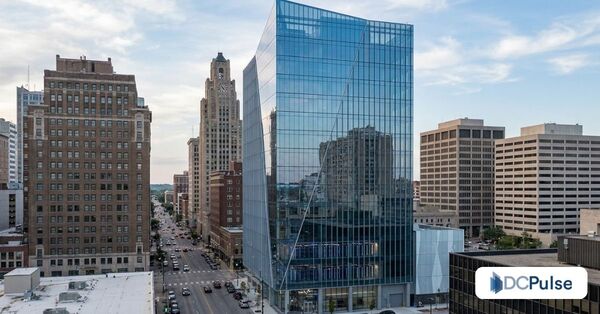
Public opposition was not limited to the historic status of the existing structure. Residents and community organizations also raised questions about the project's energy, water, cooling, land-use, and environmental implications.
Earlier public discussions around the proposal included concerns about cooling requirements and the potential effect of large mechanical systems within a dense downtown environment. Community groups also questioned whether a data center would deliver enough local economic and employment benefits relative to the amount of downtown space it would occupy.
Employment became particularly relevant during the commission's review. Reporting from KSHB said project filings estimated approximately 30 employees, while commissioners questioned whether that level of employment represented an adequate community benefit for a high-rise occupying a prominent downtown site.
Those concerns illustrate a growing policy challenge for municipalities. Data centers can represent substantial digital infrastructure investment while requiring relatively few permanent employees compared with other commercial developments of similar physical scale. Local governments therefore increasingly have to assess projects through multiple measures, including tax contributions, infrastructure demand, employment, land use and long-term strategic value.
Kansas City's regulatory environment is becoming more important
The rejection also comes as Kansas City has tightened its approach to data center development.
City rules adopted earlier in 2026 introduced additional restrictions affecting where data centers can be developed and created circumstances in which special-use approval may be required. The downtown proposal was subject to additional review because of the applicable zoning and permitting requirements.
That regulatory environment could become an important factor for future digital infrastructure investment in the Kansas City region. The metro area already has established data center activity, including facilities in downtown Kansas City, while other projects are being considered across the broader region.
The result is a market where demand for data center capacity exists, but developers must increasingly demonstrate that individual projects fit local planning priorities.
Decision leaves the project’s next step uncertain
The Plan Commission's vote does not necessarily end the developer's options. Revitalization Unlimited can seek further consideration through the City Council, although Mayor Quinton Lucas has indicated that he does not expect to support an effort to reverse the commission's decision. The developer has said it is considering its next steps.
For the data center industry, the immediate outcome is the loss of a proposed downtown computing facility rather than the cancellation of a broader regional demand for digital infrastructure. The decision instead reinforces the importance of site selection, community engagement, and local permitting strategies at a time when AI and cloud infrastructure requirements are expanding.
Kansas City's experience also illustrates the changing nature of data center development. Power availability and network connectivity remain fundamental, but projects increasingly face questions about urban compatibility, cooling, water, energy sourcing, employment, and community benefit.
For developers seeking new capacity in established cities, the downtown Kansas City proposal offers a clear example of how those factors can determine whether a technically feasible data center can ultimately secure planning approval.