DCPulse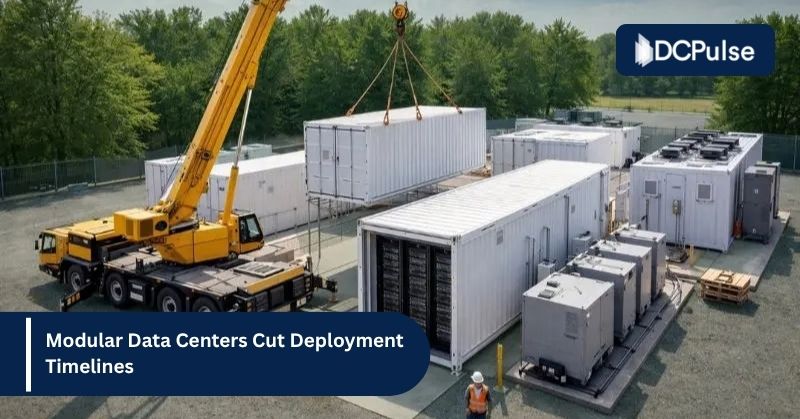
The pressure to bring new data center capacity online faster is reshaping how infrastructure is designed and constructed. Demand from cloud services, AI workloads, edge computing, and enterprise applications is increasing the importance of deployment schedules, while conventional projects can involve lengthy design, procurement, construction, and commissioning processes.
Modular data centers offer a different approach. Power systems, cooling equipment, IT spaces, and supporting infrastructure can be engineered and assembled as standardized modules before arriving at the deployment site. The model moves a greater portion of construction and integration work into controlled manufacturing environments.
The headline figure of up to 50% faster deployment is not universal. Project scope, site conditions, permitting, utility availability, customization, and commissioning requirements can significantly affect the actual schedule. However, vendors and industry participants have reported schedule reductions of this magnitude for particular modular configurations. Vertiv, for example, has described deployments that reduce timelines by 50% or more compared with certain conventional projects, while NTT Facilities announced a modular construction approach targeting reductions of up to approximately 50%.
Parallel Construction Creates the Main Schedule Advantage
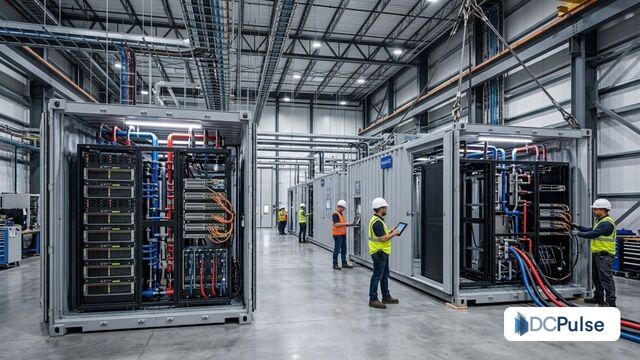
The biggest difference between modular and conventional construction is the ability to perform activities in parallel.
A conventional data center project can require multiple activities to occur sequentially. Site preparation, structural construction, mechanical and electrical installation, equipment integration, and commissioning can create dependencies between project stages.
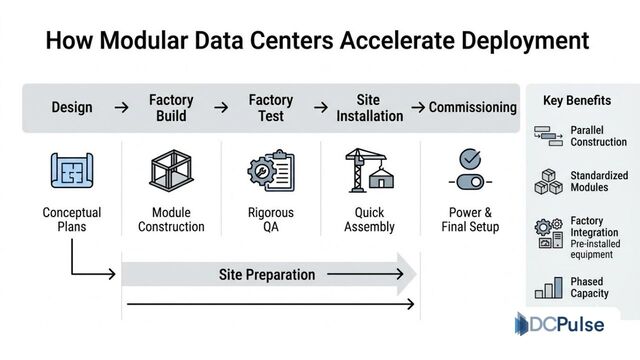
A modular approach changes that sequence. Factory production of infrastructure modules can proceed while civil and utility work continues at the destination site. The two workstreams can converge when the modules arrive, reducing the amount of infrastructure that needs to be assembled from individual components on-site.
The scheduling advantage is therefore less about eliminating construction work and more about relocating and overlapping that work.
For data center developers, this distinction is important. A shorter factory production period does not automatically translate into a shorter overall project if permitting, grid interconnection, land preparation, or other site requirements remain unresolved.
Factory Manufacturing Moves Complexity Off-Site
Factory-based production introduces greater control over the environment in which data center components are assembled.
Electrical distribution equipment, cooling systems, racks, monitoring infrastructure, and other components can be integrated before transportation. Factory-based processes can also support repeatable assembly and testing procedures.
The approach can reduce the amount of complex mechanical and electrical integration required at the final site. Vertiv describes its modular solutions as factory-built systems designed to provide faster deployment, while other modular providers similarly emphasize factory integration and pre-testing as core elements of the model.
For operators, the benefit extends beyond construction speed. Greater factory integration can make project execution more repeatable when the same or similar designs are deployed across multiple locations.
Standardization Supports Repeatable Deployments
Standardization is another important contributor to deployment speed.
A traditional facility may require substantial project-specific engineering for mechanical, electrical, structural, and IT infrastructure. Modular platforms can instead use predefined architectures that are adapted to specific capacity, environmental, and operational requirements.
The degree of standardization varies considerably between projects. Highly customized facilities may retain many of the engineering challenges associated with conventional construction.
Repeated deployments, however, can benefit from established designs and processes. Once a configuration has been engineered and validated, subsequent projects can potentially reuse elements of the architecture rather than beginning every design process from the same starting point.
That characteristic is particularly relevant to operators deploying distributed capacity across multiple markets.
AI Infrastructure Is Strengthening the Case for Speed
AI infrastructure is adding another dimension to the deployment challenge. High-density computing environments require careful coordination between compute hardware, power delivery, networking, and thermal management.
The modular model can package some of these infrastructure requirements into standardized blocks. Schneider Electric, for example, describes prefabricated AI pods that integrate power and cooling distribution for high-density computing environments and positions modular deployment as a way to accelerate AI capacity expansion.
The operational requirement is not simply faster construction. AI infrastructure also evolves quickly, creating uncertainty around future compute configurations, rack densities, cooling architectures, and capacity requirements.
Modular infrastructure can provide a way to introduce capacity incrementally rather than committing an entire site to a single large build-out.
Power and Cooling Remain Critical Constraints
Modular construction does not remove the physical requirements of a data center.
Power availability remains a fundamental dependency. A factory-built module cannot become operational until the site has the electrical infrastructure required to support its intended load.
Cooling presents a similar consideration. Modular systems can incorporate cooling equipment into standardized designs, but the selected architecture still needs to match the computing workload, environmental conditions, redundancy requirements, and operational strategy.
Utility interconnection, permitting, site preparation, and connectivity can therefore remain on the critical path. Modularization can shorten certain construction activities without eliminating external dependencies.
This distinction is particularly important when evaluating claims about deployment timelines. A module may be manufactured rapidly, but the overall project schedule depends on the complete path from design and approvals through installation, testing, and operational handover.
Commissioning Becomes a Key Schedule Consideration
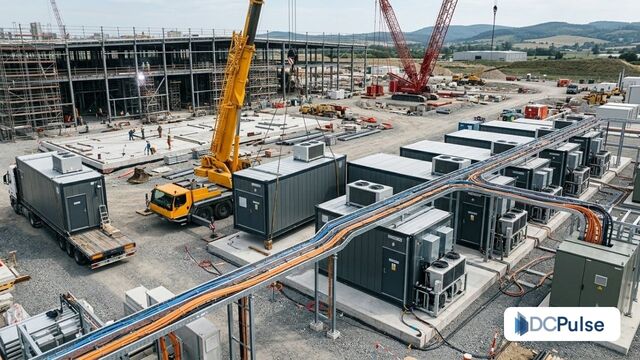
Commissioning is another area where modular construction can influence deployment schedules.
Factory assembly allows portions of the infrastructure to be tested before shipment. Integrated testing can identify certain issues before equipment reaches the final site, potentially reducing the amount of troubleshooting required after installation.
Site commissioning remains necessary because individual modules still need to operate as an integrated facility after transportation and installation. Electrical, mechanical, control, networking, and safety systems must function together under the conditions defined for the project.
The distinction between factory testing and final integrated testing is therefore important. Faster deployment does not mean bypassing validation. Instead, some validation work can move earlier in the project lifecycle.
Modular Capacity Supports Phased Expansion
Modularity can also change the way operators plan capital expenditure and capacity expansion.
A conventional facility may require significant infrastructure to be constructed before the entire capacity becomes commercially useful. Modular architectures can allow capacity to be added in defined blocks, depending on the design.
Vertiv's MegaMod approach, for example, describes capacity blocks that can be deployed incrementally rather than requiring all white space and supporting infrastructure to be built at once.
This model can be relevant to operators facing uncertain demand. Instead of building for the maximum projected requirement immediately, infrastructure can be expanded as workload demand and available power justify additional capacity.
Site Selection Still Determines Deployment Speed
The modular advantage has limits when site constraints dominate the project schedule.
Land preparation, electrical interconnection, permitting, fiber connectivity, transportation access, environmental requirements, and local construction regulations can all influence when a facility becomes operational.
A highly standardized module cannot independently resolve an unavailable power connection or an extended permitting process.
Successful deployment therefore depends on coordination between factory manufacturing and site readiness. Early site assessment becomes particularly important because any unresolved external dependency can offset the schedule benefits created by modular construction.
Modular Data Centers Are Becoming a Deployment Strategy
The significance of modular data centers extends beyond faster construction. The approach represents a shift toward manufacturing-led infrastructure delivery, where standardized components are produced, integrated, tested, transported, and assembled through a more controlled process.
For cloud providers, colocation operators, AI infrastructure developers, and edge computing companies, that model can provide another route to adding capacity when deployment timing is a major consideration.
The up-to-50% schedule reduction should be viewed as a project-specific potential rather than a universal industry benchmark. Evidence from infrastructure providers shows that substantial reductions are achievable in selected applications, but actual performance depends on the architecture and conditions of each project.
The broader implication is that data center construction is moving closer to a manufacturing model. As computing demand becomes more dynamic and infrastructure requirements become more complex, the ability to standardize, manufacture, test, and deploy capacity in parallel could become an increasingly important part of the global data center development strategy.