DCPulse
Data centers have become essential infrastructure for modern economies. Cloud computing, artificial intelligence, digital payments, enterprise applications, and connected services all depend on facilities capable of processing, storing, and transferring large volumes of data. However, the development and operation of these facilities involve challenges that extend far beyond technology and engineering.
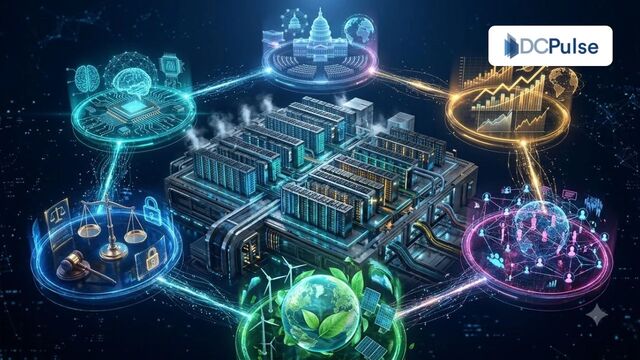
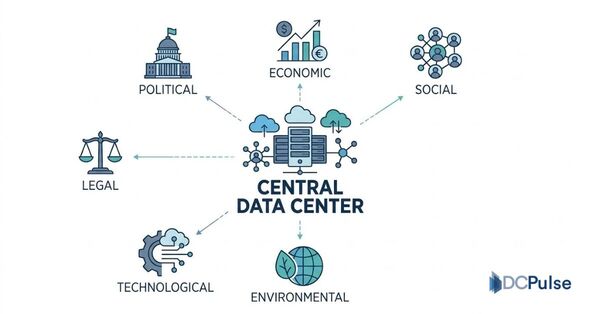
Political decisions, economic conditions, social expectations, technological changes, legal requirements, and environmental pressures increasingly influence data center investments. Together, these six factors form the basis of a PESTLE analysis, a strategic framework used to understand external forces affecting an industry.
For data center operators, developers, investors, and technology companies, understanding these pressures is becoming increasingly important. Yet one significant blind spot remains: these factors are often evaluated separately, even though their combined effects can determine whether a data center project is commercially viable, operationally sustainable, and acceptable to the communities around it.
Political Pressure: Data Sovereignty and Infrastructure Security
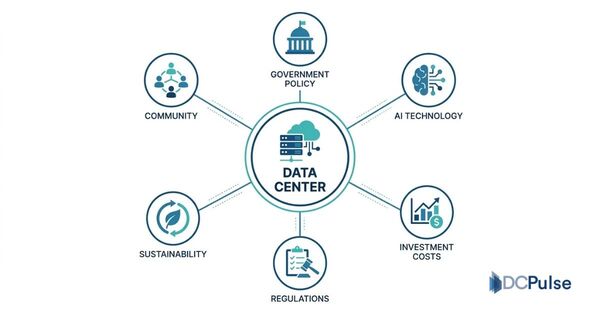
Government policies are playing an increasingly important role in determining where data centers are developed. National digital strategies, cybersecurity requirements, foreign investment regulations, and data localization policies influence infrastructure planning and investment decisions.
Data sovereignty has become particularly relevant as governments seek greater control over information generated within their jurisdictions. Requirements concerning data storage, processing, and access can encourage companies to establish infrastructure closer to their customers and regulatory environments.
Geopolitical developments also influence the global data center industry. Trade restrictions, technology export controls, international conflicts, and supply chain dependencies can affect access to servers, networking equipment, advanced processors, and other critical components.
For operators, political uncertainty creates additional considerations when selecting locations and planning long-term investments. A region with attractive land and power availability may still present challenges if its regulatory environment changes or access to essential technologies becomes restricted.
Government incentives and infrastructure policies can support development, but long-term planning requires more than short-term investment benefits. Political stability, regulatory consistency, and national infrastructure priorities remain important considerations.
Economic Pressure: Capital, Energy, and the Cost of Expansion
Data center development requires substantial capital investment. Land acquisition, building construction, electrical infrastructure, cooling systems, networking equipment, and computing hardware contribute to project costs.
Economic conditions influence how quickly developers can secure financing and bring new capacity online. Interest rates, inflation, construction costs, currency movements, and equipment prices can affect project economics and investment decisions.
Energy represents another major economic consideration. Electricity consumption is central to data center operations, making power prices, availability, and long-term supply agreements important factors in operating expenditure.
The expansion of AI infrastructure adds another layer of financial complexity. High-performance computing environments can require specialized servers, advanced cooling systems, and significant electrical capacity. These requirements can increase the investment needed to develop facilities suitable for intensive AI workloads.
However, investment opportunities do not automatically translate into sustainable returns. Developers must consider customer demand, utilization rates, operating expenses, financing costs, and the commercial lifespan of infrastructure.
The economic blind spot emerges when investment decisions focus heavily on construction costs and expected capacity without adequately examining the long-term cost of operating that capacity.
Social Pressure: Communities, Skills, and Public Acceptance
Data centers are often discussed as digital infrastructure, but their physical presence creates direct relationships with local communities. Land use, construction activity, electricity demand, water consumption, traffic, and noise can influence public attitudes toward new developments.
Community acceptance is becoming an important consideration in project planning. Residents may support investments that create employment and improve local infrastructure while raising concerns about environmental impacts and pressure on existing resources.
Employment expectations also require careful consideration. Data center construction can support activity across engineering, construction, electrical installation, and related services. However, permanent operational staffing requirements differ from construction employment, and the number of long-term jobs depends on the facility and its operating model.
Skills availability presents another challenge. The industry needs professionals with expertise in electrical engineering, mechanical systems, cooling, cybersecurity, network operations, and critical infrastructure management.
Competition for these skills can influence project timelines and operational readiness. Developers entering emerging data center markets may also need to invest in workforce development and technical training.
Public acceptance cannot be treated as a secondary communication exercise. Early engagement, transparent resource planning, and realistic employment expectations can help reduce friction between infrastructure developers and the communities hosting their facilities.
Technological Pressure: AI, Computing Density, and Infrastructure Readiness
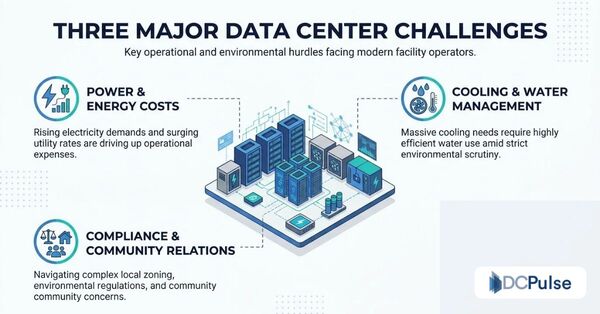
Technology remains one of the strongest forces reshaping data center requirements. The growth of cloud computing, AI applications, machine learning, and high-performance computing is changing expectations around computing capacity, networking performance, and cooling infrastructure.
Traditional enterprise environments and modern AI workloads do not necessarily have identical infrastructure requirements. AI systems can involve high-density computing equipment, advanced accelerators, specialized networking, and greater demands on electrical distribution and thermal management.
These changes create challenges for existing facilities. Buildings designed around earlier computing requirements may face limitations involving power distribution, cooling capacity, rack configurations, and available space.
Liquid cooling is receiving increased attention as operators explore ways to manage heat generated by high-density computing equipment. However, adopting new cooling technologies requires careful evaluation of facility design, maintenance procedures, water management where applicable, and equipment compatibility.
Networking is equally important. AI training and distributed computing environments depend on efficient communication between servers, storage systems, and connected facilities. Network architecture, bandwidth, latency, and interconnection capabilities therefore influence infrastructure planning.
The technological blind spot is the assumption that a data center built for today's requirements will automatically remain suitable for future workloads. Infrastructure flexibility, upgrade pathways, and equipment lifecycle planning must become central parts of investment decisions.
Legal Pressure: Compliance, Cybersecurity, and Operational Accountability
The regulatory environment surrounding digital infrastructure continues to evolve. Data protection, cybersecurity, energy reporting, environmental compliance, building standards, and occupational safety requirements can all influence data center development and operations.
Data protection regulations are particularly important for facilities hosting information belonging to businesses, governments, and individual users. Operators must understand their responsibilities concerning physical security, access management, information handling, and contractual obligations.
Cybersecurity is another critical area. Data centers provide the physical and digital foundations for essential services, making security risks relevant to both operators and their customers. Physical access controls, network protection, monitoring systems, incident response, and business continuity planning are important elements of operational governance.
Legal responsibilities also extend beyond information security. Planning approvals, construction permits, electrical safety standards, environmental permissions, and water-related regulations can affect project schedules and operating requirements.
For international operators, compliance becomes more complex when facilities operate across multiple jurisdictions. Different countries may impose different requirements for data handling, infrastructure security, environmental reporting, and energy efficiency.
A failure to integrate legal considerations into early project planning can result in delays, additional costs, and operational restrictions. Regulatory compliance should therefore be considered throughout the infrastructure lifecycle rather than only during final approval or operational audits.
Environmental Pressure: Power, Water, and Sustainability
Environmental considerations have become central to data center development. Rising computing requirements increase the importance of electricity supply, energy efficiency, cooling performance, and resource management.
Power availability is a major site-selection consideration. In regions where electricity infrastructure faces capacity constraints, new data center projects may require additional grid connections, transmission upgrades, substations, or alternative power arrangements.
Renewable energy procurement is another important part of sustainability strategies. Operators are exploring different approaches to securing lower-carbon electricity, including power purchase agreements and other renewable energy arrangements. However, renewable energy availability, grid conditions, and the timing of electricity consumption must all be considered.
Water management is equally important, particularly for facilities using water-based cooling systems. Local water availability, competing demand, seasonal conditions, and environmental regulations can influence cooling choices and site suitability.
The industry also faces questions around equipment manufacturing, electronic waste, refrigerants, construction materials, and the environmental impact of infrastructure expansion.
Sustainability assessments must therefore extend beyond a single efficiency metric. Energy efficiency, water consumption, carbon emissions, equipment lifecycle management, and local environmental conditions all contribute to the broader environmental performance of a facility.
The Blind Spot: Six Pressures Cannot Be Managed Separately
The real value of PESTLE analysis lies in understanding how external pressures interact. Political decisions can influence energy policy, while environmental regulations can affect project economics. Technological developments can increase electricity demand, creating additional pressure on local infrastructure and community relationships.
These connections are particularly important during data center site selection and investment planning.
A location with affordable land may face limited grid capacity. A region with strong renewable energy resources may have regulatory or transmission challenges. A facility designed for advanced AI workloads may require cooling technologies that introduce additional water management considerations.
Similarly, a project that meets technical and financial requirements may still encounter delays if community concerns, permitting requirements, or workforce availability are overlooked.
For developers and investors, a more integrated assessment can help identify these dependencies before significant capital is committed. Political stability, economic feasibility, social acceptance, technological readiness, legal compliance, and environmental sustainability should be evaluated as connected elements of the same infrastructure decision.
A Broader Framework for Data Center Investment
The global data center industry is entering a period in which infrastructure decisions involve increasingly complex trade-offs. Computing demand remains an important driver, but the ability to deliver new capacity depends on a wider set of external conditions.
PESTLE analysis offers developers, operators, investors, and policymakers a structured way to examine these conditions. Its effectiveness, however, depends on moving beyond six individual categories and understanding their combined implications.
The next generation of data center development will require more than access to capital, land, power, and technology. Long-term success will also depend on regulatory preparedness, community relationships, infrastructure resilience, and responsible resource management.
The six pressures are visible. The greater challenge is recognizing the connections between them. That is the blind spot that data center decision-makers can no longer afford to overlook.